Average Cost of a Wedding in the UK (2026): Real Costs, Breakdown & Budget Examples
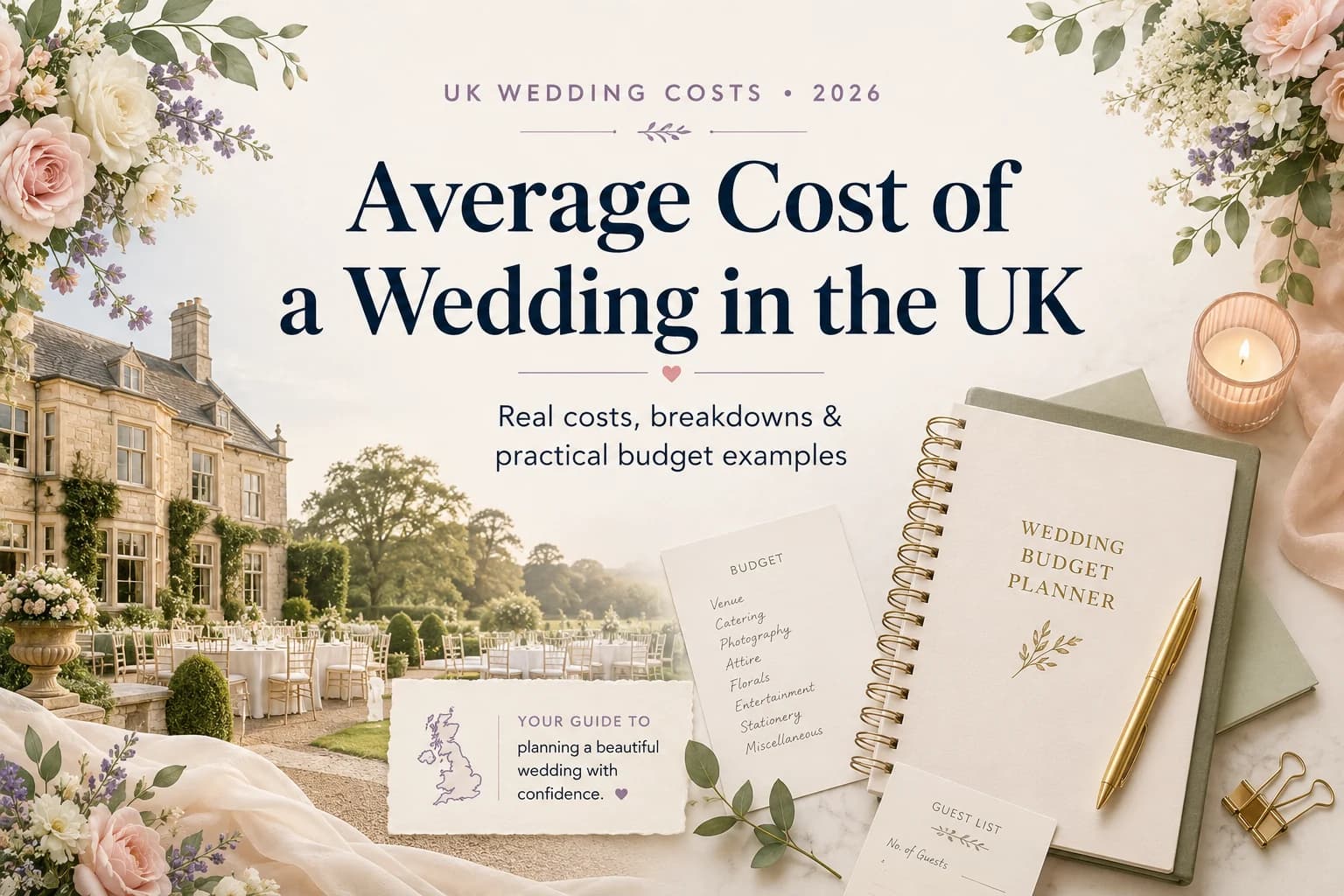
The average cost of a wedding in the UK in 2026 is around £20,600–£22,000, depending on which major survey you use.
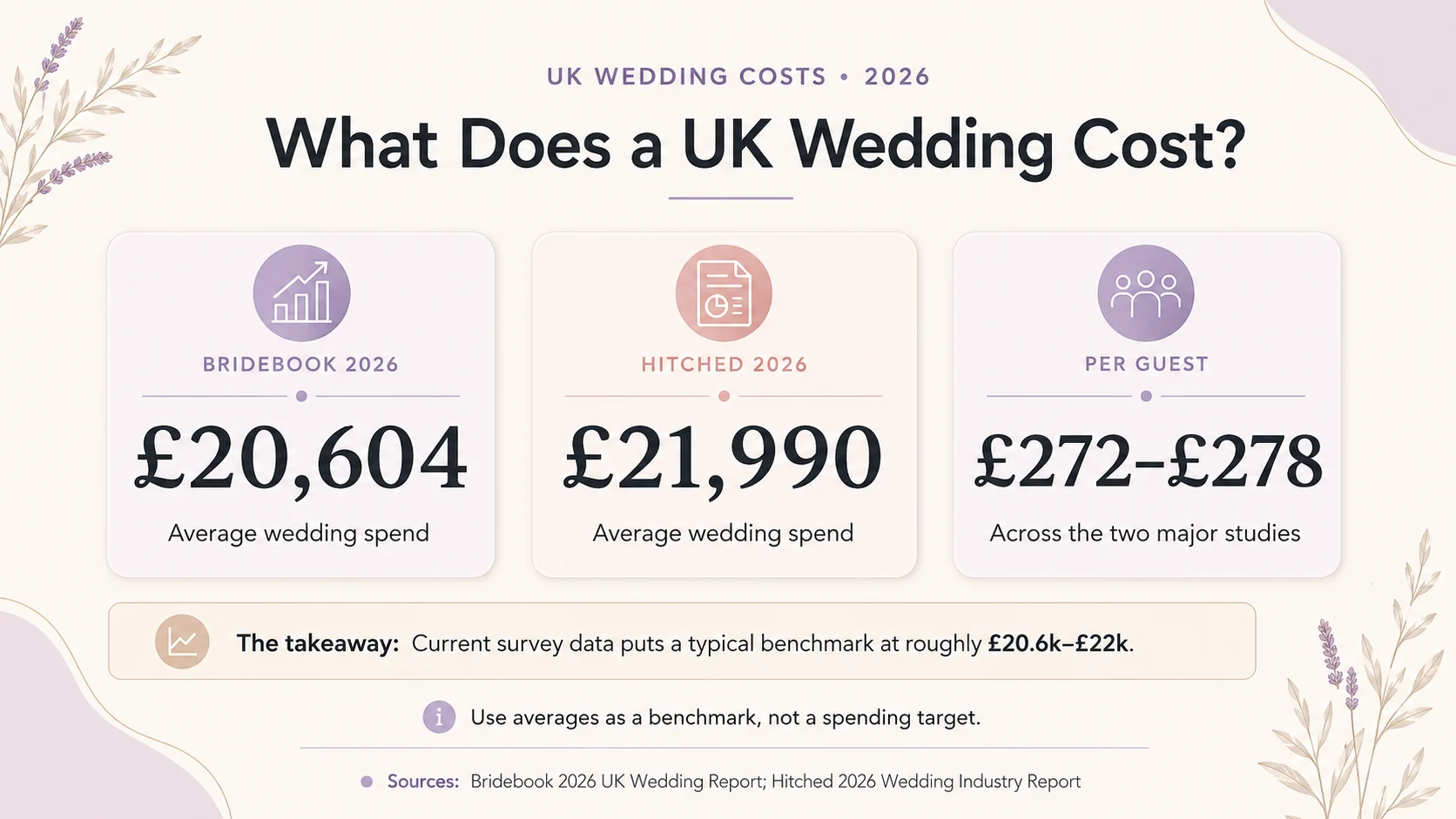
Bridebook puts the average at £20,604, while Hitched reports £21,990. Both exclude the engagement ring and honeymoon.
That difference is worth paying attention to. There is no single "correct" wedding budget. Guest count, location, venue, date and the suppliers you choose can move the final figure by thousands of pounds.
So treat the national average as a benchmark, not a target.
| 2026 benchmark | Current figure |
|---|---|
| Bridebook average | £20,604 |
| Hitched average | £21,990 |
| Average spend per guest | About £272–£278 |
| Largest spending area | Venue and catering |
Figures last verified: 19 August 2026.
What Is the Average Cost of a Wedding in the UK in 2026?
The two major current wedding surveys land in broadly the same range, but they do not measure exactly the same thing.
| Source | Figure | Method | Best used for |
|---|---|---|---|
| Bridebook | £20,604 | Around 7,000 newly married and actively planning couples | Broad UK planning benchmark |
| Hitched | £21,990 | More than 2,000 couples who married in 2025 | Recent newlywed spending benchmark |
| CompareWeddingInsurance | £23,994 | Cancellation cover selected across thousands of wedding insurance policies | Indication of insured financial exposure |
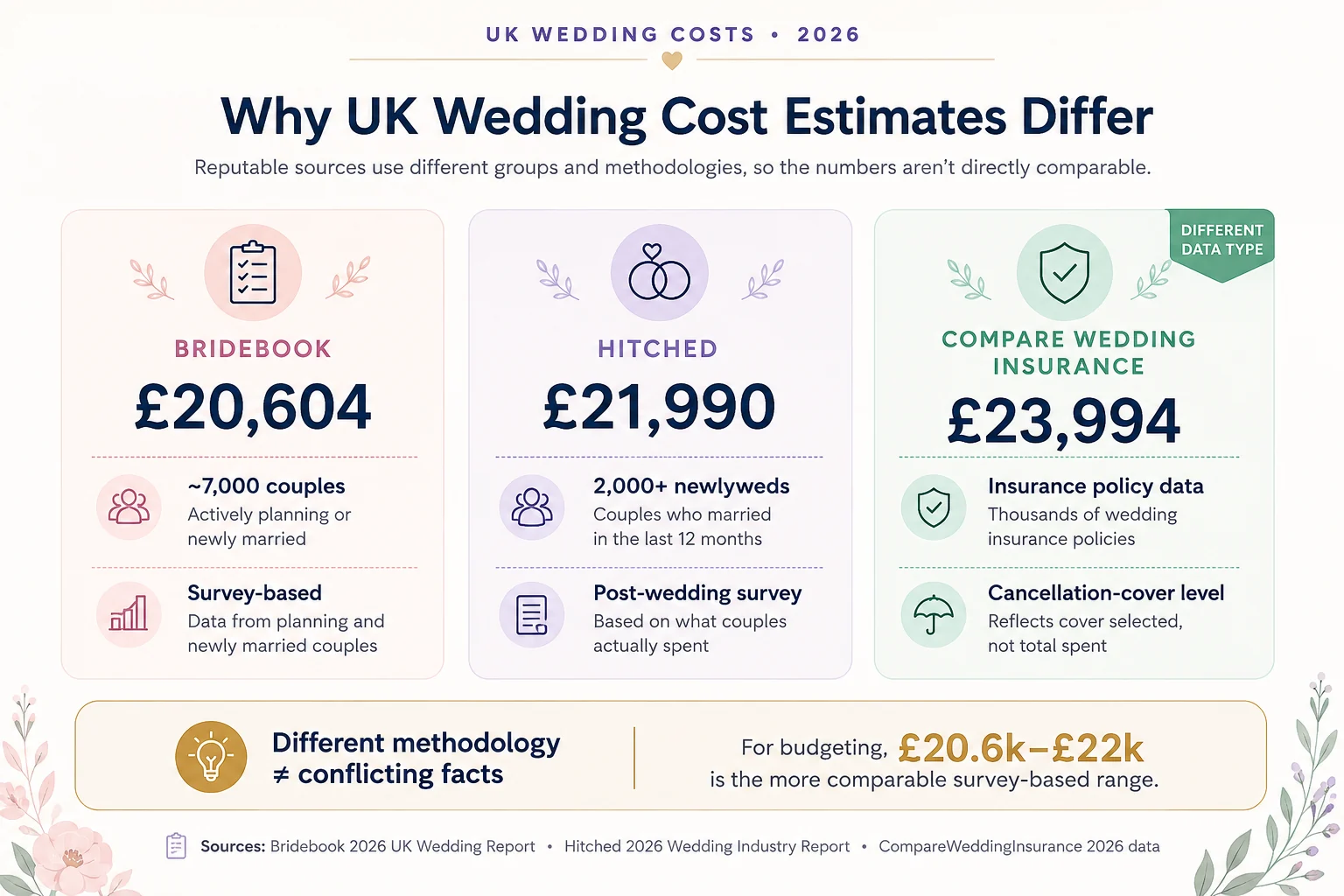
The £23,994 CompareWeddingInsurance figure should not be treated as another version of the same survey. It is based on the amount of cancellation cover couples selected rather than a conventional breakdown of final wedding spending.
For most couples trying to answer "How much does a wedding cost in the UK?", £20,600–£22,000 is therefore the more useful current survey-based range.
Sources: Bridebook UK Wedding Report, Hitched Wedding Industry Report and CompareWeddingInsurance.
What Does the Average Wedding Cost Include?
Bridebook's £20,604 figure covers the wedding itself, including major expenses such as the venue, catering, photography, clothing, flowers and entertainment.
Hitched uses a similar wedding-day definition.
Both exclude the engagement ring and honeymoon from their headline averages.
That distinction matters when comparing your budget with somebody else's. A couple saying they spent £30,000 may be including a honeymoon, pre-wedding events or other expenses that another couple has left out.
Whenever you compare wedding costs, check what is actually included before deciding whether one number looks high or low.
UK Wedding Cost Breakdown: Where Does the Money Go?
Venue and catering account for the biggest share of wedding spending.
Bridebook's 2026 data attributes 51% of the average budget to venue hire and catering, followed by attire, photography and videography.
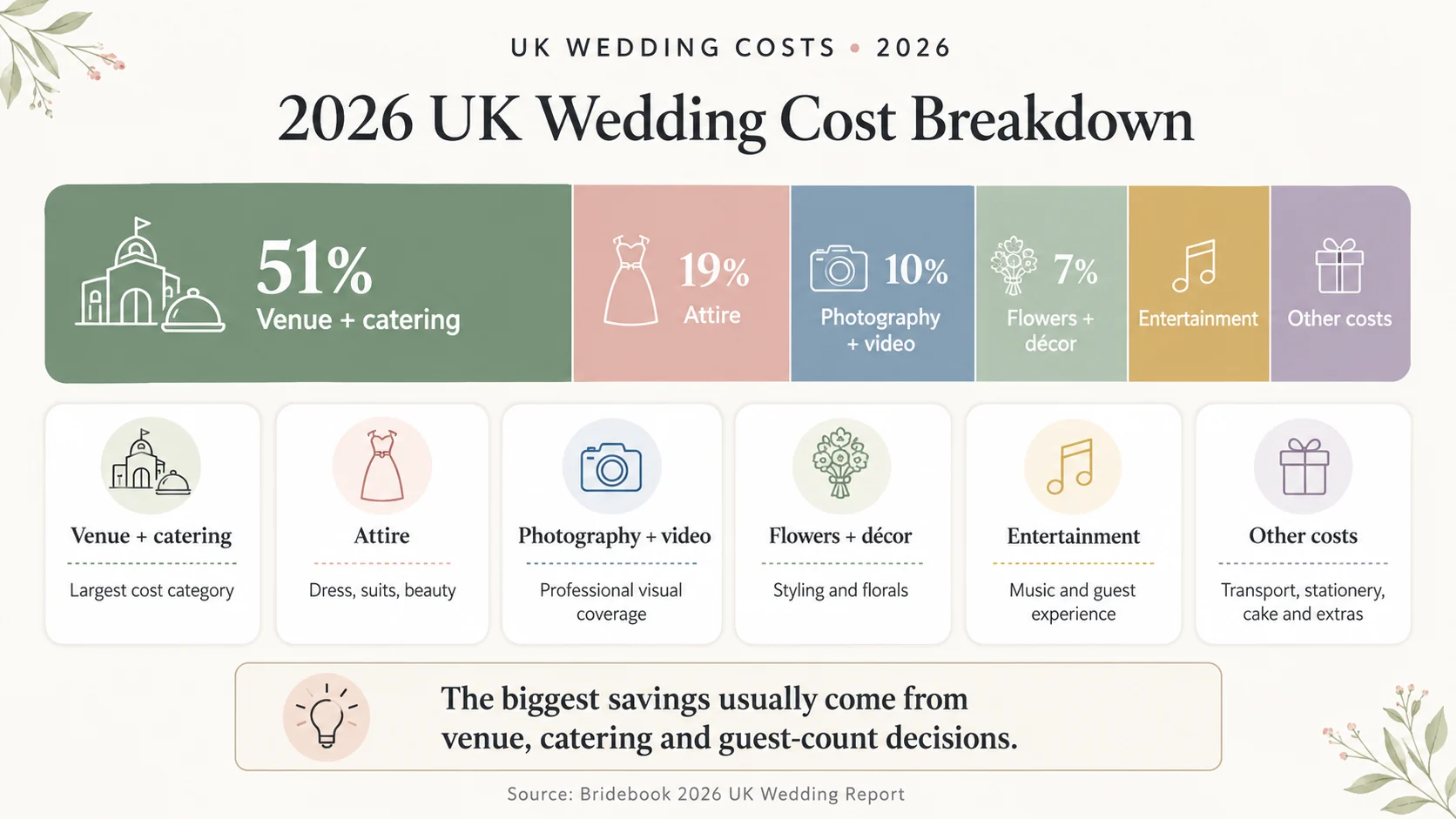
| Budget area | Share of average budget | Example 2026 supplier figures |
|---|---|---|
| Venue and catering | 51% | Venue £6,040; reception catering £5,406 |
| Wedding attire | 19% | Dress £1,532; menswear £859 |
| Photography and videography | 10% | Photographer £1,484; videographer £1,514 |
| Flowers and décor | 7% | Florist £1,187; décor £1,404 |
| Entertainment | 7% | Reception music £1,061 |
| Other suppliers and extras | 6% | Transport £593; stationery £378; cake £360 |
Source: Bridebook 2026 UK Wedding Report.
These figures are useful for comparison, but they are not a shopping list. Couples use different combinations of suppliers, packages and DIY options, so adding every individual supplier average together will not produce a meaningful "standard wedding".
Venue and Catering
This is normally the first place to look when trying to understand a wedding budget.
Bridebook reports an average £6,040 for venue hire excluding catering, with reception catering averaging £5,406.
The headline hire fee rarely tells the whole story. When comparing venues, check whether the price includes:
- Ceremony space
- Tables and chairs
- Staffing
- Food
- Drinks
- Setup and breakdown
- Accommodation
- Cleaning
- Minimum food or drink spend
An apparently expensive venue can work out better value if much of that is included. A cheaper blank-canvas space can move in the opposite direction once furniture, catering, staffing and equipment are added.
If you are still shortlisting venues, our guide to choosing and comparing wedding venues covers the questions worth asking before you sign a contract.
Photography and Videography
Bridebook's 2026 averages are £1,484 for wedding photography and £1,514 for videography.
When comparing packages, look beyond the starting price. Coverage hours, a second photographer, travel, albums, editing, video length and overtime can all change what you actually receive.
It is also useful to separate professional photography from the pictures guests take themselves. Your photographer is there to create deliberate, professionally edited coverage. Guests capture the smaller moments happening at different tables, on the dance floor and while you are somewhere else entirely.
If those extra perspectives matter to you, our guide to collecting wedding photos from guests covers the main options. Guestreel also lets guests scan a personalised QR code and upload photos and videos through their browser, with everything collected in one private gallery.
Attire, Flowers and Entertainment
Current Bridebook averages put a wedding dress at £1,532, menswear at £859, flowers at £1,187 and reception music at £1,061.
These categories are much more flexible than venue and catering costs. One couple may want custom clothing and elaborate floral installations; another may happily hire outfits, use seasonal flowers or rely on a venue that already looks finished.
That is why category averages work best as reference points. They tell you roughly what other couples are spending, not what deserves the same proportion of your budget.
How Much Does a Wedding Cost by Guest Count?
Guest count has a major effect on total cost because every additional person can affect food, drink, stationery, furniture and venue capacity.
Bridebook's 2026 data shows the relationship clearly:
| Day guests | Average total spend | Average spend per guest |
|---|---|---|
| 50 | £15,162 | £303 |
| 70 | £21,791 | £311 |
| 100 | £22,510 | £225 |
| 120+ | About £26,000 | £217 |
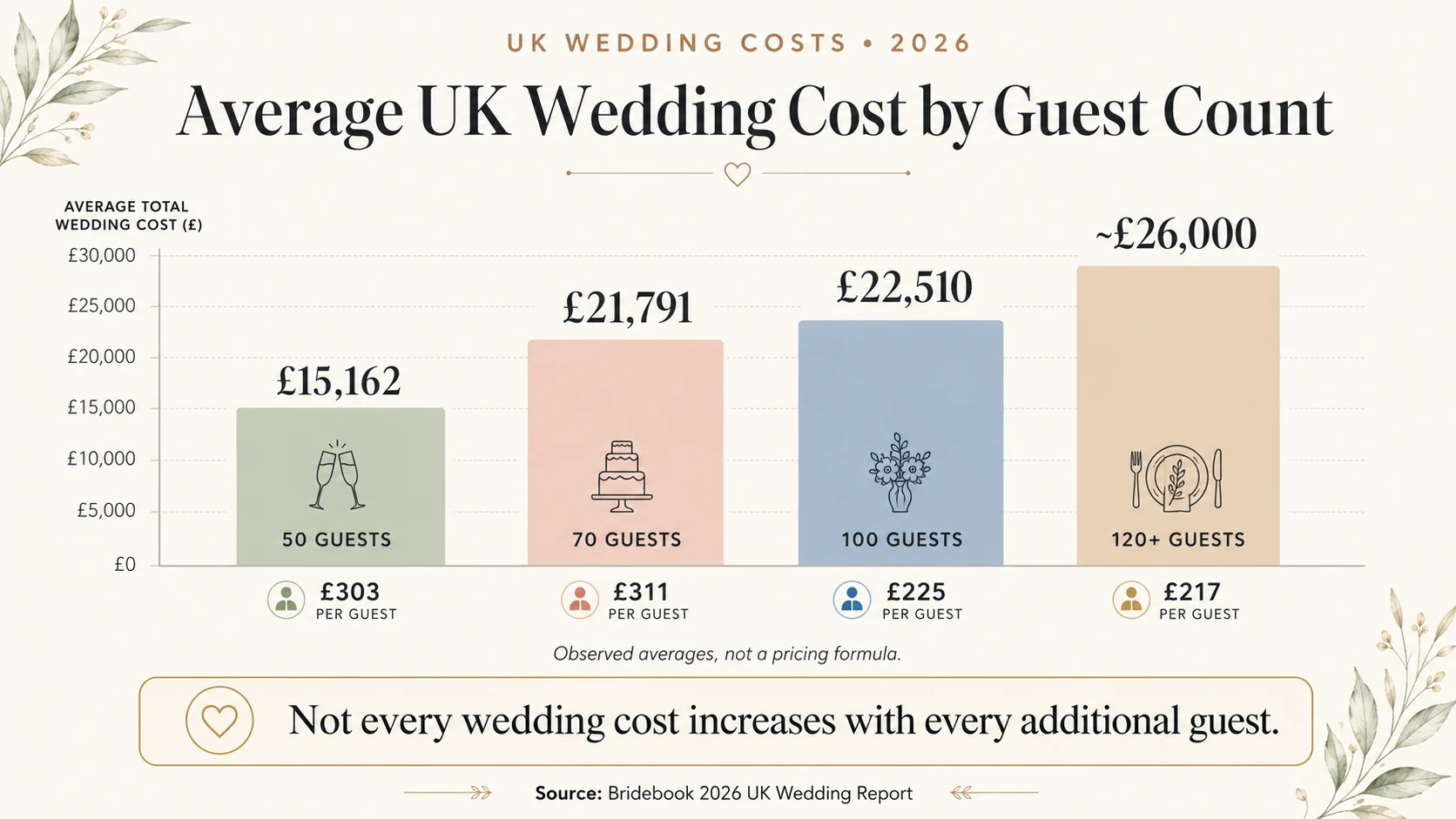
These are observed averages, not a formula for what your wedding will cost.
A 100-person wedding does not automatically cost twice as much as a 50-person wedding because many expenses stay relatively stable regardless of guest count.
Fixed Costs vs Per-Guest Costs
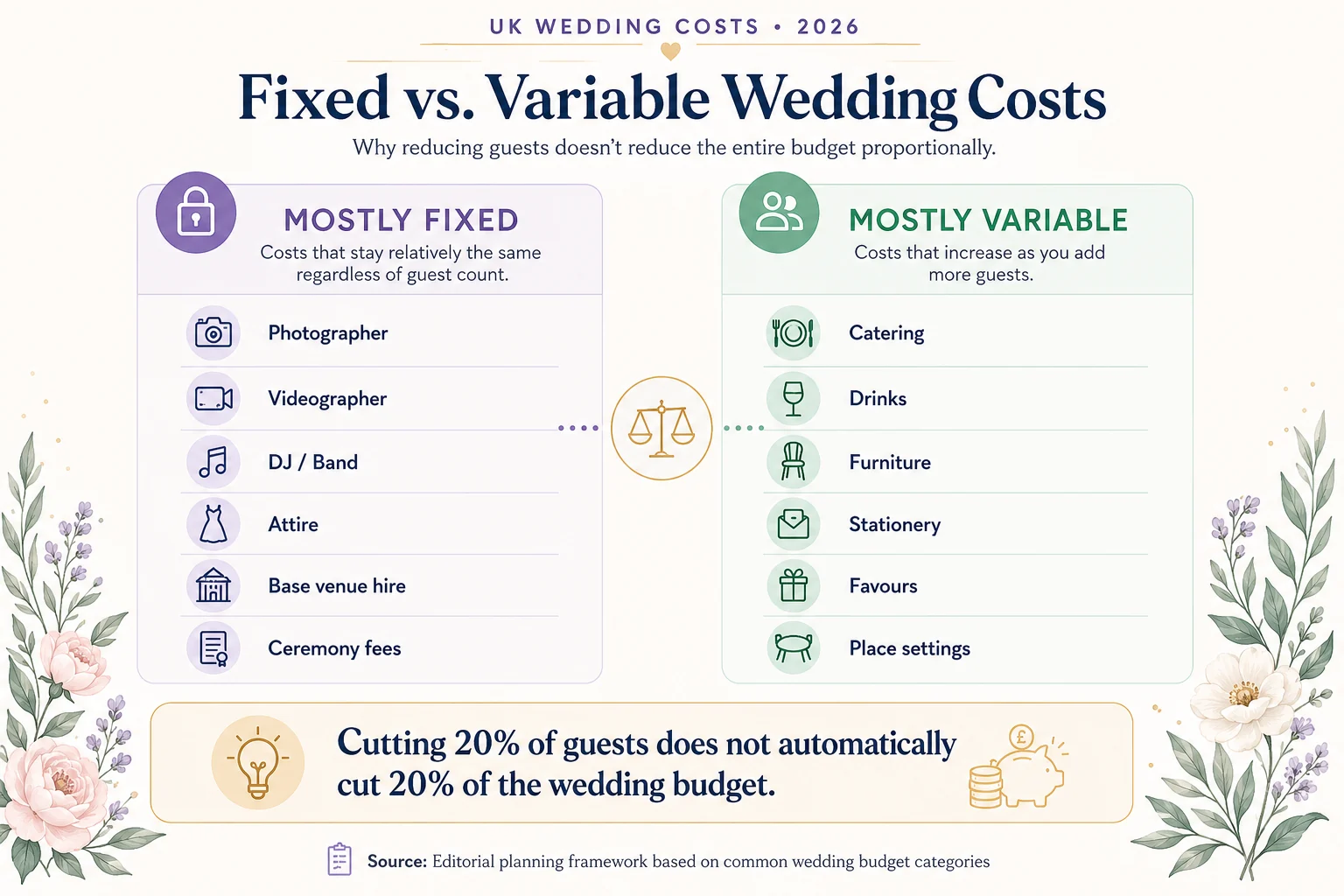
Some costs are largely fixed:
- Photographer and videographer
- Wedding clothing
- DJ or band
- Some venue hire
- Ceremony fees
- Certain décor or entertainment packages
Others increase as the guest list grows:
- Catering
- Drinks
- Place settings
- Invitations
- Favours
- Furniture or linen hire
This is why removing 20% of your guests rarely removes 20% of the total budget.
A more useful way to think about your own wedding is:
Fixed wedding costs + per-guest costs × number of guests + contingency = working budget
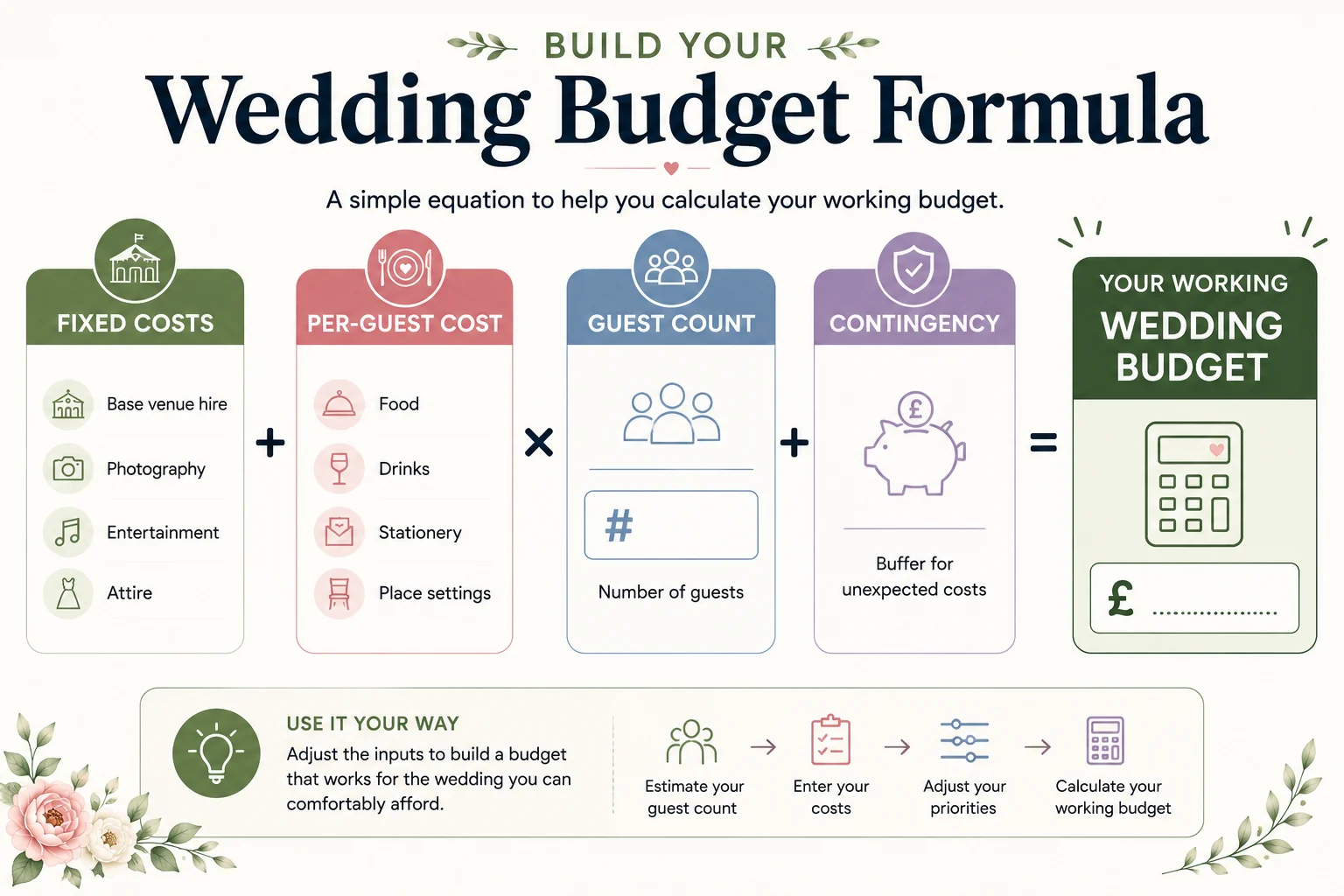
That calculation will tell you far more about affordability than the national average alone.
What Is the Average Wedding Cost Per Guest in the UK?
The two major current studies put overall spending at roughly £272–£278 per guest.
Bridebook reports £278 per guest, while Hitched reports £272.
That is not the same as a caterer's "price per head". Wedding cost per guest spreads the wider cost of the celebration across everyone attending, including fixed expenses such as photography, entertainment and clothing.
It also explains why a small wedding does not necessarily have a low per-person cost. A photographer who charges £1,500 does not suddenly charge half that amount because the guest list falls from 100 to 50.
Average Wedding Cost by UK Region
Location can make a significant difference to venue and supplier prices.
Bridebook's current regional averages are:
| Region | Average wedding spend |
|---|---|
| London | £26,986 |
| Scotland | £22,987 |
| South East England | £22,637 |
| South West England | £22,304 |
| West Midlands | £20,006 |
| East of England | £19,794 |
| Wales | £19,175 |
| Yorkshire and the Humber | £18,769 |
| Northern Ireland | £18,564 |
| North East England | £18,410 |
| East Midlands | £17,981 |
| North West England | £17,342 |
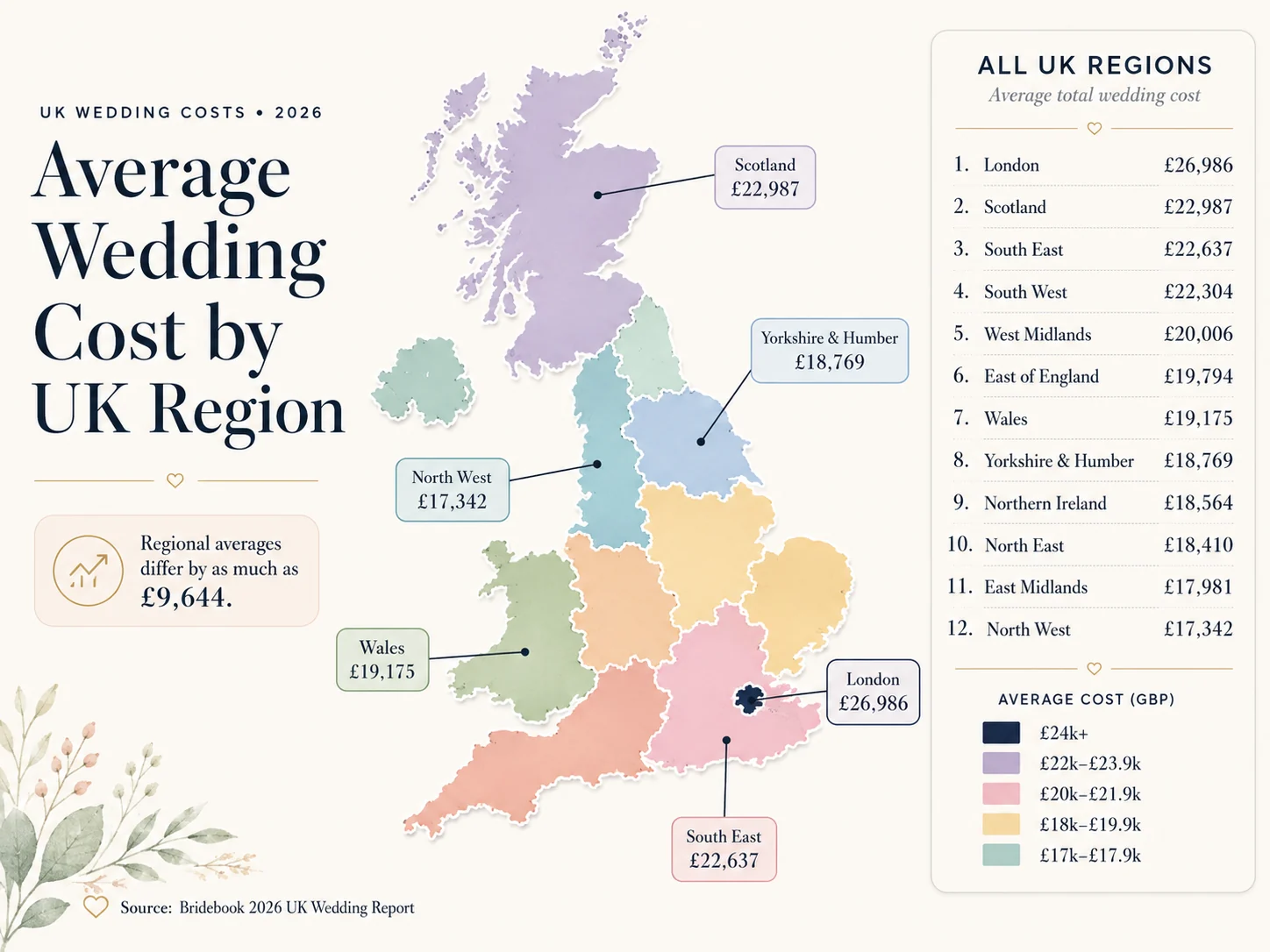
London is the most expensive region in both Bridebook's and Hitched's current research, although the exact numbers differ between datasets.
Regional averages are useful for understanding the market you are entering. Once you start getting quotes, however, those real supplier prices should replace national or regional averages in your spreadsheet.
When Is It Cheapest to Get Married in the UK?
Bridebook's 2026 data found the lowest average spending among couples marrying in:
- January: £11,000
- February: £17,563
- October: £17,873
The highest averages appeared in June, August and September, with June reaching £23,809.
There is an important catch.
This does not mean moving an identical wedding from June to January will automatically cut its cost by more than £12,000. Couples choosing different seasons may also choose different venues, guest counts and wedding styles.
If saving through timing is important, ask venues and major suppliers for like-for-like quotes for your preferred Saturday, a weekday and an off-season date. That gives you a real saving rather than an assumed one.
Hidden Wedding Costs Couples Often Forget
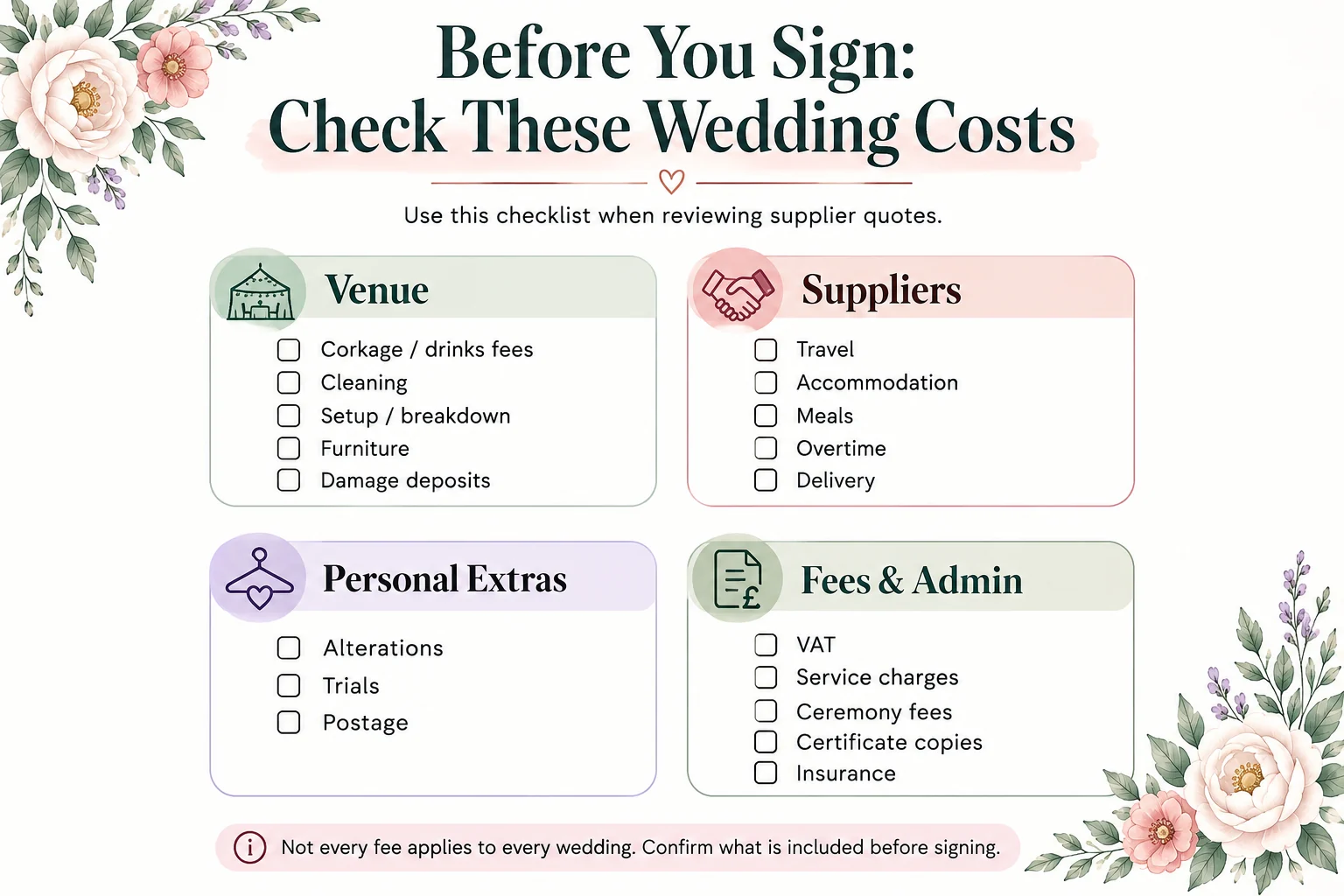
Most budgets include the venue, food and photographer from the start. The surprises tend to come from smaller contractual extras.
Check quotes and contracts for:
- VAT and service charges
- Corkage
- Delivery and collection
- Setup and breakdown
- Supplier travel or accommodation
- Supplier meals
- Overtime
- Furniture or equipment hire
- Hair and makeup trials
- Clothing alterations
- Postage
- Cleaning or damage deposits
- Wedding insurance
- Certificate copies
Legal Wedding Costs
Legal fees vary across the UK, so there is no single nationwide "marriage licence" price.
| Jurisdiction | Current standard notice fee |
|---|---|
| England and Wales | £46.50 per person |
| Scotland | £45 per person |
| Northern Ireland | £22 per marriage notice form |
Ceremony, registrar, venue and certificate charges can be separate.
For England and Wales, GOV.UK says couples will normally need to give notice at least 29 days before the ceremony. Scotland and Northern Ireland have their own processes.
Because fees and requirements can change, confirm them with GOV.UK, National Records of Scotland or nidirect, depending on where you are marrying.
VAT
The standard UK VAT rate is 20%, but do not assume every supplier will simply add 20% to the price you first see.
The practical question is:
Is this the final price we will pay, including VAT and every compulsory charge?
Get that answer before comparing two quotes.
What Can a £10,000, £20,000 or £30,000 Wedding Budget Look Like?
There is no standard way to divide a wedding budget. These are planning examples rather than reported averages.
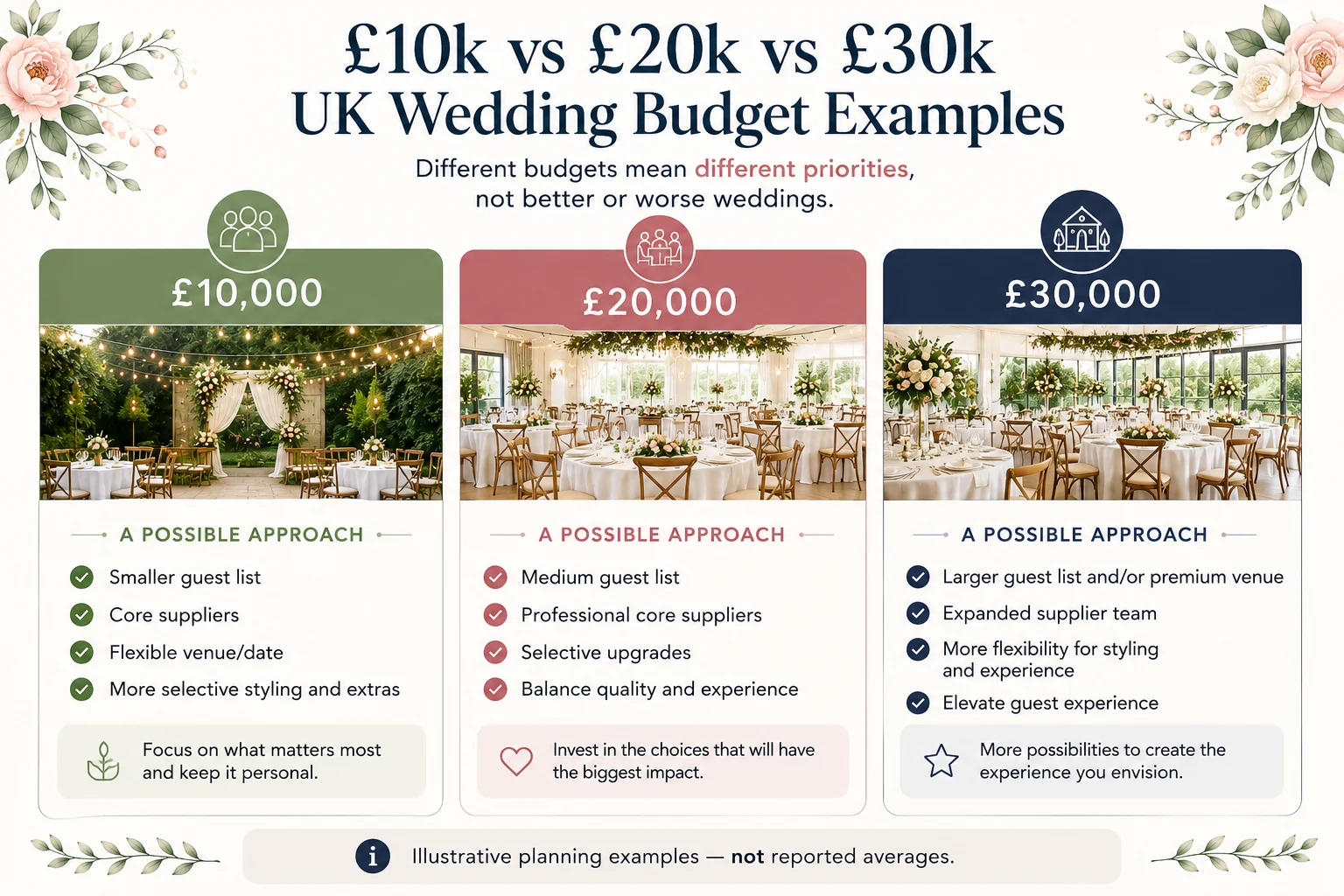
| Total budget | One realistic direction |
|---|---|
| £10,000 | Smaller guest list, simpler venue format, careful supplier choices and a clear focus on one or two priorities |
| £20,000 | Medium-sized celebration with professional core suppliers and room to spend more selectively on the details that matter |
| £30,000 | More flexibility for a larger guest list, premium venue or expanded supplier team, although catering and guest-driven costs can still use the budget quickly |
A £10,000 wedding is not a stripped-down version of a £30,000 one. It is usually a different set of decisions.
The useful question is not "What should our budget buy?"
It is "Which parts of the day matter enough that we do not want to compromise on them?"
How to Build a Wedding Budget That Works for You
Start with the maximum amount you can genuinely afford. The national average should come afterwards, as context.
Then build the budget in this order:
- Confirm available funds. Include savings and any family contributions that have actually been agreed.
- Draft the guest list. Guest count and venue budget need to work together.
- Choose your priorities. Pick the two or three things you care about most before allocating every category.
- Separate fixed and per-guest costs. This makes it much easier to see the financial impact of changing the guest list.
- Compare complete quotes. Record VAT, travel, overtime, compulsory extras and what each package includes.
- Keep some money unallocated. A 5–10% contingency is a useful planning rule of thumb if your overall finances allow it.
Once the numbers are working, a wedding planning checklist and timeline can help you decide when deposits, bookings and final payments need to happen.
Where Can You Make the Biggest Savings?
Start with decisions that can move hundreds or thousands of pounds. Tiny savings on favours or stationery will not rescue a budget if the venue or guest list is unaffordable. Our guide on how to cut wedding costs goes deeper on this.
Guest count is usually one of the most powerful levers because it changes several costs at once.
Venue choice can also reshape the entire budget. Compare the full cost of a hotel, restaurant, pub, country house, village hall or blank-canvas space rather than comparing hire fees alone.
Date flexibility is another useful lever. Ask for actual quotes for weekday or off-season dates instead of assuming the national averages represent the saving available to you.
Finally, be willing to remove traditions you do not care about. There is no rule saying a wedding needs favours, elaborate stationery, several outfit changes, huge floral installations or every category found on a generic checklist.
Spend where you will notice the difference.
Frequently Asked Questions
Is £10,000 Enough for a Wedding in the UK?
Yes. Bridebook reports that roughly a quarter of couples in its 2026 research spent £10,000 or less. A smaller guest list, lower-cost venue format and selective supplier spending make the target much more realistic.
What Is the Biggest Wedding Expense?
Venue and catering are normally the largest combined expense. Bridebook's 2026 data attributes 51% of average spending to those areas.
How Much Does a 50-Person Wedding Cost in the UK?
Bridebook reports an average of £15,162 for a 50-guest wedding. It is a benchmark rather than a quote: venue, location, date and supplier choices can move the final total substantially.
How Much Does a 100-Person Wedding Cost?
Bridebook's current data puts the average for a 100-guest wedding at £22,510. Fixed costs explain why that figure is not simply double its 50-guest average.
Does the Average Wedding Cost Include the Honeymoon?
No. The headline averages from both Bridebook and Hitched exclude the honeymoon and engagement ring.
How Much Should We Keep for Unexpected Wedding Costs?
There is no mandatory percentage, but keeping roughly 5–10% of your available budget unallocated is a practical rule of thumb if you can afford to do so. Treat it as protection against genuine changes rather than extra money for early upgrades.
How We Sourced These Figures
The national benchmarks in this guide come primarily from Bridebook's 2026 UK Wedding Report and Hitched's 2026 wedding research.
CompareWeddingInsurance is shown separately because its £23,994 figure comes from cancellation-cover selections rather than the same type of couple-spending survey.
Legal information is checked against official UK government and registration sources rather than wedding blogs.
Where this article provides budgeting frameworks or £10k/£20k/£30k examples, they are presented as planning guidance, not survey findings.
Wedding prices change, so national averages are best used to orient your plans. Once you have actual supplier quotes, those should become the numbers your budget is built around.
The Bottom Line
The current survey data puts the average UK wedding at roughly £20,600–£22,000, but that does not mean £21,000 is the amount you need to spend.
Start with what you can afford. Then look at guest count, fixed costs, location and the things you care about enough to prioritise.
A wedding below the national average is not missing something, and a wedding above it is not automatically better. A useful budget is one that lets you create the celebration you want without letting an industry average make the decisions for you.