25 Wedding Planning Mistakes to Avoid (and How to Fix Them)
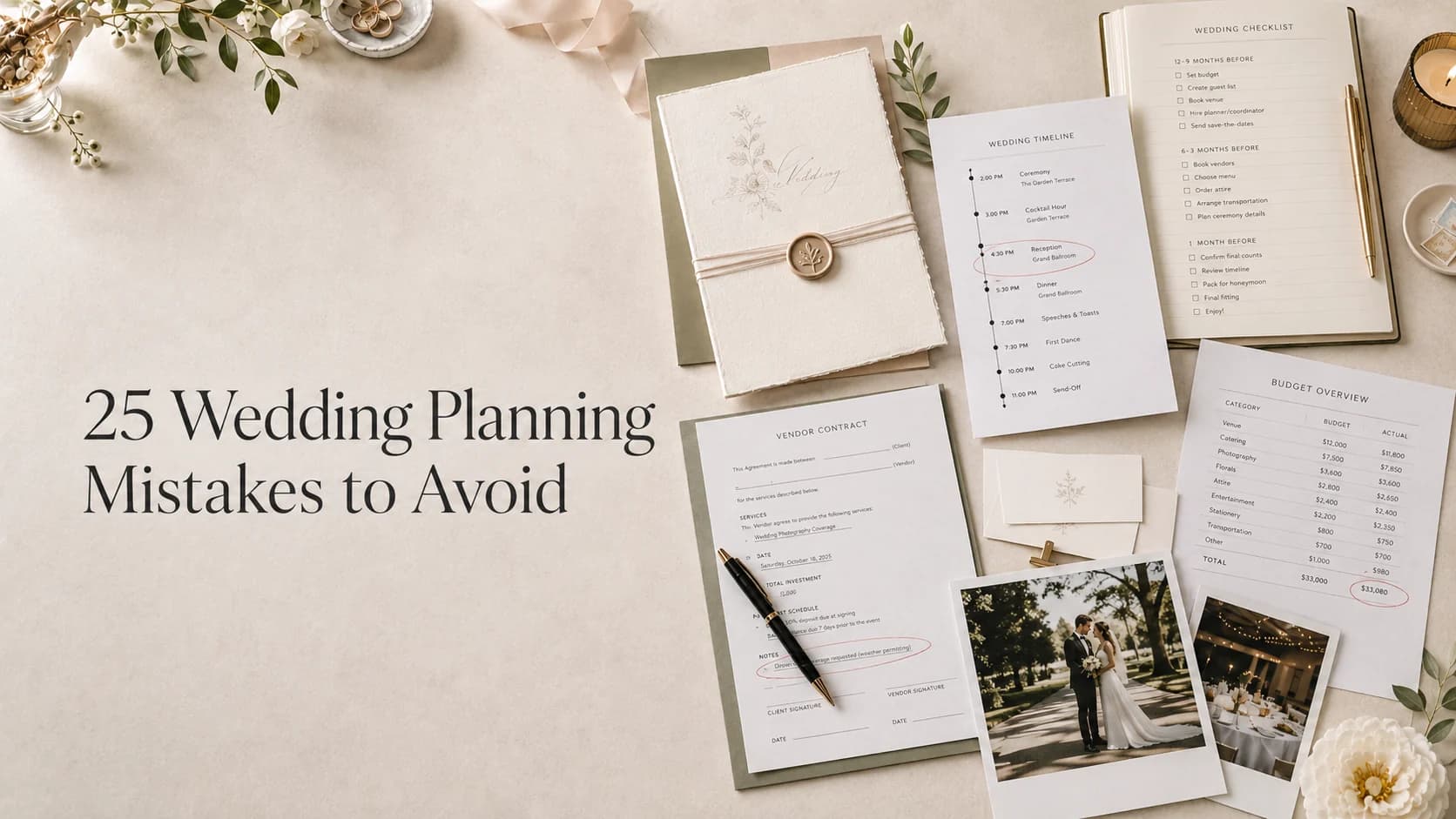
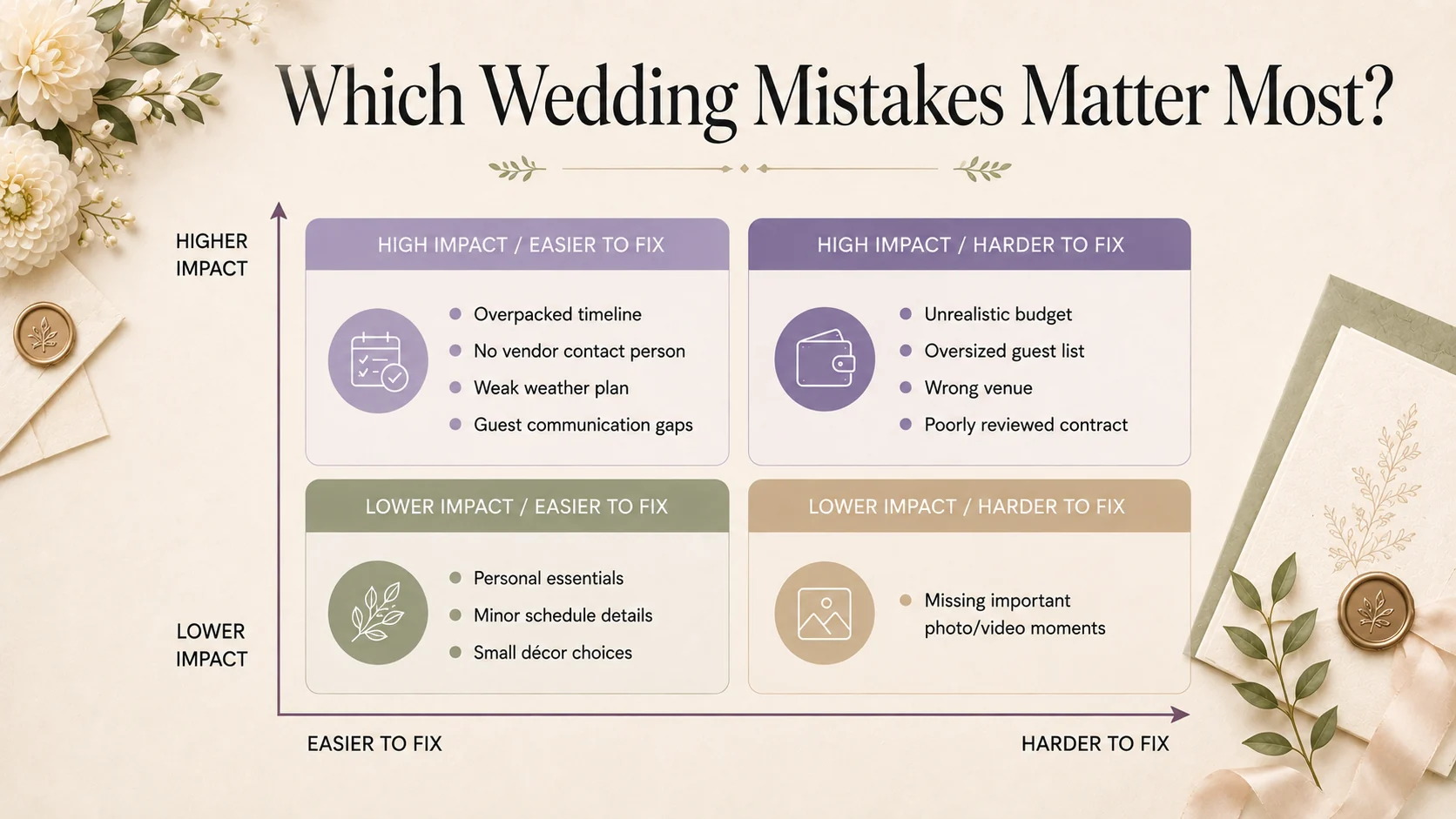
Most wedding planning mistakes are not about choosing the wrong napkin color or forgetting a decorative detail. The ones that matter tend to affect your budget, your guests, the flow of the day, or the memories you get to keep afterward.
The biggest problems usually happen when couples commit too early: booking before the budget is clear, inviting more people than the venue comfortably holds, signing contracts they have only skimmed, or building a schedule that works perfectly on paper and nowhere else.
Here are 25 wedding planning mistakes worth preventing, plus what to do instead and what you can still fix if you've already made one.
The Biggest Wedding Planning Mistakes at a Glance
| Mistake | Why it matters | What to do instead |
|---|---|---|
| Planning without clear priorities | Money gets spread across things you do not value equally | Agree on your biggest priorities first |
| Setting an unrealistic budget | Early spending can leave little room for later essentials | Start with what you can actually afford |
| Letting the guest list grow unchecked | Guest count affects almost every major cost | Set a realistic maximum before booking |
| Choosing a venue on looks alone | Restrictions and logistics can create problems later | Evaluate how the venue actually works |
| Comparing only headline prices | The final cost may be much higher | Compare what is included and what costs extra |
| Skimming vendor contracts | Important terms can be missed until it is too late | Read the details before paying a deposit |
| Packing too much into the timeline | Small delays can turn into constant rushing | Build the schedule with your vendors |
| Overlooking guest needs | Confusion and discomfort are remembered | Plan communication, access and transport early |
| Having no weather backup | Last-minute changes become harder to manage | Agree on a workable Plan B |
| Leaving memory planning until the day | Photos, video and candid moments may be missed | Decide in advance what you want captured |
Mistakes to Avoid Before You Book Anything
1. Starting With Pinterest Before Deciding What Actually Matters to You
There is nothing wrong with collecting inspiration. The problem starts when every good idea becomes something you feel your wedding now needs.
Before comparing venues or suppliers, each of you should pick a few things you genuinely care about. Maybe that is excellent food, a packed dance floor, photography, keeping the guest list intimate, or simply not spending more than a certain amount.
Those priorities give you something to come back to when the options multiply.
A £1,500 décor upgrade is easier to turn down when you already know décor sits below photography, music and food on your list.
If you have already booked several things, you can still do this exercise. Use it to guide the money and decisions you have left.
2. Building the Wedding Budget Around the Wedding You Want Rather Than the Money You Have
A useful budget starts with what you can comfortably spend.
It should not begin with an industry average and work backward from there.
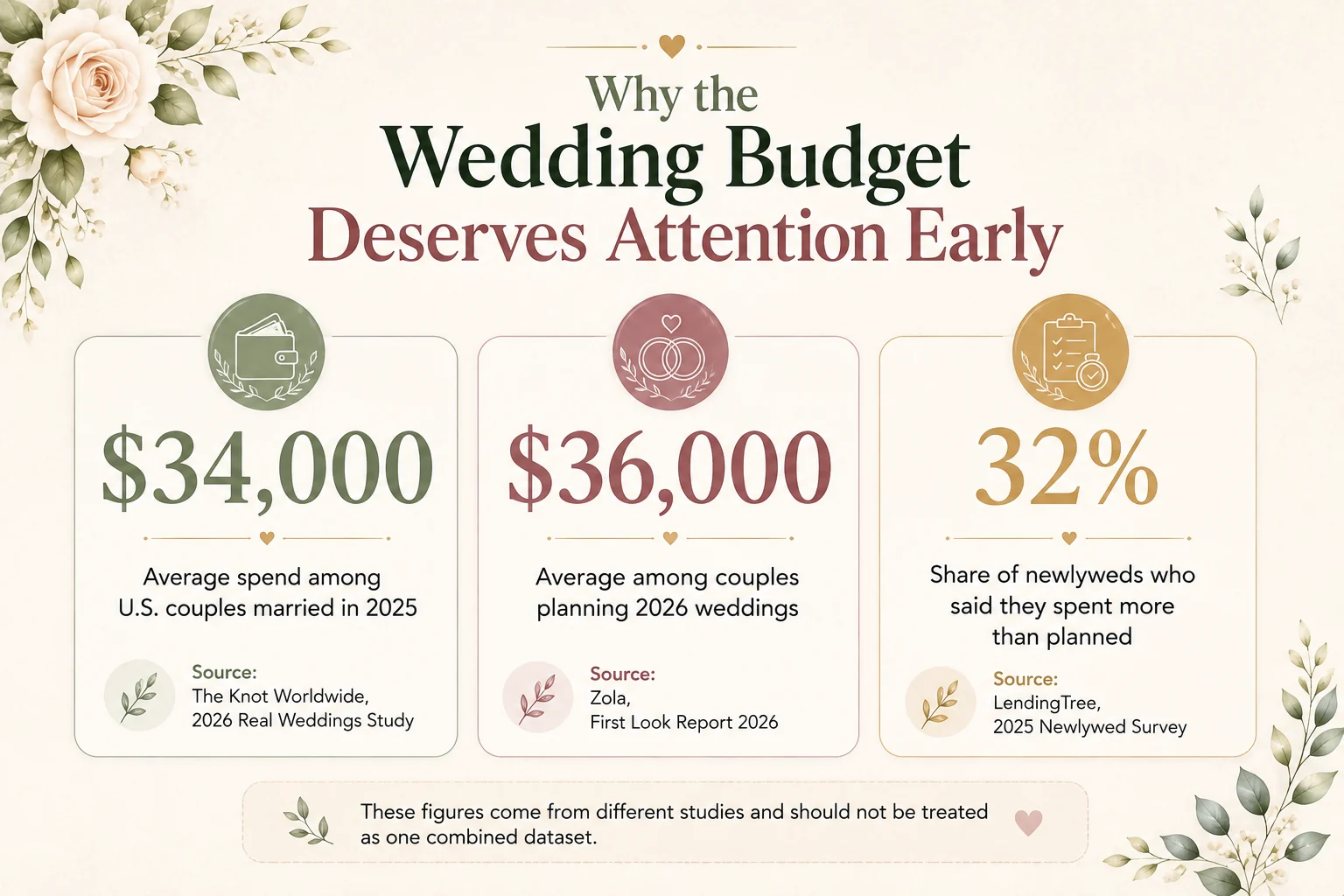
Wedding costs vary widely by location, guest count and the type of celebration. For context, The Knot Worldwide's 2026 Real Weddings Study reported average spending of $34,000 among the U.S. couples in its study who married in 2025. Zola's 2026 First Look Report reported a $36,000 average among couples planning weddings in 2026.
Neither number tells you what your wedding should cost.
Start with:
- The total amount you can use comfortably
- Who is contributing
- Whether family contributions come with expectations
- Your realistic guest count
- The areas you care most about
- Money left uncommitted for expenses you have not anticipated
Going over budget is not unusual. In a 2025 LendingTree survey of 1,050 U.S. newlyweds, 32% said they spent more than planned.
If your budget is already slipping, stop adding optional expenses and update the numbers before booking anything else.
Our wedding budget planner can help you break the total down.
3. Finalizing a Guest List Without Checking What It Does to the Budget
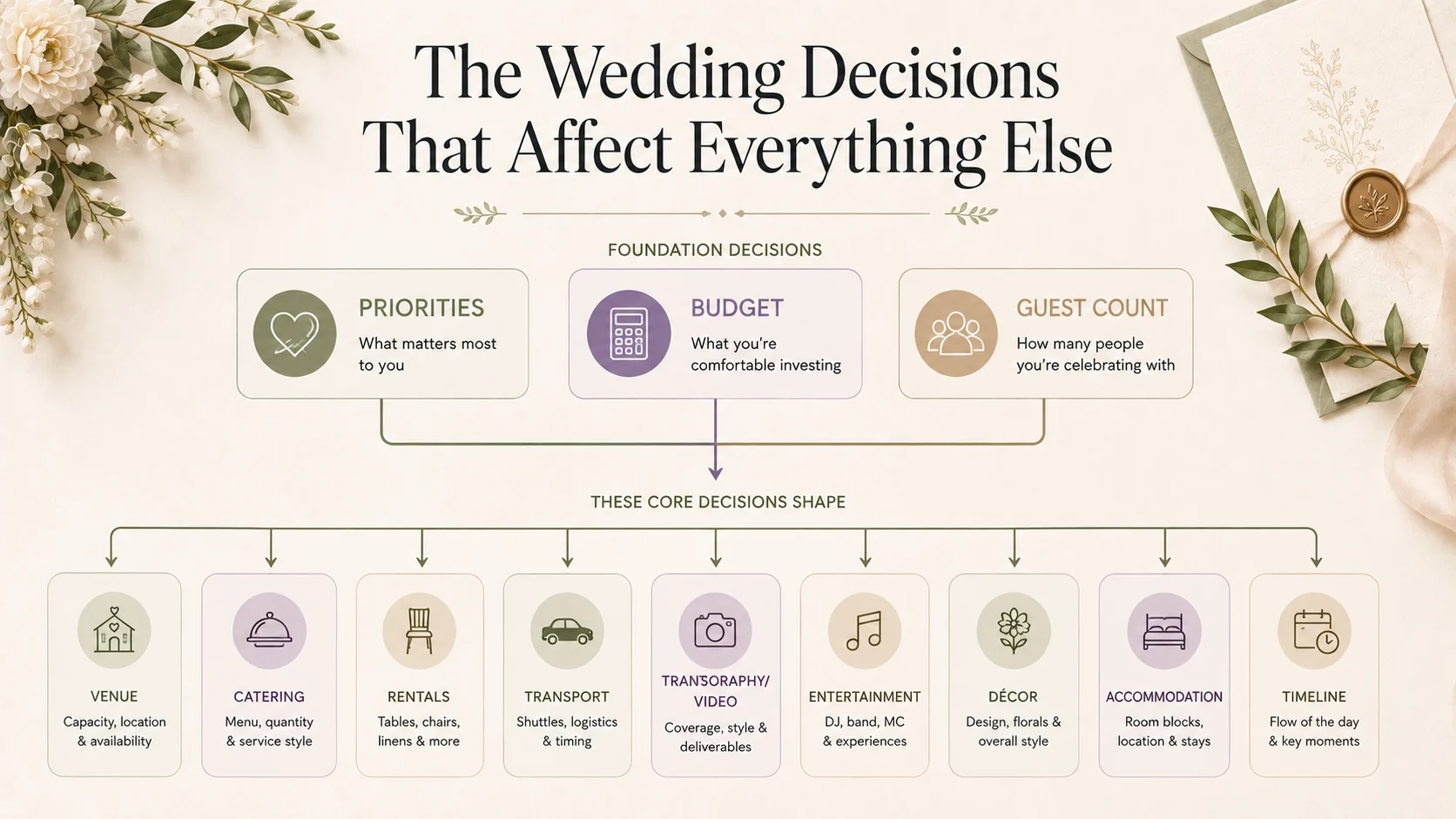
Every extra guest can affect more than the catering bill.
It can mean:
- A larger venue
- More tables and chairs
- More stationery
- More drinks
- More transport
- Additional rentals
- More staff
Build the list before committing to a venue that only works if a convenient number of people decline.
A simple way to start is to separate guests into people you absolutely want there, people you would strongly like to invite, and people you would include if budget and capacity allow.
If invitations have already gone out, do not start making changes in a panic. First work out whether the actual problem is venue capacity, cost, seating or something else.
4. Choosing a Venue Because It Looks Perfect in Photos
Some venues are easy to fall in love with during a tour and much harder to run a wedding in.
Look beyond the ceremony backdrop.
Check:
- Comfortable capacity for your layout
- Accessibility
- Parking and transport
- Noise restrictions
- Curfews
- Catering and bar rules
- Furniture and equipment included
- Setup and collection times
- Vendor restrictions
- Accommodation nearby
- Wet-weather options
- What happens if part of the schedule changes
A venue can photograph beautifully and still be a logistical headache.
Our wedding venue planning guide covers the comparison process in more detail.
5. Spending Every Part of the Budget Too Early
It is easy to feel as though every dollar or pound needs a job from day one.
It does not.
Keep some flexibility for expenses that appear later. That could be an alteration, an extra transport run, a supplier requirement you missed, or something you simply decide matters more as the wedding gets closer.
There is no single contingency percentage that works for every wedding. The useful principle is much simpler: avoid reaching the final weeks with your entire budget already committed.
Budget and Vendor Mistakes
6. Comparing Vendors by Starting Price Instead of Likely Final Cost
One photographer charges $3,000. Another charges $2,600.
The second one looks cheaper until you discover travel, an extra hour of coverage and the album you want are all separate.
Depending on the service, ask about:
- Travel
- Setup
- Delivery
- Staffing
- Rentals
- Extra hours
- Service charges
- Taxes
- Optional upgrades
Compare the packages you would realistically buy, not the lowest number on the price list.
If your total is already becoming uncomfortable, look at ways to cut wedding costs before reducing every category equally.
7. Following a Generic Vendor Booking Order Too Literally
You'll often see advice telling you exactly which vendor must be booked first, second and third.
Use those timelines as a guide, not a law.
If your dream band only has one date available, your priorities may look different from those of a couple planning around a particular photographer or venue.
Book the things that:
- Lock in your date or location
- Have limited availability
- Affect other bookings
- Matter most to you
A good wedding planning checklist should help you see dependencies without pretending every wedding follows the same sequence.
8. Giving a Friend an Important Wedding Job Without Talking Through What It Involves
A talented friend may be perfectly capable of photographing your ceremony, baking the cake or doing your flowers.
The risk is assuming both of you have the same idea of what the job involves.
Talk about:
- What they are responsible for
- When they need to arrive
- Whether they are working or attending as a guest
- Equipment or supplies
- Payment or expenses
- What happens if they become unavailable
This matters most when the role is difficult to replace at short notice.
Sometimes using a friend works brilliantly. It works better when the arrangement is clear.
9. Signing a Contract You Have Only Skimmed
The time to discover a cancellation clause or overtime rate is before the deposit leaves your account.
Read the parts covering:
- Exactly what you receive
- Payment dates
- Deposits
- Cancellation
- Rescheduling
- Additional hours
- Travel
- Setup and collection
- Replacement providers
- What happens if the vendor cannot perform
- Image or content usage rights where relevant
If something matters to you but only appears in an email or conversation, ask whether it should also appear in the agreement.
Contract law and consumer rights vary by location. For anything with serious legal or financial consequences, use official guidance or qualified legal advice.
10. Assuming the Venue Coordinator Is Managing the Whole Wedding
The title can be misleading because different venues define the role differently.
A venue coordinator may handle everything connected to the property but not your external photographer, transport, entertainment or wider wedding schedule.
Ask one very practical question:
Who deals with this if something changes on the wedding day?
Do that for the timeline, vendors, guest questions, transport and setup.
You may discover the venue has everything covered. You may find you need a separate planner or coordinator. Either is fine, as long as you know where the gaps are.
11. Choosing Vendors Because You Love Their Work but Ignoring What They Are Like to Work With
A beautiful portfolio gets a vendor onto your shortlist. It should not automatically get them the booking.
Pay attention to communication too.
Do they answer questions clearly? Do they understand the type of wedding you're planning? Are reviews consistently positive about reliability as well as the finished work?
This matters even more for people who will spend hours beside you on the day.
You want a photographer whose work you love. You probably also want one you will not dread seeing at 8 a.m.
Guest List and Guest Experience Mistakes
12. Waiting Too Long to Ask About Dietary or Accessibility Needs
This becomes much easier when guests can tell you what they need during the RSVP process.
Depending on your wedding and your guest list, that may include:
- Food allergies or dietary requirements
- Step-free access
- Accessible toilets
- Seating requirements
- Transport between locations
- Accessible accommodation
- Somewhere quieter to step away if needed
Do not rely entirely on a venue describing itself as "accessible." A guest with a specific requirement can usually tell you exactly what would help.
Pass relevant information to the appropriate vendors early enough for them to act on it.
13. Making Guests Piece Together Basic Information
A guest should not need to search three messages, an invitation and a group chat to work out where to park.
Put the practical information in one clear place.
That might include:
- Venue address
- Arrival time
- Parking or transport
- Dress code where relevant
- Accommodation
- RSVP instructions
- Plus-one or child arrangements
- Any unusual venue requirements
A wedding website is useful here, but only if it stays current.
The point is not to tell guests everything. It is to answer the questions they need in order to show up comfortably and on time.
14. Planning the Ceremony and Reception but Forgetting What Happens Between Them

Walk through the wedding like a guest.
They arrive. Then what?
What happens after the ceremony? Is there a 90-minute gap? Do they need to drive somewhere else? Is there somewhere to sit? What if it is hot, cold or raining?
Some of the most noticeable guest-experience problems happen in the gaps between the headline moments.
Fixing those usually does more than adding another decorative detail or entertainment extra.
15. Treating Every Opinion Like a Problem You Have to Solve
Family opinions are part of wedding planning for many couples.
Some deserve serious consideration. Others are simply preferences.
There is a difference between a guest saying, "My grandmother cannot manage those stairs," and a relative saying, "I don't like that color."
Protect the experience and needs of the people you love, but do not let dozens of personal preferences slowly redesign the wedding for you.
Wedding-Day Timeline and Logistics Mistakes
16. Building a Timeline That Only Works If Nothing Runs Late
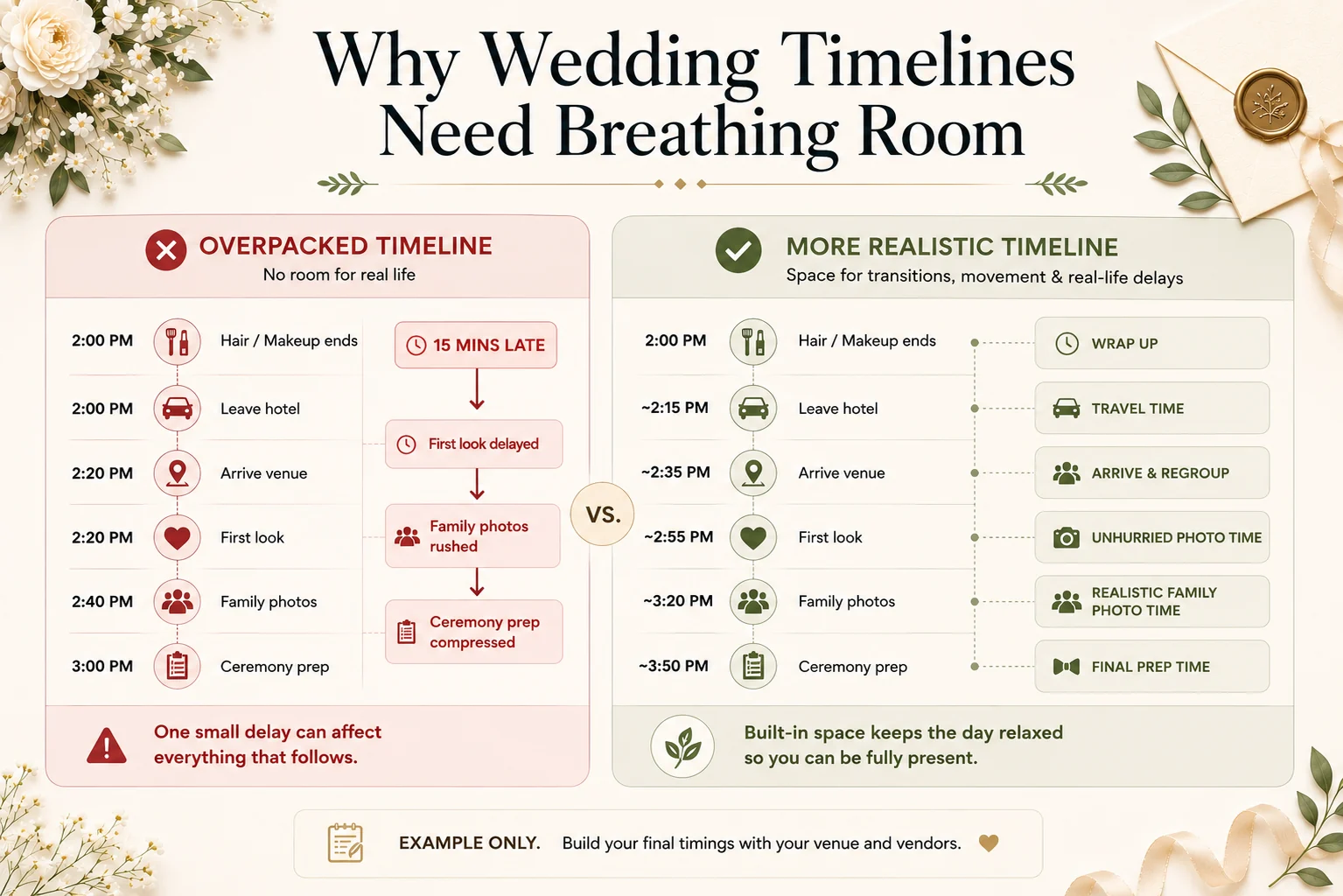
Hair and makeup takes longer than expected. A guest cannot be found for a family photo. Traffic is worse than usual. Moving 100 people from one space to another takes time.
Wedding timelines need room for real people.
Build yours with the vendors responsible for the major transitions, particularly your coordinator, venue, photographer, hair and makeup team and transport provider.
They know how long their part usually takes.
That is more reliable than applying the same arbitrary 15-minute buffer to every wedding.
17. Making Yourselves the Contact Person for Every Small Problem
You probably do not want to be answering:
"Where does the florist unload?"
while getting dressed.
Decide who vendors should contact with routine questions. Depending on the wedding, that could be a planner, coordinator, venue contact or a trusted person who has agreed to help.
Give them:
- The final timeline
- Important phone numbers
- Setup information
- Clear limits on what they can decide
Do not quietly assign the job to a bridesmaid or sibling and assume they will figure it out.
18. Sending Out Several Different Versions of the Timeline
A small schedule change can become a surprisingly big mess if half the suppliers still have the old version.
Once the final details are agreed, send one clearly dated timeline to everyone who needs it.
Confirm:
- Arrival times
- Addresses
- Setup
- Important guest numbers
- Named contacts
- Collections
- Final changes
Then stop creating new versions unless something genuinely changes.
19. Having a Rain Plan That Is Really Just a Rain Idea
"We can move inside" sounds reassuring until you ask where the chairs go, how long the change takes, or whether the indoor space can hold everyone.
A proper backup should answer:
- Where will everything move?
- Who makes the call?
- When is that decision made?
- Who tells the vendors?
- Does the timeline change?
- Do transport or photo plans change?
Think beyond rain too. Extreme heat, cold and strong wind can affect outdoor plans just as easily.
20. Planning So Much That You Barely Experience Your Own Wedding
It is possible to plan a wonderful wedding and spend most of it moving from one scheduled item to another.
Be careful with:
- Long photo lists
- Multiple outfit changes
- Too many entertainment moments
- Constant venue changes
- Very tight meal and speech schedules
Leave some parts of the day unscheduled.
Eat. Have a drink of water. Talk to people. Sit down for five minutes. Spend a little time with the person you just married.
Those moments do not need a line on the itinerary to matter.
21. Forgetting the End of the Night
Everyone plans the entrance.
Far fewer people think through what happens to everything once the music stops.
Before the wedding, work out:
- Who takes cards and gifts
- Who collects personal belongings
- What happens to décor you own
- Who returns hired items
- Whether flowers, cake or other items are being taken home
- How the couple is leaving
- Who checks getting-ready rooms or storage areas
Give those jobs to specific people rather than hoping someone notices at midnight.
Photography, Video and Memory Mistakes
22. Building Your Photo Plan Around Pinterest Instead of Your Actual Wedding
Inspiration photos are useful for communicating style.
They are less useful as a checklist.
A sunset portrait from a destination wedding may not be realistic at your venue in November. A huge family photo may take far longer than it looks.
Talk to your photographer about:
- People who matter most
- Family groupings you actually want
- Moments that cannot be repeated
- Available locations
- Your real timeline
- The light likely to be available
Then let them help shape a plan that works for your day.
23. Assuming the Professional Photographer Will Capture Every Moment
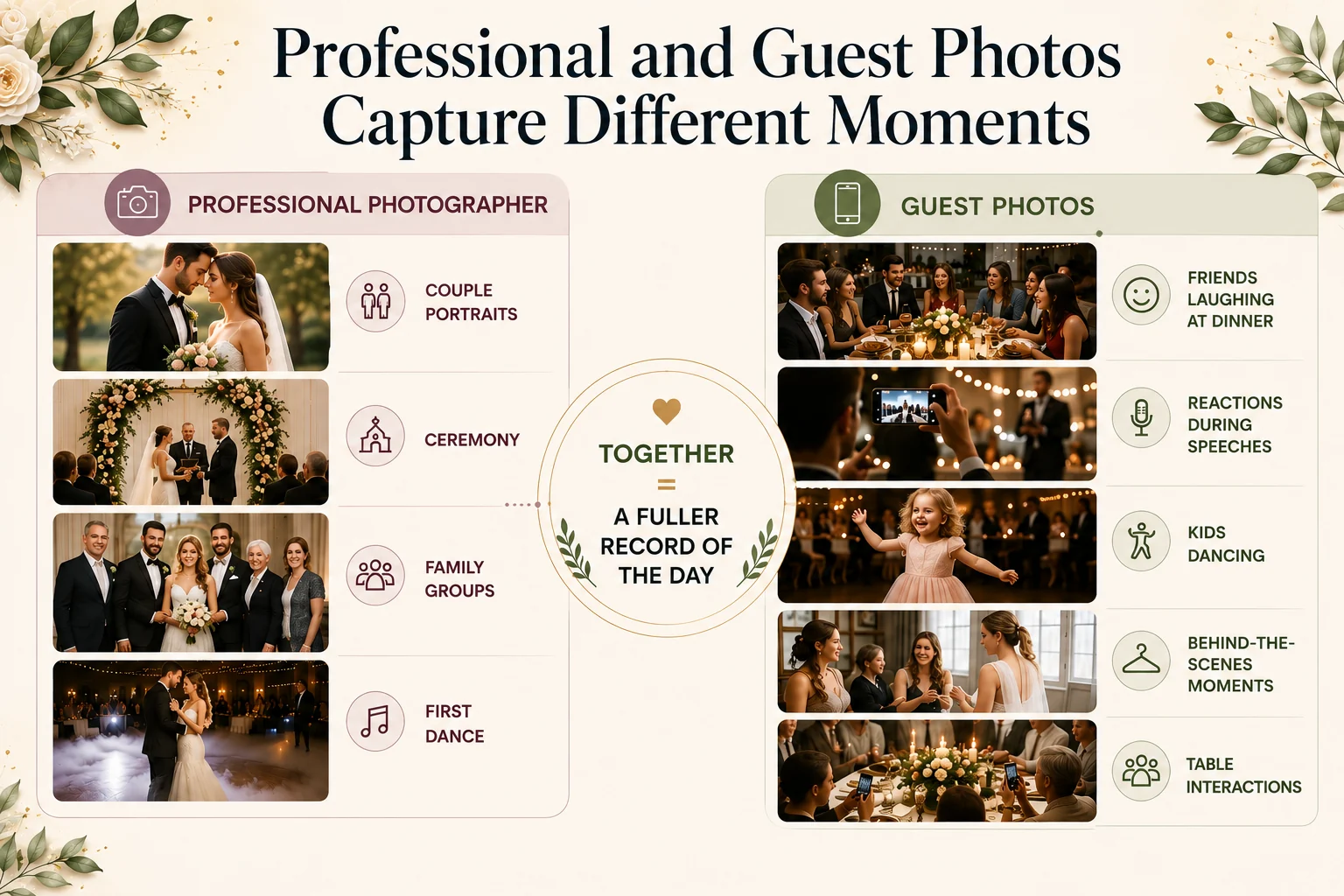
Your photographer is one person, or perhaps a small team. Your guests are everywhere.
Professional and guest photography serve different purposes.
The photographer deliberately documents the important moments, portraits and overall story. Guests capture things happening around them: reactions across the room, old friends laughing at dinner, a child dancing, something happening while the photographer is somewhere else.
If you would like those photos too, decide how they will reach you.
Our guide to collecting wedding photos from guests compares the main options.
24. Thinking About Photos but Forgetting About Voices and Movement
There are things a photograph cannot preserve particularly well.
The sound of a parent's speech. The way someone laughs. A first dance. A reading. A conversation with someone you may not always have around.
That does not mean every couple needs a professional videographer.
It does mean video is worth deciding on intentionally rather than treating it as an afterthought.
Ask yourselves what you would genuinely want to hear or watch again in 10 or 20 years. Then decide whether professional video belongs high enough on your priority list to justify the cost.
25. Assuming Guests Will Send You Their Photos Later
Some will.
Others will mean to and forget. Some photos will end up in WhatsApp conversations, shared albums, social posts and camera rolls you never see.
Choose a collection method before the wedding.
You might use:
- A shared photo album
- Cloud storage
- Direct file sharing
- A QR-code photo gallery
Whatever you choose, keep the guest instructions short and put them somewhere people will actually see them.
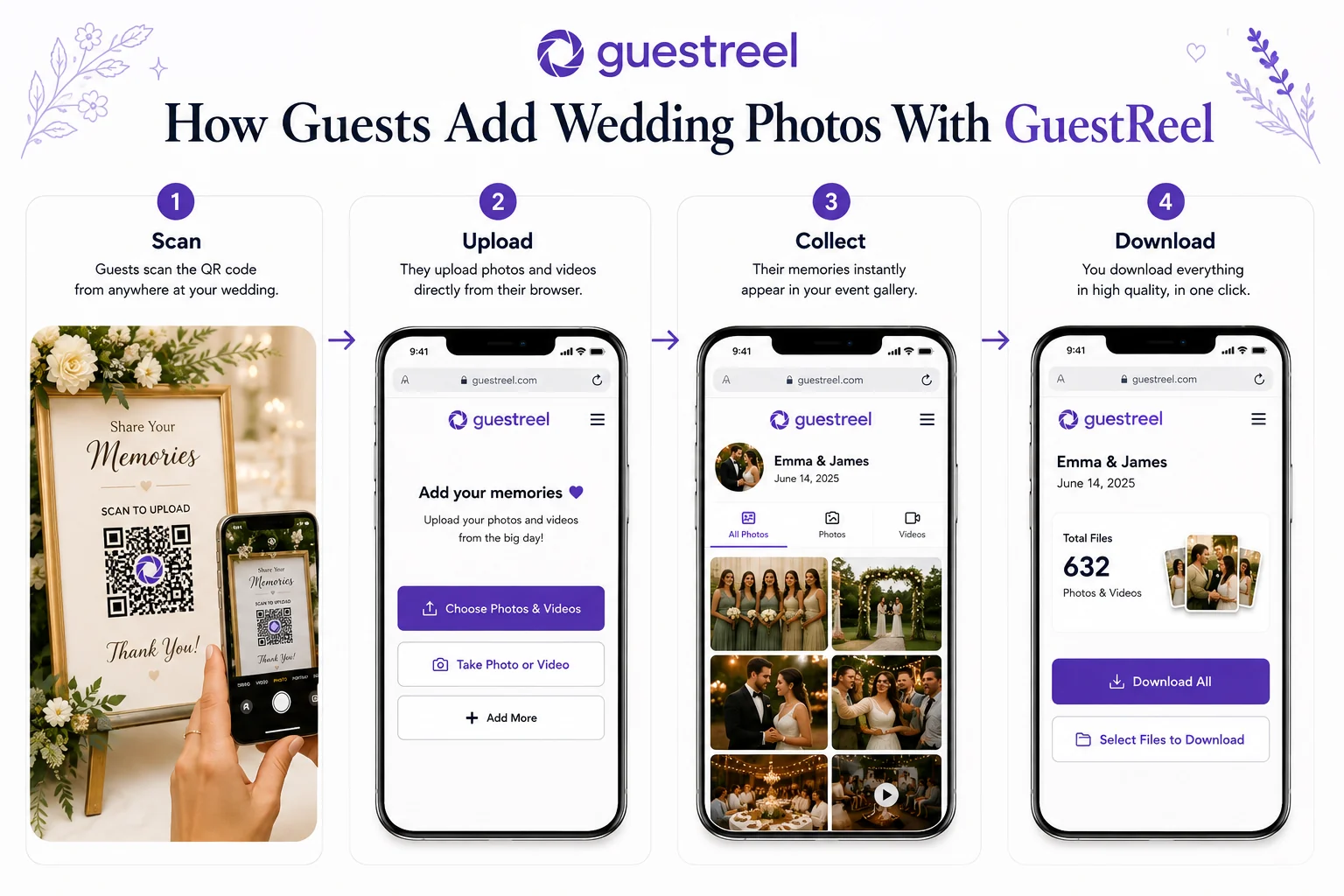
Guestreel is one option designed for this. Guests scan a personalized QR code or open the event link and upload their photos and videos through their browser, without downloading an app. The files are collected in one private event gallery and can be downloaded afterward.
If that sounds useful for your wedding, see how QR code wedding photo sharing works.
A Few Smaller Wedding Regrets That Are Easy to Overlook
Not every regret is about the budget or the venue.
In wedding-planning communities, couples also talk about smaller things they would change: spending too little time together, missing conversations with important people, failing to record a speech, overloading the schedule, or realizing afterward that many guest photos never made it to them.
Those stories are anecdotes, not evidence that every couple will feel the same way. But they are useful reminders.
When the big logistics are under control, ask one final question:
What part of this day would we be genuinely disappointed to miss while it is happening?
That answer is often more useful than another checklist.
Already Made One of These Mistakes? Start Here
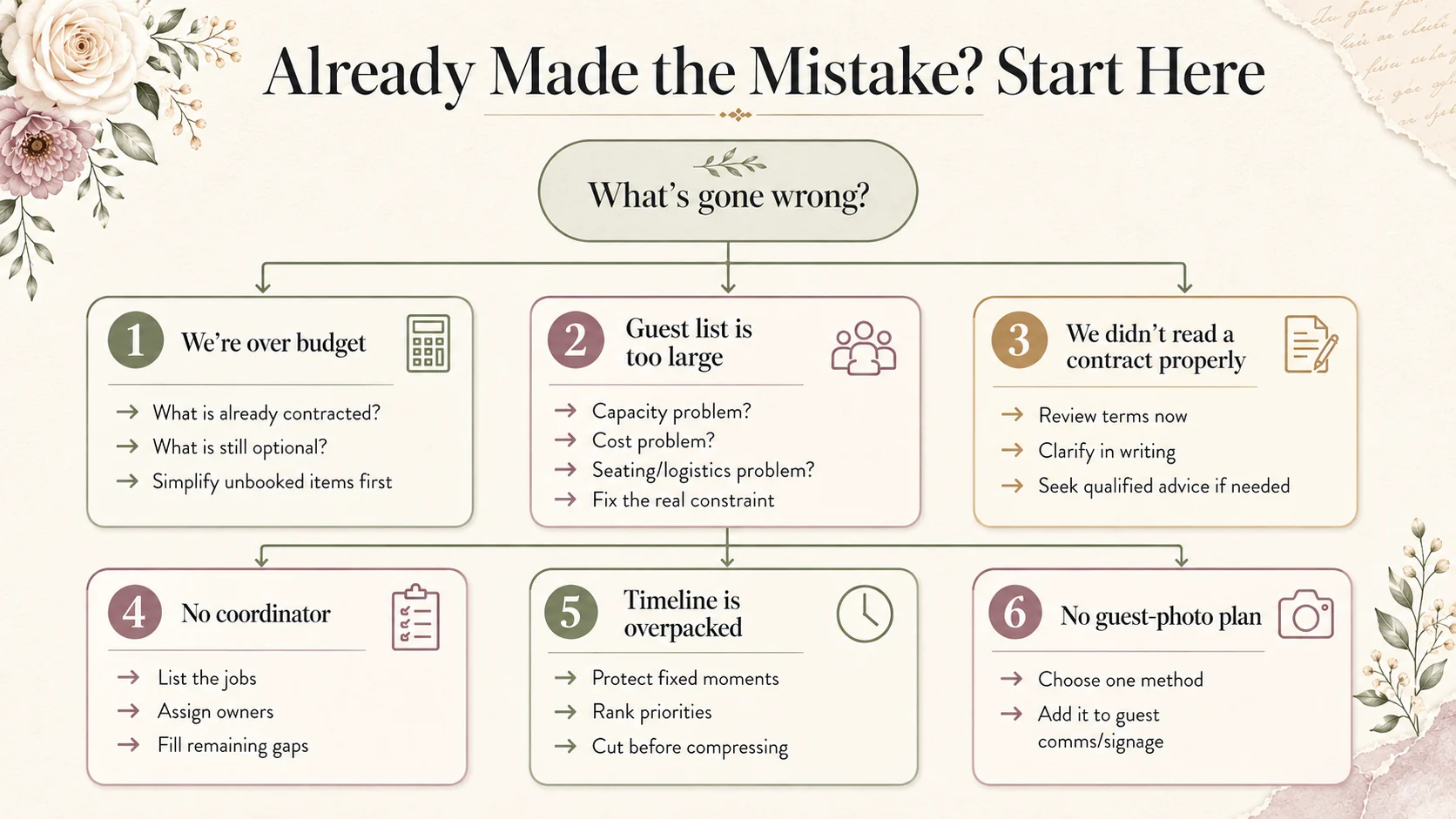
You do not need to rebuild the whole wedding because one decision is no longer ideal.
| Problem | What to do next |
|---|---|
| You're already over budget | List what you have already committed to, what still has to be paid, and what remains optional. Cut or simplify unbooked items before breaking contracts. |
| The guest list is too large | Work out whether capacity, catering, seating or total cost is the real problem before changing anything. |
| You signed a contract without reading it carefully | Read it now, flag anything unclear, and ask the vendor to clarify in writing. Get qualified advice for serious legal or financial concerns. |
| You have no coordinator | List the day-of responsibilities and assign each one. Hire help only if there are important gaps nobody else can realistically cover. |
| The timeline is overcrowded | Keep the fixed and highest-priority moments. Remove or shorten the rest rather than squeezing every transition. |
| You have no plan for guest photos | Pick a collection method before the final guest messages or signage are finished, then communicate it clearly. |
The useful question is not "Did we plan this perfectly?"
It is "What can we still improve without creating a bigger problem?"
Final No-Regrets Wedding Checklist
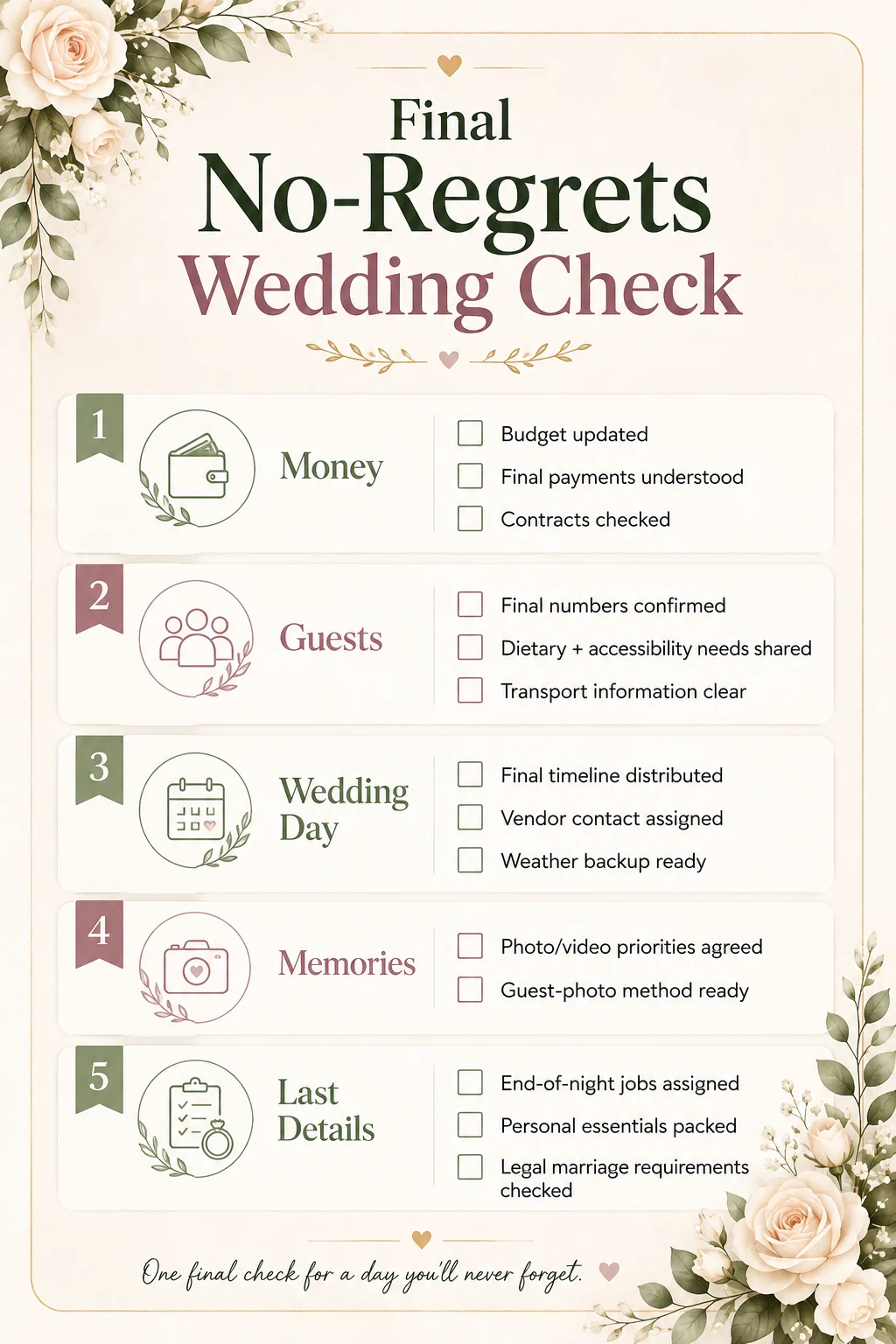
Before the wedding, confirm that:
- Your budget reflects what you have actually booked.
- Your guest numbers work with the venue and catering plan.
- Important contracts have been read.
- Guests have shared relevant dietary or accessibility needs.
- Everyone knows where to go and when.
- Transport and accommodation arrangements are clear where needed.
- Weather-dependent plans have a workable alternative.
- Vendors have one final timeline.
- Someone other than the couple can handle routine day-of questions.
- Photography and video priorities have been discussed.
- You have chosen a way to collect guest photos and videos.
- End-of-night responsibilities have been assigned.
- Personal essentials are packed.
- Legal marriage requirements have been checked through the appropriate authority for your location.
For the full planning process, use our wedding planning checklist and timeline.
Frequently Asked Questions
What are the biggest wedding planning mistakes?
The most consequential mistakes tend to involve the foundations: an unrealistic budget, an uncontrolled guest list, unsuitable venue logistics, unread vendor contracts, an overpacked timeline and unclear day-of responsibilities. Those decisions can affect several other parts of the wedding, which is why they are worth addressing early.
How can we avoid going over our wedding budget?
Start with the amount you can comfortably spend, then build the wedding around that figure. Track signed contracts, compare vendors using likely final cost rather than starting prices, and keep part of the budget uncommitted. Recalculate whenever the guest count or scope changes.
Do we need a wedding coordinator?
Not necessarily. Smaller or simpler weddings may work perfectly well without one. What you do need is clarity about who handles vendors, timing and unexpected logistical questions while you are occupied. If those responsibilities have no realistic owner, a coordinator may be worth considering.
What should we check before signing a wedding vendor contract?
Check what is included, payment dates, cancellation and rescheduling terms, additional fees, overtime, travel, setup and collection responsibilities, replacement arrangements and anything else important to the service. Ask questions before signing rather than assuming verbal conversations override the written agreement.
What wedding details are commonly forgotten?
End-of-night logistics, transport, dietary requirements, accessibility, vendor contact details, final payments, legal paperwork, personal essentials and plans for collecting guests' photos are all easy to overlook because they sit between the bigger planning decisions.
How can we collect wedding photos from guests?
Choose one method and communicate it clearly. Shared albums, cloud storage and QR-code photo galleries can all work. QR-code services such as Guestreel let guests open an upload page from their phone browser, which removes the need to download another app.
Focus on the Decisions That Are Hard to Undo
A good wedding plan does not remove every surprise. It gives the important parts enough thought that a small surprise does not take over the day.
Get the budget, guest list, venue, contracts and logistics right first. Decide what memories you want to preserve. Give someone else permission to handle minor problems while you are busy getting married.
Then allow the wedding to be a wedding rather than a project that still needs managing right up to the last dance.