A birthday party doesn't need a packed schedule. It needs a few things people actually want to do, and a plan for the awkward moments when a game finishes early or not everyone wants to join in.
For young children, try a bubble station, a picture-clue treasure hunt or freeze dance. Tweens and teenagers may prefer puzzles, creative challenges and music games. Adults often have more fun with birthday trivia, shared stories or a relaxed activity they can dip into between conversations.
Below you'll find ideas for different ages, instructions you can use on the day, and two sample schedules. Choose the activities that suit your guests; there's no need to run all of them.
Best Birthday Party Activities at a Glance
| Activity | Best for | Space | Play time | Main supplies |
|---|---|---|---|---|
| Bubble station | Ages 2-5 | Outdoors | 10-15 min | Solution, wands |
| Birthday art mural | Ages 2-5 | Either | 15-20 min | Paper, crayons |
| Freeze dance | Ages 4-9 | Indoors | 10-15 min | Music |
| Picture-clue treasure hunt | Ages 5-9 | Either | 20-30 min | Printed clues |
| Cupcake decorating | Ages 6+ | Indoors | 20-30 min | Cupcakes, toppings |
| Drawing telephone | Ages 10+ | Indoors | 15-20 min | Paper, pencils |
| Mystery-envelope challenge | Ages 10+ | Either | 20-30 min | Puzzles, envelopes |
| Music guessing game | Teens, adults | Indoors | 15-20 min | Music, answer sheets |
| Birthday-person trivia | Teens, adults | Either | 15-20 min | Questions, pens |
| Lawn game stations | Mixed ages | Outdoors | Flexible | Games, open space |
| Photo scavenger hunt | Older kids, adults | Either | 20-30 min | Phones, prompt cards |
| Birthday wishes station | Mixed ages | Either | Ongoing | Cards, pens |
Times are planning estimates, not measured averages. Allow more time for large groups, explanations and transitions.
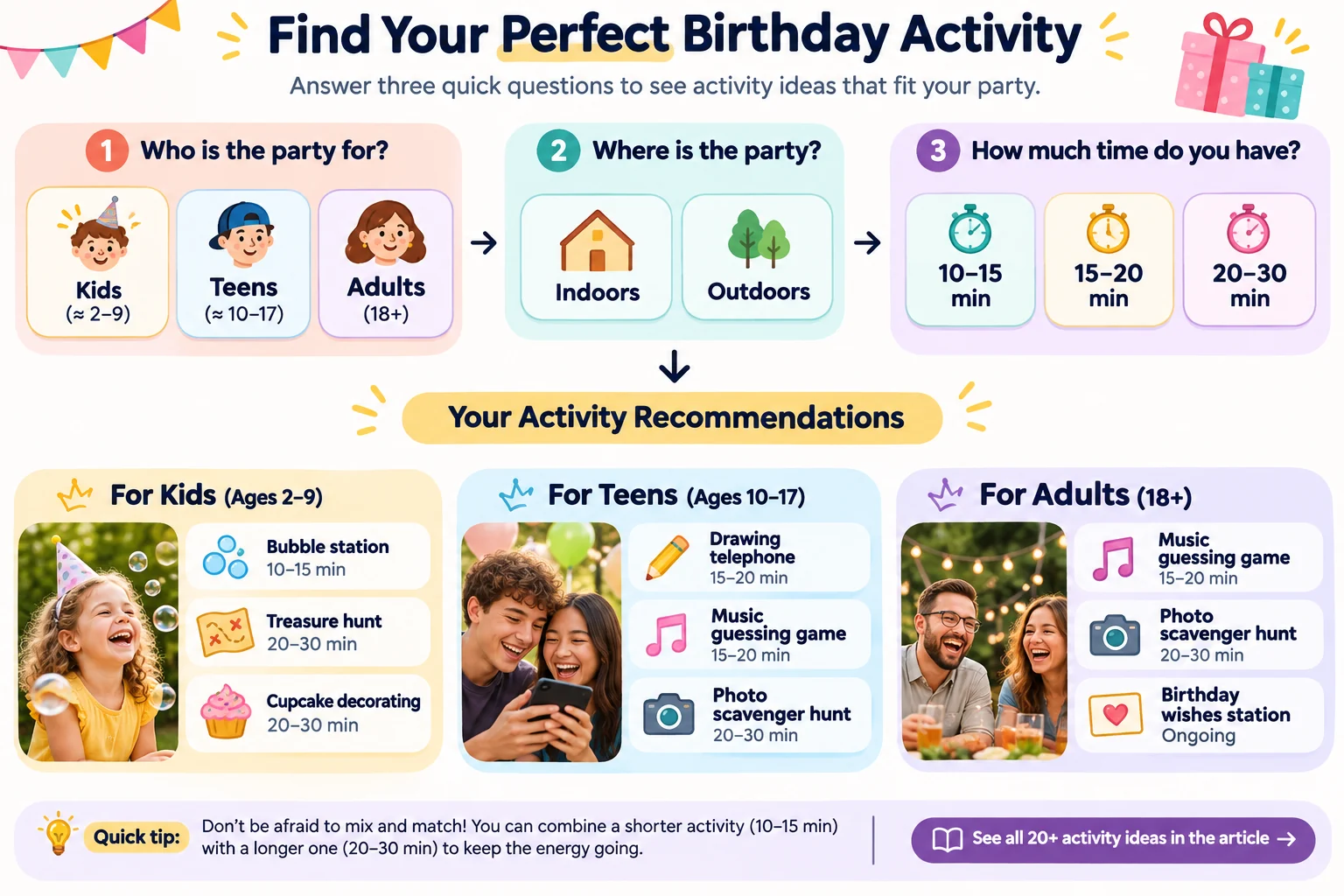
If you're short on planning time, pick one arrival activity, one group activity and one quieter option. Add a backup game, then leave space for cake, food and conversation.
How to Choose Activities Guests Will Enjoy
Start with the birthday person. A child who loves making things may prefer a craft table to musical chairs. A teenager who dislikes being the center of attention probably won't enjoy a game that requires a solo performance.
Next, ask yourself three questions:
- Who is coming? Consider ages, interests, accessibility needs and whether guests already know one another.
- What does the venue allow? A small flat suits seated games; a backyard can accommodate relay races and several stations. Check the weather and the noise level you can reasonably manage.
- How much structure does the party need? Children's gatherings often benefit from short, guided activities. Adults may prefer just one optional game and plenty of unplanned time.
For a mixed group, avoid games where half the guests spend their time watching. Set up two or three stations so people can join at their own pace, or change the rules so no one gets eliminated.
Don't overlook preparation. A fifteen-minute game that takes an hour to assemble may not be worth it when you're also handling food, decorations and guests. For the wider to-do list, use Guestreel's birthday party planning checklist.
Birthday Party Activities for Ages 2-5
Keep the instructions short and the activities flexible. Some children will participate immediately; others may want to watch first or stay close to a parent.
1. Bubble and Chalk Station
You'll need: Bubble solution, age-appropriate wands, chunky sidewalk chalk and a supervised outdoor area. Allow: 10-15 minutes or leave it open as an arrival station.
Draw a few large shapes on the ground and invite children to chase bubbles, follow the chalk paths or make their own drawings. Adults should handle the bubble solution for younger children.
This is a useful first activity because late arrivals can join without interrupting anyone. Clean up spills promptly and keep the area away from traffic and slippery surfaces.
2. Giant Birthday Mural
You'll need: A roll of paper, washable crayons, tape and table covering. Allow: 15-20 minutes.
Write the birthday child's name in the center of the paper. Guests can draw their favorite animals, a pretend birthday cake or a picture of themselves with the birthday person.
Leave the mural on a low table so children can return to it whenever they like. At the end, roll it up for the birthday child to keep.
3. Animal Parade
You'll need: A few animal picture cards and optional music. Allow: 10 minutes.
Hold up a picture and ask the children to move like that animal: waddle like penguins, stretch like cats or tiptoe like mice. Let different children choose the next card.
There are no winners and no one gets knocked out. Children who don't want to move can help hold the cards or make the animal sounds.
Birthday Party Games for Ages 6-9
This is a good age range for recognizable games with a clear goal. Explain the rules once, demonstrate a round and begin before enthusiasm fades.
4. Picture-Clue Treasure Hunt
You'll need: Printed picture clues, envelopes and a small final surprise. Allow: 20-30 minutes.
Hide each clue where the previous one points. A drawing of a shoe might lead to the shoe rack; the next picture could lead to a bookshelf, then a flowerpot and finally the prize.
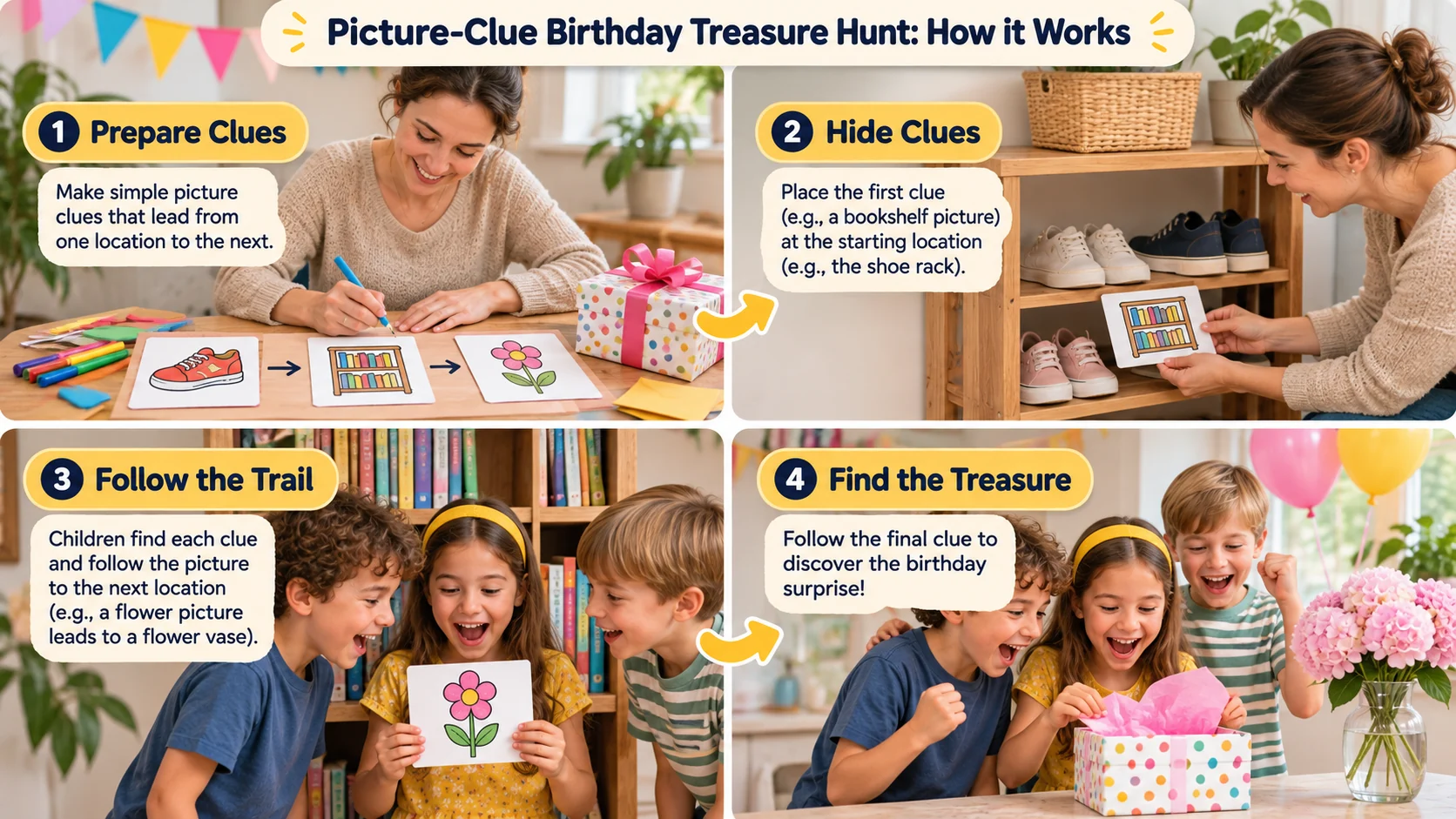
For a larger party, make teams and give each team a separate route. Keep all clues in supervised, accessible areas. If children are still learning to read, pictures are easier than written riddles.
5. Freeze Dance
You'll need: A playlist and enough clear space for everyone to move. Allow: 10-15 minutes.
Play music, pause it unexpectedly and ask everyone to freeze. Instead of sending movers out, give each round a new twist: dance like a robot, move in slow motion or strike a superhero pose.
The game stays lively, and nobody has to sit on the sidelines after one mistake.
6. Pass the Parcel
You'll need: A small age-appropriate prize, wrapping paper and music. Allow: 10-15 minutes.
Wrap the prize in several layers. Children pass it around a circle while music plays; whoever holds it when the music stops removes a layer. Continue until the last layer comes off.
If you want everyone to receive something, place suitable small rewards in some of the layers. Avoid tiny items around younger siblings, and consider arranging turns so no child is consistently passed over.
7. Cupcake Decorating
You'll need: Plain cupcakes, frosting, safe decorating tools and clearly labeled toppings. Allow: 20-30 minutes.
Bake or buy cupcakes in advance so the activity is about decorating, not waiting for an oven. Offer a couple of playful prompts: make a rainbow, invent a cupcake monster or decorate one for the birthday person.
Check allergies and dietary restrictions beforehand. Serve toppings separately and take care to avoid allergen cross-contact.
Creative Birthday Activities for Tweens (Ages 10-12)
Tweens often enjoy solving something together or making an item they can take home. Give them a challenge without turning the entire party into a competition.
8. Mystery-Envelope Challenge
You'll need: Four envelopes, simple puzzles and a final clue. Allow: 20-30 minutes.
Invent a small mystery: the birthday cake recipe has vanished, or someone has hidden the key to a pretend treasure chest. Each solved puzzle leads to the next envelope.
Use a mixture of picture riddles, letter codes and matching tasks. Give every team the same clues, and keep a hint card ready so no group gets stuck for too long. There's no need to lock anyone in a room.
9. Build-It Challenge
You'll need: Paper, cardboard, tape and a small object to test with. Allow: 20-25 minutes.
Give small teams the same materials and a goal, such as building the tallest freestanding tower or a bridge that holds a toy. Allow a few minutes for planning before anyone starts building.
At the end, ask the teams how they approached the problem. Recognize imaginative designs and clever teamwork, not just the structure that wins.
10. Drawing Telephone
You'll need: One sheet of paper and a pencil per person. Allow: 15-20 minutes.
Each guest writes a funny sentence, passes the paper along and has the next player draw it. Fold over the original sentence. The following player guesses what the drawing shows, folds that away and passes it on again.
Unfold the papers at the end to see how far the messages have wandered. Short, silly prompts work better than complicated ones.
Birthday Party Activities for Teens
Ask the birthday teen what they'll actually enjoy. It's perfectly fine if the answer is “music and somewhere to hang out.” Choose activities that add to the gathering rather than making it feel like a school assignment.
11. Guess the Song
You'll need: A speaker, a playlist and answer sheets. Allow: 15-20 minutes.
Play short clips and let small teams guess the song or artist. Include tracks the group knows, plus a round of the birthday person's favorites. Write the answers down rather than rewarding whoever shouts the loudest.
12. Five-Photo Story Challenge
You'll need: Phones, a prompt card and optional props. Allow: 20-30 minutes.
Give groups a theme (“our most ridiculous birthday adventure,” for example) and ask them to tell it in five photographs. The photos can be staged, candid or close-ups of objects.
At the end, each group arranges its pictures in order and shares the story if it wants to. Agree on photo-sharing boundaries beforehand, especially when children are involved.
13. Customize Something
You'll need: Plain tote bags, fabric markers, patches or age-appropriate bracelet supplies. Allow: 25-40 minutes.
Set out a few examples, then let guests create their own designs while chatting. A relaxed making station works particularly well when not everyone arrives at the same time.
Don't choose a project that needs specialized equipment or hours of drying unless you've planned for it.
For a milestone celebration, Guestreel's 16th birthday party guide offers more age-specific planning ideas.
Birthday Party Activities for Adults
Adult birthdays rarely need a host announcing the next game every fifteen minutes. One activity that gets people laughing or sharing a story can be enough.
14. How Well Do You Know the Birthday Person?
You'll need: Ten questions, pens and paper. Allow: 15-20 minutes.
Ask about the birthday person's first job, favorite trip, unusual habit or long-standing ambition. Mix easy questions with ones that reveal a story, and let guests play in pairs if they don't all know each other.
The answers are usually more interesting than the score. Leave room for the birthday person to explain a few of them.
15. Match the Memory
You'll need: Old photographs or written memories, numbered cards and an answer sheet. Allow: 15-25 minutes.
Choose pictures from different years or collect short, anonymous memories from willing guests. Ask everyone to guess when each photograph was taken or who shared each memory.
For a 40th, 50th or 60th birthday, this can bring several generations into the conversation without requiring anyone to give a speech.
16. Mystery Tasting
You'll need: A small selection of clearly identified food or non-alcoholic drinks, tasting cups and answer cards. Allow: 15-20 minutes.
Let guests guess fruit juice flavors, chocolate varieties or an assortment of herbs and spices. Use separate utensils and make ingredient and allergen information available before anyone participates.
Keep the challenge lighthearted. Guests should always be able to decline a sample without missing out on the rest of the party.
17. Make a Group Keepsake
You'll need: A large sheet or canvas, pens or paint markers and a protective table covering. Allow: 20-30 minutes, or leave it available all evening.
Ask guests to contribute a small drawing, a sentence or a memory. You could theme it around places the birthday person loves or a shared group joke.
The result won't be perfectly polished, and that's part of the appeal. It's a record of the people who were there.
If cost is your main constraint, see these low-budget birthday ideas for adults.
Birthday Activities for Small Spaces, Backyards and Tight Budgets
You don't need three separate sets of games. Many activities can be adjusted to fit the space you have.
In a Small Room
Try birthday bingo, charades, drawing games or a board-game table. Keep one clear walkway and avoid activities where players need to run. If the group is large, use small teams instead of making everyone compete individually.
In a Backyard or Park
Set up two or three stations: beanbag toss, ring toss and a simple relay with no obstacles to jump over. Guests can rotate without waiting through long turns. Check the ground and weather before introducing active games.
With Almost No Supplies
Play 20 Questions, Would You Rather, Simon Says or a group story game where everyone adds one sentence. These work well as backups when a craft finishes early or outdoor plans change.
Here's a quick rain-plan swap:
| Outdoor plan | Indoor alternative |
|---|---|
| Relay race | Timed tabletop building challenge |
| Outdoor treasure hunt | Picture-clue hunt around safe rooms |
| Lawn game stations | Drawing or board-game stations |
| Sidewalk chalk art | Shared paper mural |
If guests are having a good time talking, drawing or playing independently, you don't need to interrupt them just because the schedule says another game is next.
Activities That Create Birthday Memories
Some of the nicest party activities leave the birthday person with something to look back on: a funny photograph, a message from a friend or a keepsake made together.
18. Set Up a Simple Photo Booth
Choose a bright spot, hang a backdrop and put out a few props. A phone on a tripod with a timer is enough; you don't need elaborate equipment.
Keep the booth somewhere guests can drop in throughout the party. A sign with the birthday person's name or age makes it feel personal, but don't require everyone to pose.
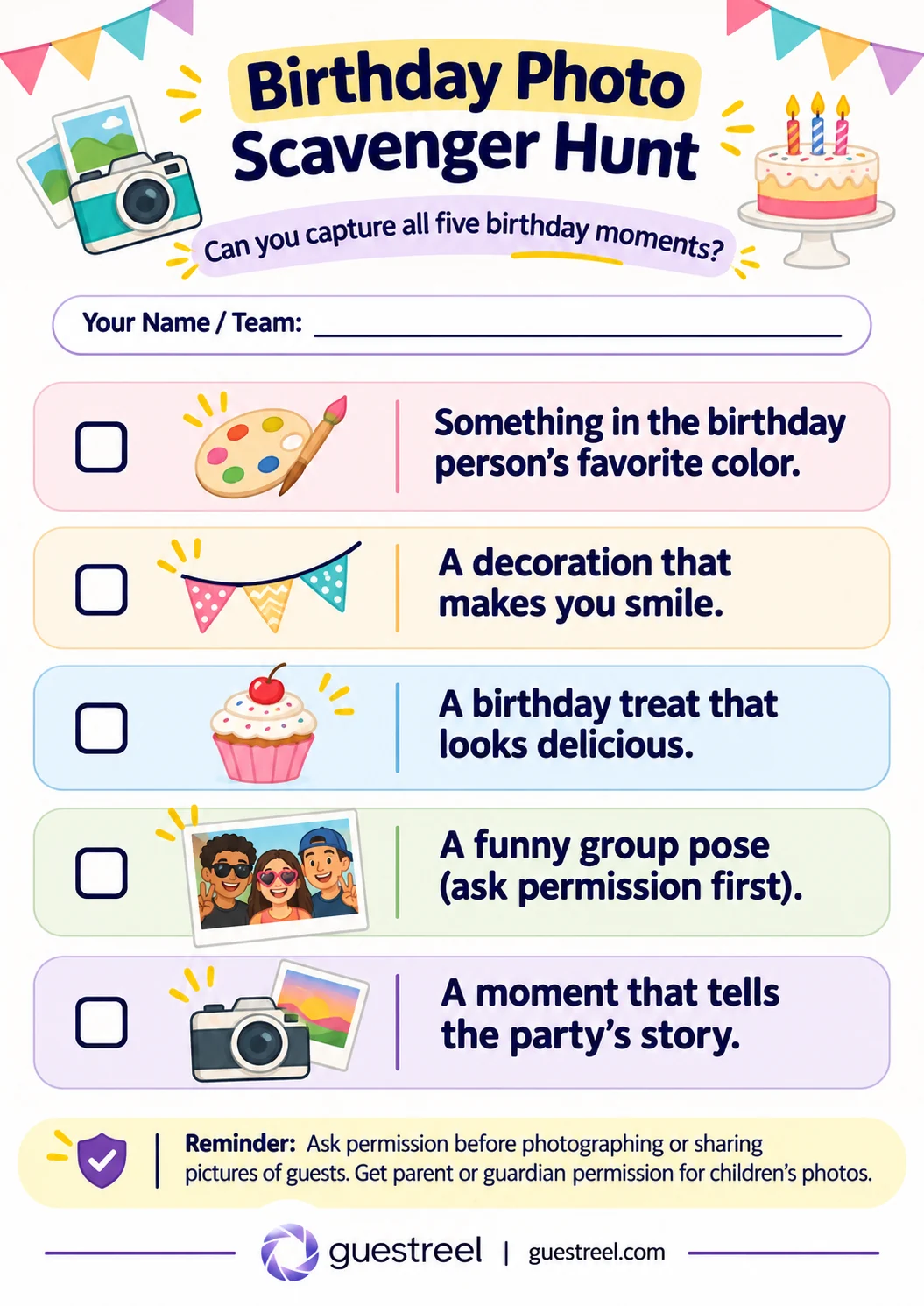
19. Run a Birthday Photo Scavenger Hunt
Give guests a list of things to photograph rather than collect. For example:
- Something in the birthday person's favorite color.
- A decoration that makes you smile.
- The most creative cupcake.
- A funny group pose, with everyone's permission.
- One moment that tells the story of the party.
Let teams explore for 20-30 minutes, then invite them to share a favorite image. Younger children can team up with a parent or guardian who handles the phone.
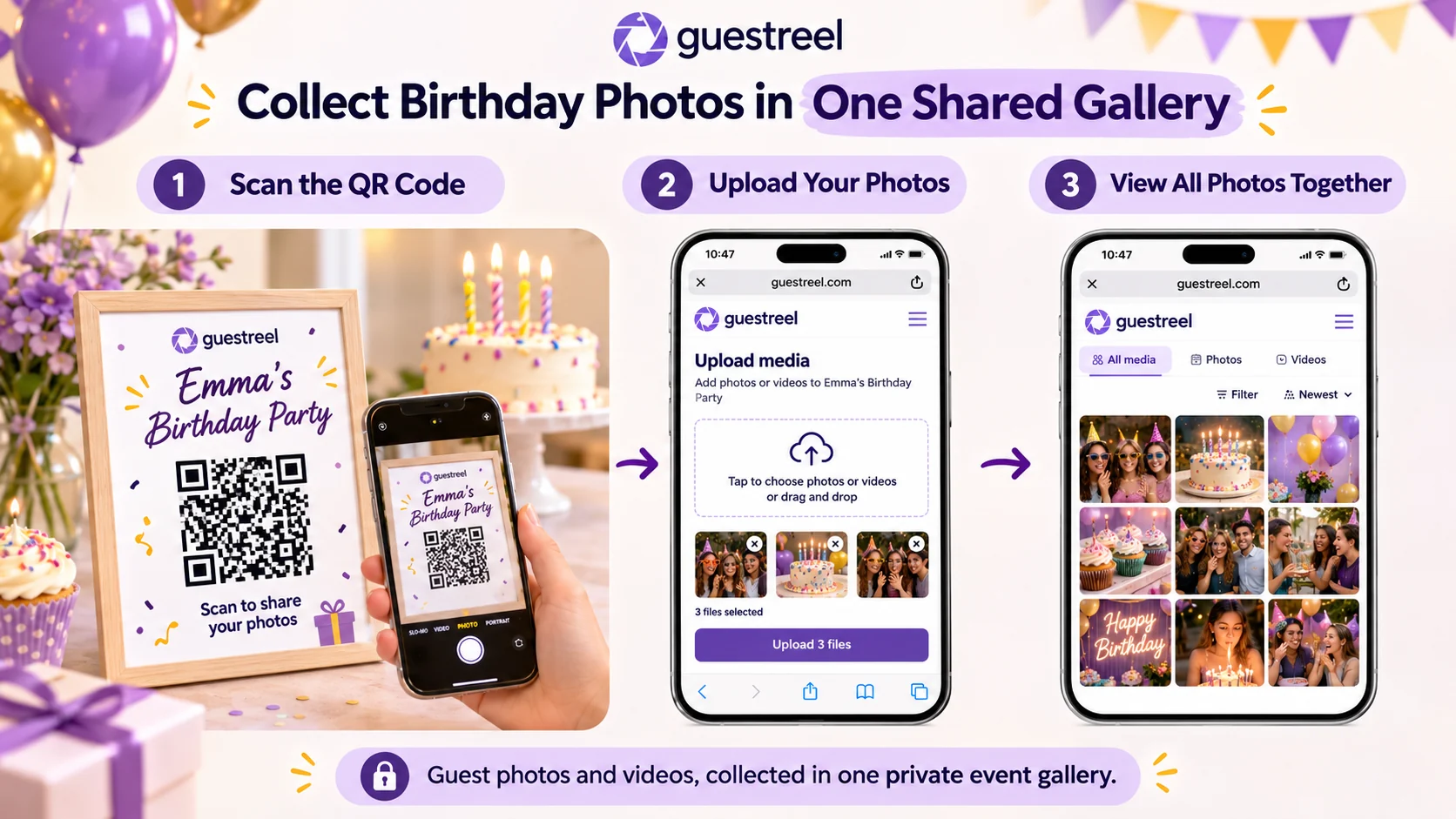
For a small party, asking guests to send photos afterward may be enough. If lots of people are taking pictures, Guestreel's birthday photo sharing lets them add photos and videos through one event QR code in their browser, without an app or account.
20. Make a Birthday Wishes Station
Put blank cards and pens on a table with prompts such as “My favorite memory with you is...” or “One thing I hope we do together is...”. Guests can write a note whenever they have a quiet moment.
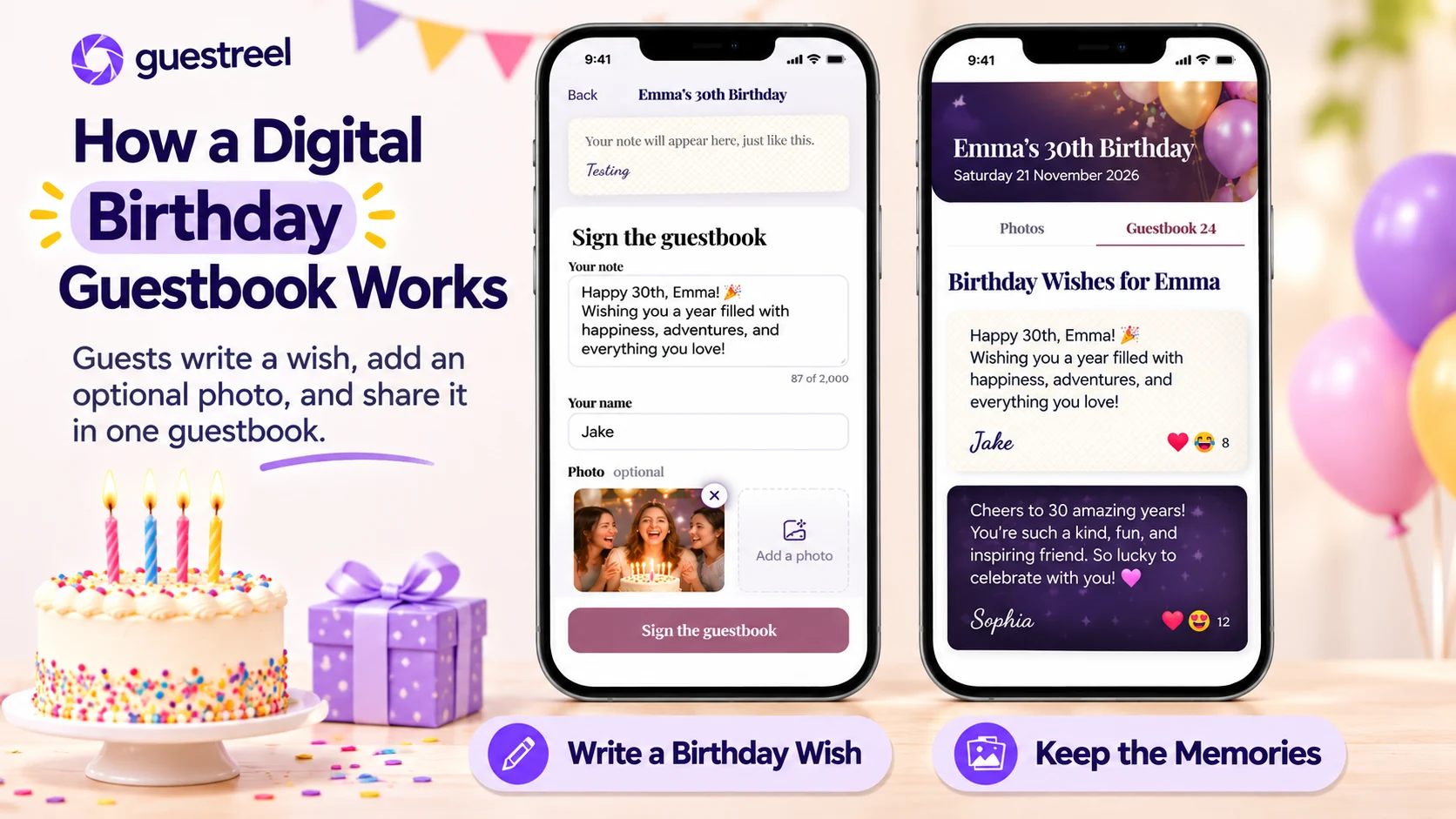
Keep the paper notes in a box or jar. If you prefer to collect messages digitally, Guestreel's digital guestbook supports written notes with optional photos and lets the host save a printable PDF.
Ask permission before photographing anyone, and get appropriate parent or guardian consent before sharing images of children.
How to Plan the Activities Without Overplanning
The schedule is there to help the host, not to make guests rush from one thing to another. Build in time for arrivals, food, cake and bathroom breaks.
The American Academy of Pediatrics suggests keeping toddler birthday parties under 90 minutes and planning flexible activities of roughly 10-15 minutes for young children. The first schedule below is deliberately shorter. Use your guests' needs, not the clock, to decide when to move on.
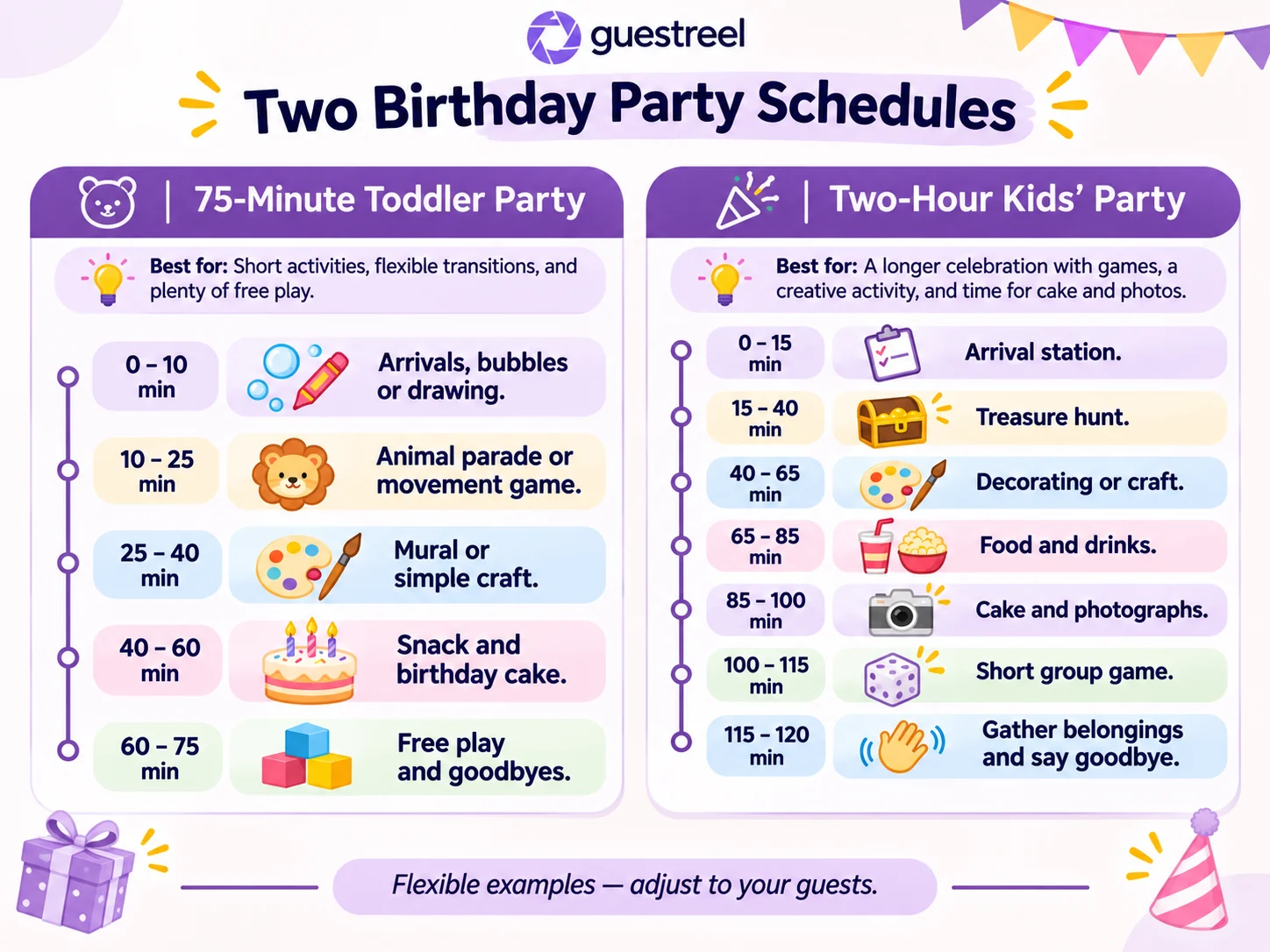
A 75-Minute Party for Toddlers
| Time | Plan |
|---|---|
| 0-10 min | Arrivals, bubbles or drawing |
| 10-25 min | Animal parade or movement game |
| 25-40 min | Mural or simple craft |
| 40-60 min | Snack and birthday cake |
| 60-75 min | Free play and goodbyes |
A Two-Hour Party for School-Aged Children
| Time | Plan |
|---|---|
| 0-15 min | Arrival station |
| 15-40 min | Treasure hunt |
| 40-65 min | Decorating or craft |
| 65-85 min | Food and drinks |
| 85-100 min | Cake and photographs |
| 100-115 min | Short group game |
| 115-120 min | Gather belongings and say goodbye |
For adults, a lighter plan usually works: arrivals and conversation, food, one optional group activity, then unstructured time together.
Set Up Zones That Make Sense
If you're hosting at home, it helps to give activities their own corners. Put the creative table away from food, leave an open area for movement, and offer somewhere quieter for anyone who needs a break.
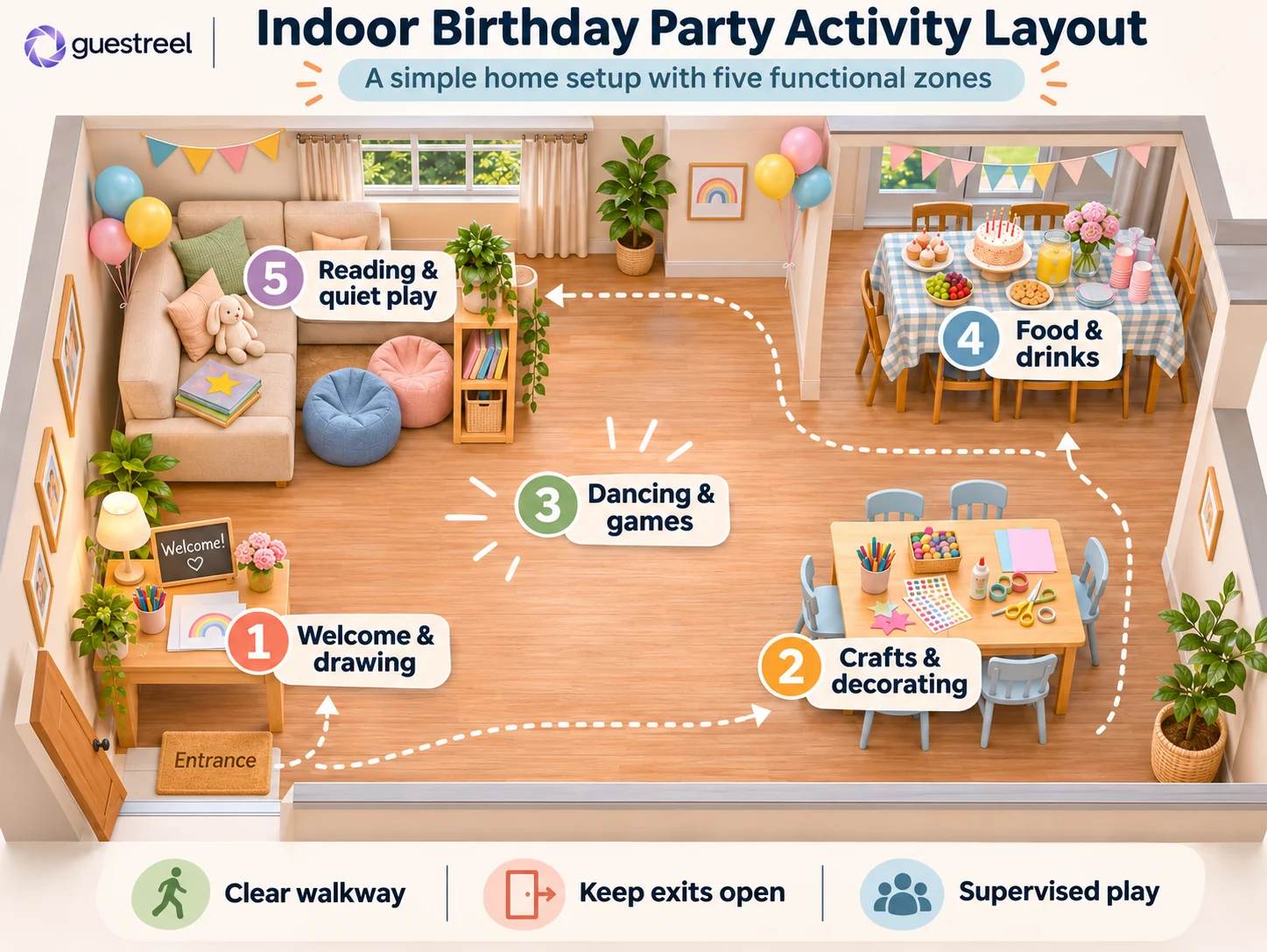
For children's parties, make sure adults know who is supervising each station. Keep exits and walkways clear and prevent spills around play areas.
Your Before-the-Party Checklist
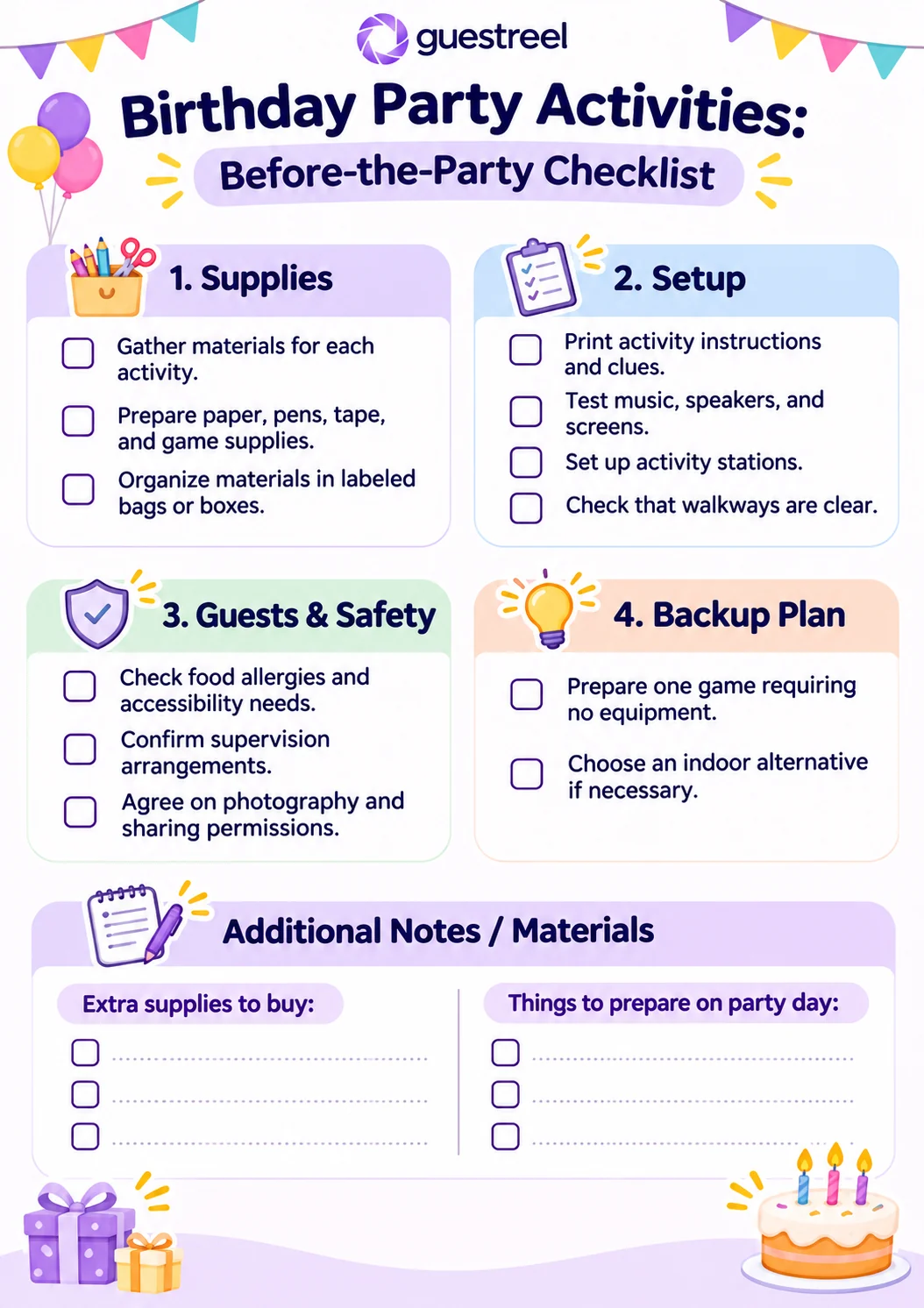
- Put supplies for each activity in a separate labeled bag or box.
- Test the music, speaker and any screen you plan to use.
- Print clues, answer sheets or instructions before guests arrive.
- Check food allergies, accessibility needs and supervision arrangements.
- Keep a quick no-equipment game available as a backup.
- Decide who will take photographs and how guests can share them.
A Few Safety Checks Worth Making
Match supplies and games to the youngest children who will be present, not just the average age of the guests. The U.S. Consumer Product Safety Commission advises keeping toys with small parts away from children under three and deflated balloons away from children under eight.
Use clear boundaries and adult supervision for active games. For food-related activities, ask about allergies and prevent ingredient cross-contact. If you're using face paint, choose products intended for skin and follow the FDA's cosmetic safety guidance.
A seated version, a quieter station or the option to watch is often all it takes to help another guest enjoy the activity.
Frequently asked questions
How many activities do you need for a two-hour birthday party?
For a two-hour children's party, two or three planned activities plus an arrival station are a sensible starting point. Leave time for food, cake and transitions. Adults often need much less structure; one optional shared game may be plenty.
What can you do when some guests don't want to play?
Let them opt out without making a fuss. A craft station, photo corner or quiet seating area gives people another way to take part. Avoid activities that require everyone to perform in front of a group.
How do you keep a large group from waiting around?
Split guests into smaller teams or set up several stations. Choose games where everyone acts at once, rather than taking one turn at a time. For children's parties, make sure there's enough supervision at each activity.
What are good last-minute birthday party games?
Charades, 20 Questions, Would You Rather and a group storytelling game need almost no setup. With paper and pencils, you can add drawing telephone or a quick birthday-person quiz.
How can you adapt birthday games for different ages?
Give younger players picture clues or simpler rules, and older players more challenging versions of the same task. Offer seated options and allow teams to work together. It's better to adapt a game than to insist every guest plays it the same way.
Keep the Party Fun, Not Over-Scheduled
Choose activities that suit the birthday person, the guests and the space. Prepare the essentials, have one backup plan and leave room for things to unfold naturally.
A treasure hunt may become the highlight of a child's party. At an adult birthday, it might be a funny trivia question that starts an hour of stories. You don't need to predict those moments. Give people a few good ways to connect, and let the celebration take it from there.
Written by Linda DoWrites Guestreel’s planning guides.