Class Reunion Ideas: Plan One Everyone Attends
The best class reunions are easy to say yes to. Start finding classmates 9 to 12 months ahead, pick a relaxed venue where people can actually talk, and give everyone a reason to come: name tags with old photos, a then-and-now display, and a few low-pressure activities that get old friends laughing again. The details matter less than making people feel welcome, whether they were class president or barely remember the cafeteria.
Most people decide whether to attend based on two questions: "Will anyone I know be there?" and "Will it be awkward?" Every idea below is aimed at answering both. It works for a 10-year high school reunion, a 50th college reunion, or a big family reunion where cousins have lost touch.
Find Your Classmates Early
The hardest part of any reunion is the guest list. People move, change names, and drop off social media. Give yourself time, and split the work across a small committee.
Build a Small Planning Committee
Three to six people is plenty. Try to include classmates from different friend groups (the athletes, the band kids, the theater crowd), because each one knows how to reach people the others never would. Give each person a clear job: the guest list, the venue, the budget, or the program.
Start With the Yearbook
Use the yearbook as your master list. Put every name into a shared spreadsheet with columns for current name, email, phone, city, and "found by." Then work outward:
- Social media groups. Create one private group for the class and ask everyone who joins to tag two people they still talk to.
- The school or alumni office. Many keep contact lists or will share your announcement in a newsletter.
- Word of mouth. Ask parents, siblings, and teachers. Small towns are surprisingly good at this.
Track Who Is Still Missing
Keep a visible "still looking for" list and share it in the group every few weeks. People love solving a mystery, and someone always knows where the quiet kid from homeroom ended up.
Your Class Reunion Planning Timeline
Reunions take longer to plan than most parties because so many people need to travel. Use this timeline as a starting point and adjust for your group size. If you have never organized an event this size, our guide on how to plan a party covers the basics of budgets and guest lists.
| When | What to do |
|---|---|
| 12 months before | Form the committee, set a rough budget, start the classmate list |
| 9 to 10 months before | Pick a date, book the venue, send a save-the-date |
| 6 months before | Open RSVPs and ticket sales, plan food and drinks |
| 3 to 4 months before | Book entertainment, collect old photos, plan the program |
| 6 to 8 weeks before | Send reminders, finalize the headcount, order name tags |
| 2 weeks before | Print signs and the photo display, confirm vendors |
| Day of | Set up the welcome table, run the program, collect everyone's photos |
| 1 to 2 weeks after | Share the photo album and thank-you note with the whole class |
Pick a Date People Can Make
Summer weekends and the weeks around Thanksgiving tend to work well, since many people are already traveling home. Avoid major holidays themselves. A quick poll in the class group with two or three date options saves a lot of back and forth.
Price Tickets Honestly
Decide early whether the reunion is ticketed, potluck, or pay-as-you-go. Keep the price as low as you can, and say clearly what it covers. A high ticket price is one of the most common reasons people quietly skip.
Choose a Venue That Lets People Talk
Reunions are about conversation, so pick a place where people can hear each other and move around freely.
Venue Ideas for Every Budget
- Your old school. A gym or cafeteria is nostalgic and often inexpensive. Ask about a campus tour before the party.
- A restaurant back room or brewery. Food and drinks are handled, and it feels relaxed.
- A park pavilion. Great for daytime reunions with partners and kids, and for family reunions.
- A hotel event space. Easier for classmates traveling in, and you can often reserve a block of rooms nearby.
Plan the Layout
Mix seating heights: a few tables for people who want to settle in, plus standing high-tops for mingling. Keep the music low enough to talk over. Put the photo display and the bar in different corners so people naturally drift around the room.
Name Tags, Then-and-Now Photos, and Displays
Nothing breaks the ice faster than a picture of who someone used to be.
Name Tags With Yearbook Photos
Print each person's yearbook photo on their name tag, with their name in large letters underneath (include maiden or former names in smaller type). Classmates will spend the first hour comparing faces. Leave a few blank tags and a marker for partners and late arrivals.
A Then-and-Now Photo Wall
Ask classmates to send one old photo and one recent one before the event. Print them side by side on a board or string them on a line with clothespins. For more layout ideas, our post on birthday party photo display ideas has setups that work just as well for a reunion.
Memory Tables and Old Artifacts
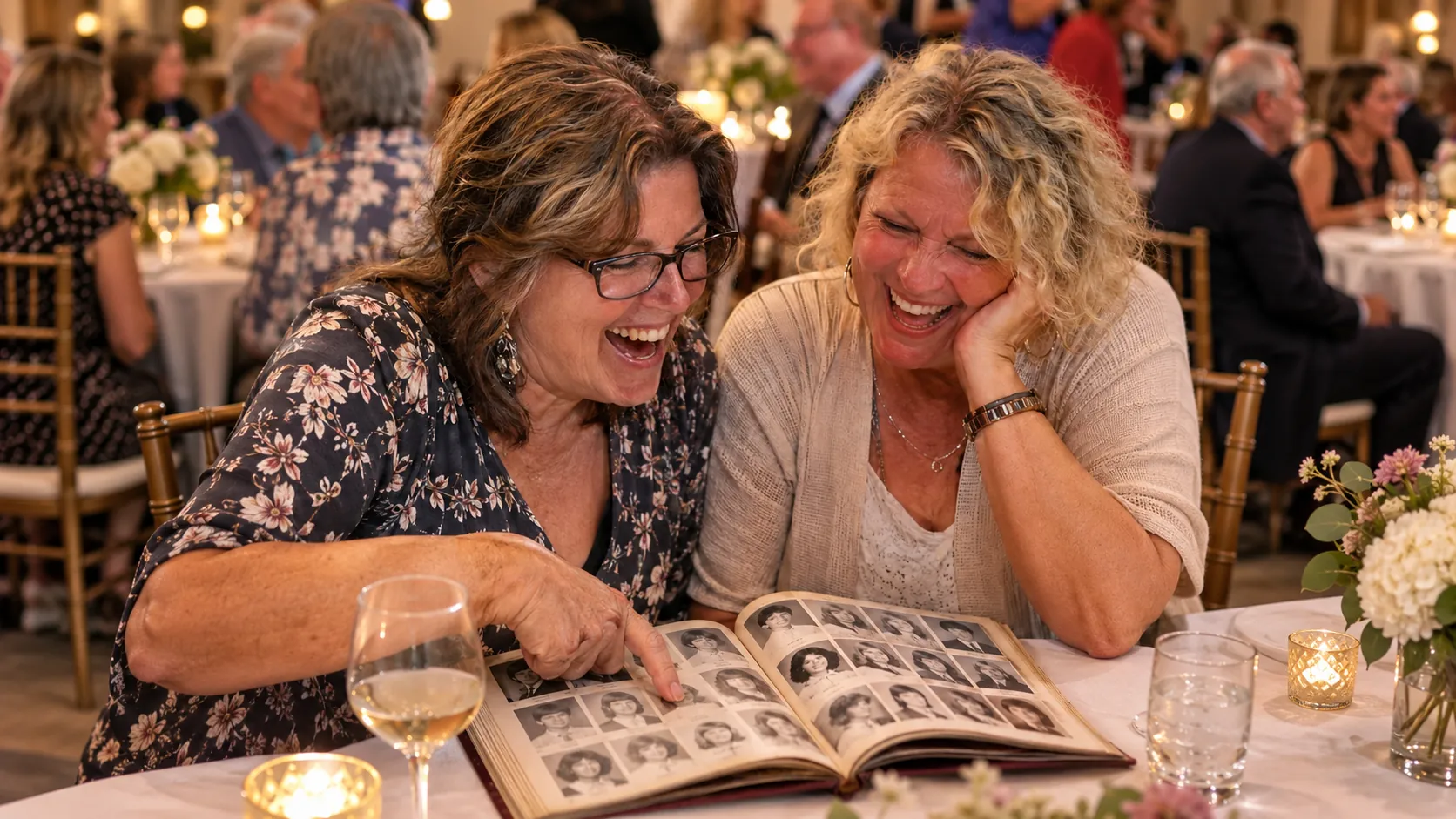
Set out yearbooks, old programs, team jerseys, prom photos, and the school newspaper. A memory table gives quieter guests a natural way to start a conversation ("Do you remember this?").
Reunion Activities and Icebreakers
Keep activities short and optional. Most guests mainly want to catch up, so think of activities as conversation starters, not a schedule.
Easy Icebreakers
- Classmate bingo. Squares like "moved more than 1,000 miles away," "still lives in town," or "married someone from our class." Guests find people who match.
- Guess who. Post baby photos or yearbook photos without names and let people guess.
- Superlatives revisited. Read the old "most likely to" list and invite people to share what actually happened.
Bigger Moments
- A short welcome. Two or three minutes from a committee member, thanking everyone for coming.
- A slideshow of old and new photos. Keep it under ten minutes and loop it in the background afterward.
- A campus or hometown tour. Walk past the old hangouts before or after the main event.
- Music from your graduation years. A playlist of the songs everyone knew instantly does a lot of work.
Family Reunion Variations
For family reunions, swap the yearbook for a family tree poster where relatives add their names and photos. Plan an activity that mixes generations, like a recipe swap, a lawn game tournament, or an interview corner where kids ask grandparents about their childhood.
Remembering Classmates Who Have Passed
Every reunion after the first few will include classmates who are no longer here. Handle this with care, and talk to the committee before deciding how.
Create a Quiet Memorial Space
A small table with photos, a candle, and a card for each person works well. Keep it to one side of the room, so people can visit it when they are ready without it setting the tone for the whole evening.
Contact Families First
If you plan to use someone's photo or say their name aloud, reach out to their family beforehand when you can. Some families appreciate being invited to the reunion, while others prefer privacy. Either answer is fine.
Keep the Words Simple
A brief moment during the welcome ("We are also remembering friends who could not be here tonight") is often enough. Let classmates leave written memories or messages at the memorial table rather than putting anyone on the spot to speak.
Collect Everyone's Photos, Old and New
At the end of the night, the photos are scattered across fifty phones, and most of them never get shared. Plan for this from the start.
Before the Reunion
Ask classmates to send their old photos ahead of time for the then-and-now wall and the slideshow. One shared upload link is much easier than gathering pictures over email and messages.
During the Reunion
Put a QR code on every table and at the welcome desk. With QR code photo sharing through Guestreel, classmates scan the code and add photos, videos, and a short guestbook note straight from their phone's browser. There is no app to download and no account to create, which matters when your guests range from tech-savvy to "can you just text it to me." Everything lands in one private album in original quality.
You can also show new photos as they come in on a TV or projector with a live picture wall. It quickly becomes the spot where people gather, point, and laugh.
After the Reunion
Classmates keep finding old photos in the weeks after a reunion. Depending on the plan, uploads stay open for 1, 14, or 30 days after the event, so people can add those prom pictures they dug out of the attic. If you want to keep things private, add a password and keep the gallery visible only to your class. When you are done, download everything in one click and share the album with the people who could not make it. The class reunion event page shows how it all fits together.
Frequently Asked Questions
How far in advance should you plan a class reunion?
Start 9 to 12 months ahead. That gives you time to track down classmates, book a venue before it fills up, and send a save-the-date early enough for people who need to travel. Smaller, local reunions can come together in 4 to 6 months.
How do you find classmates for a reunion?
Start with your yearbook and build a shared spreadsheet of names. Then use a private social media group, the school's alumni office, and word of mouth from friends, parents, and teachers. Keep a "still looking for" list and share it regularly so others can help.
What do you do at a class reunion?
Most of the time is spent catching up, so plan a relaxed setting with food and drinks. Add a few optional activities: yearbook-photo name tags, a then-and-now photo wall, classmate bingo, a short slideshow, and a playlist from your graduation years. A short welcome and a memorial moment round it out.
How do you get more people to come to a reunion?
Keep the ticket price low and explain what it covers. Share who has already RSVP'd, since people come when they know friends will be there. Reach out personally to classmates who are on the fence, and choose a casual venue so nobody feels they need to dress up or impress.
How do you honor deceased classmates at a reunion?
Set up a quiet memorial table with photos and a candle, placed to one side of the room. Contact families before using photos or names, and keep any spoken tribute brief. A card or guestbook where classmates can leave written memories is a gentle way to include everyone.
What is the difference between planning a class reunion and a family reunion?
A class reunion is built around shared school memories, so yearbooks and nostalgia lead the way. A family reunion spans generations, so plan activities for kids and grandparents together, like a family tree poster, a recipe swap, or outdoor games. Both benefit from early planning and one shared place to collect everyone's photos.