Choosing a wedding photographer is partly about loving their photos, but that is only the starting point. You also need someone whose work stays consistent across a full wedding day, whose way of working suits you, and whose contract, pricing and backup plans leave very little room for surprises.
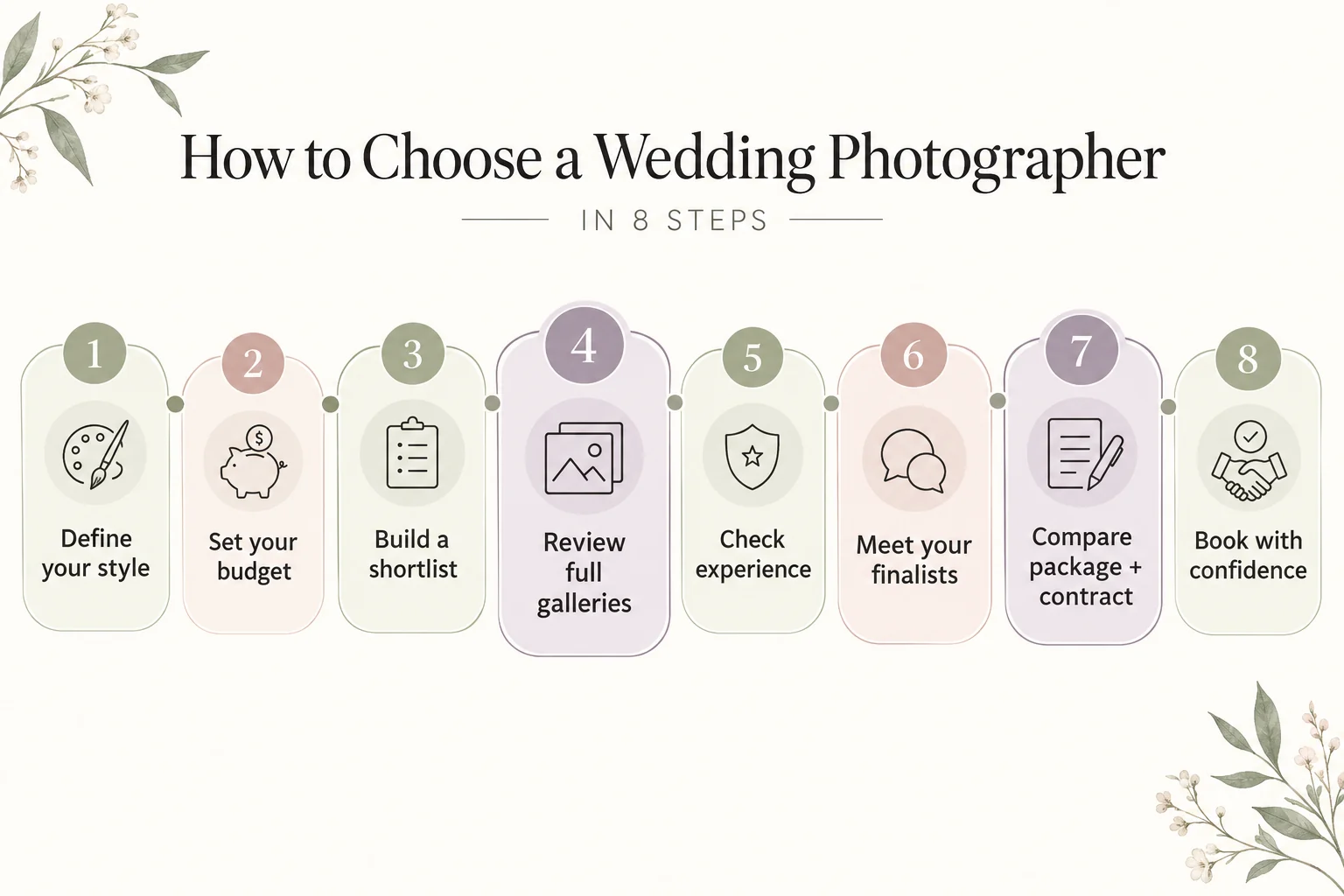
A good selection process looks like this:
- Work out which photography style you actually like.
- Set a realistic budget.
- Shortlist photographers whose work fits that brief.
- Review full wedding galleries, not only portfolio highlights.
- Check reviews, experience and backup arrangements.
- Meet your finalists and talk through how they work.
- Compare packages and contracts carefully.
- Choose the photographer whose work and process you trust.
Start With the Wedding Photos You Actually Want
Before searching for photographers, spend a little time looking at wedding photos without worrying about who took them.
Save the images you keep returning to. After 15 or 20, patterns usually start to appear. Perhaps you like unposed photographs where people barely notice the camera. Maybe you prefer polished portraits with deliberate composition. You might love bright colours and realistic skin tones but dislike heavily desaturated edits.
Three things are worth separating: shooting style, editing style and direction style.
Wedding Photography Shooting Styles
| Style | What it tends to look like | How the photographer often works | Best suited to couples who want |
|---|---|---|---|
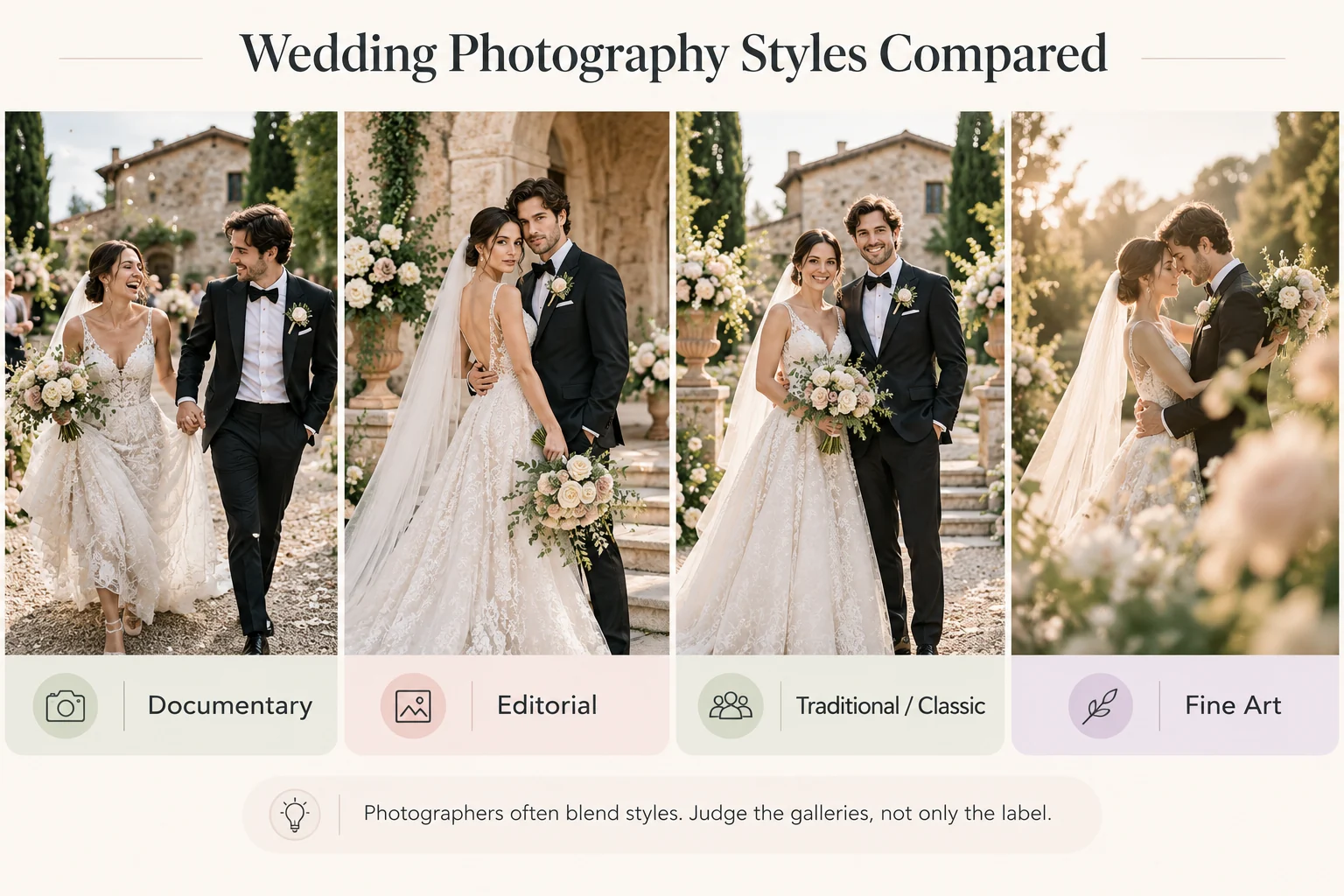
| Documentary / photojournalistic | Natural, candid and story-led | Watches rather than constantly directing | Genuine reactions and unscripted moments |
| Editorial | Polished, composed and fashion-influenced | Gives more direction | Striking portraits and magazine-style images |
| Traditional / classic | Timeless and structured | Organises key portraits and groups | Formal family photographs alongside candid coverage |
| Fine art | Romantic, carefully composed and visually refined | Pays close attention to light and composition | A more artistic interpretation of the day |
Plenty of photographers blend two or more approaches. The labels matter less than the actual galleries.
Look at Editing Separately
Shooting style describes how photographs are created. Editing determines how the finished images look.
You will commonly see approaches such as:
- True-to-colour: natural-looking colours and skin tones.
- Light and airy: bright exposure, softer contrast and lighter tones.
- Dark and moody: deeper shadows, richer colours and stronger contrast.
- Film-inspired: softer colours, grain or other characteristics influenced by analogue photography.
Do not judge editing from five sunset portraits. Look at what happens when the photographer moves indoors, photographs speeches under artificial light or reaches the dance floor after dark.
Think About How Much Direction You Want
Some photographers stay quietly in the background for most of the day. Others are comfortable taking charge, arranging groups and giving detailed posing direction.
Neither is inherently better.
If being photographed makes you nervous, more direction can be reassuring. If the thought of spending ten minutes perfecting every pose makes you uncomfortable, a more documentary photographer may suit you better.
Set a Realistic Photography Budget
Wedding photography prices vary considerably by country, location, experience, season, coverage and what comes with the package.
For context, The Knot's 2026 Real Weddings Study puts average professional wedding photography spend in the US at $3,000, based on couples who married in 2025. Bridebook's 2026 UK data reports an average of £1,484, with prices commonly ranging from £500 to £2,500.
Those numbers are useful reference points, not targets for your own wedding.
Two packages with similar prices can also contain very different things. When comparing quotes, check:
- coverage hours;
- who will actually photograph the wedding;
- whether a second photographer is included;
- engagement sessions;
- travel charges;
- overtime;
- albums and prints;
- digital delivery;
- gallery access;
- delivery times;
- image-use rights.
Compare the things you care about rather than the number of extras. An included album is not good value if you would rather put that budget towards longer coverage.
If photography is one part of a larger budget you are still building, our wedding planning checklist and timeline can help you see when photography and other major suppliers fit into the wider planning process.
Build a Shortlist Without Getting Lost in Instagram
Recommendations from recently married friends are a good starting point, as are photographers suggested by your planner or venue. Google, wedding directories and Instagram can help you find more options, especially if you search photographs tagged at your venue.
Try to shortlist photographers who are broadly comparable in style and budget. Otherwise you can end up deciding between entirely different approaches rather than between photographers.
Reviews are useful too, but the star rating alone tells you very little. Read recent reviews and look for recurring comments about:
- communication;
- organisation;
- how the photographer behaved on the day;
- comfort in front of the camera;
- delivery times;
- handling unexpected problems.
One unhappy review does not necessarily mean much. Repeated complaints about the same issue do.
Once someone looks promising, move beyond social media and inspect their actual wedding work.
How to Review a Wedding Photographer's Portfolio Properly
A photographer's homepage is usually a collection of their strongest images. That shows what they can create at their best.
What you really need to know is whether the quality holds up for eight or ten hours when the light, locations and pace keep changing.
Portfolio vs Full Wedding Gallery
A portfolio is a curated selection of photographs, often collected from many weddings.
A full wedding gallery contains a much broader set from one wedding, covering the different conditions the photographer faced throughout that day.
A portfolio answers:
Can this photographer create beautiful photographs?
A full gallery gets much closer to:
Can they do it consistently?
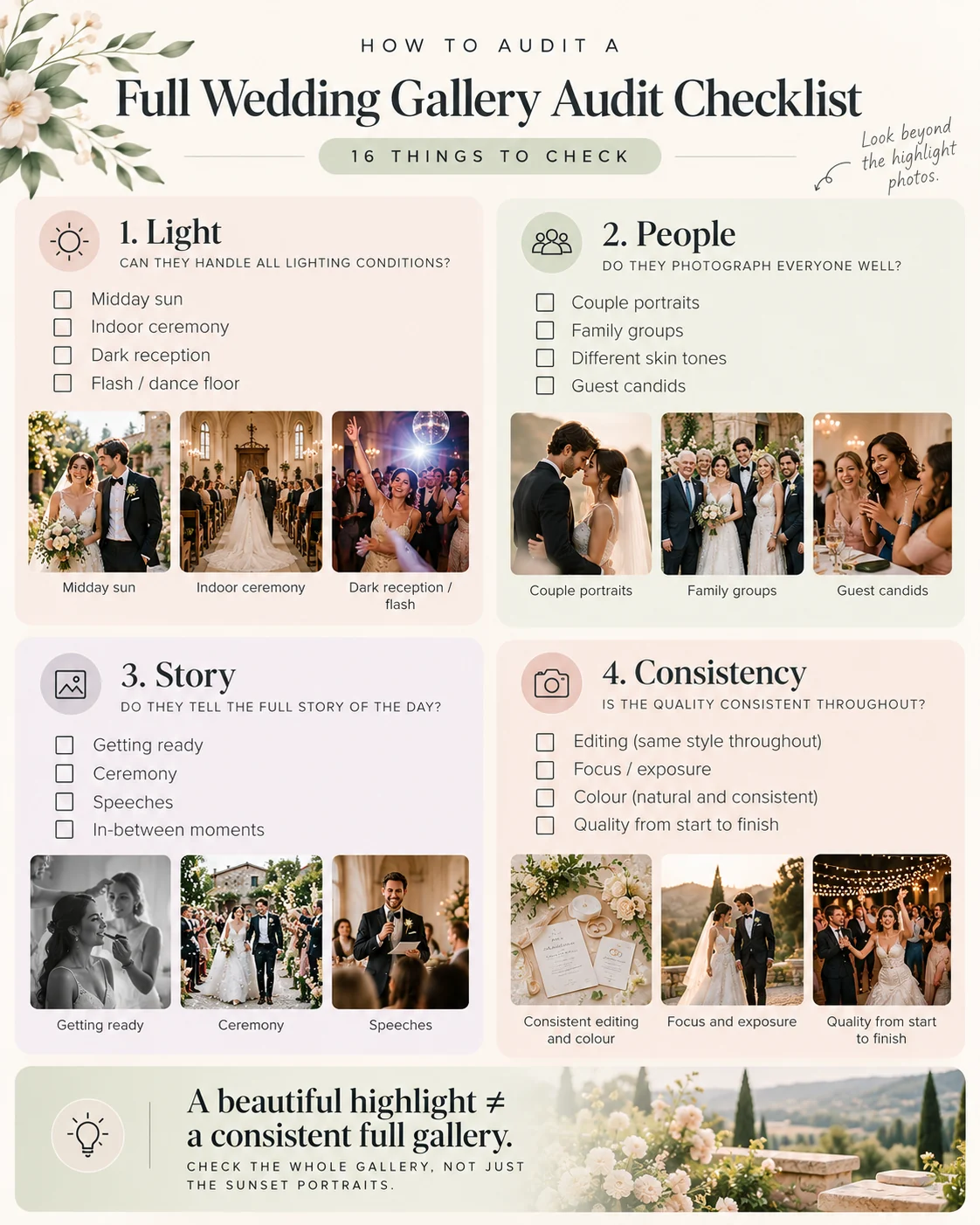
What to Inspect in a Full Gallery
Do not spend all your time on the couple portraits. Look at the less glamorous parts of the job too:
- getting-ready photographs in ordinary rooms;
- harsh midday sunlight;
- indoor or backlit ceremonies;
- family groups;
- different skin tones under the same lighting;
- guests rather than just the couple;
- wide venue photographs;
- speeches;
- dim reception spaces;
- flash photography;
- dance-floor images;
- small interactions between the headline moments.
A stunning golden-hour portrait tells you very little about how someone handles a dark reception room.
If your wedding will be in winter, inside a church, under a marquee or in another setting with challenging light, look for comparable work.
What If They Cannot Show a Full Wedding Publicly?
That is not automatically a problem.
Previous clients may not want hundreds of personal photographs available on a public website. Ask whether the photographer has a complete or near-complete gallery they have permission to show privately.
You need evidence of consistency, not access to somebody else's wedding.
Questions to Ask a Wedding Photographer Before Booking
A consultation is most useful when you get beyond the information already on the photographer's website.
You are trying to understand how they work when the day does not go perfectly.
| Question | Why it matters | What to listen for |
|---|---|---|
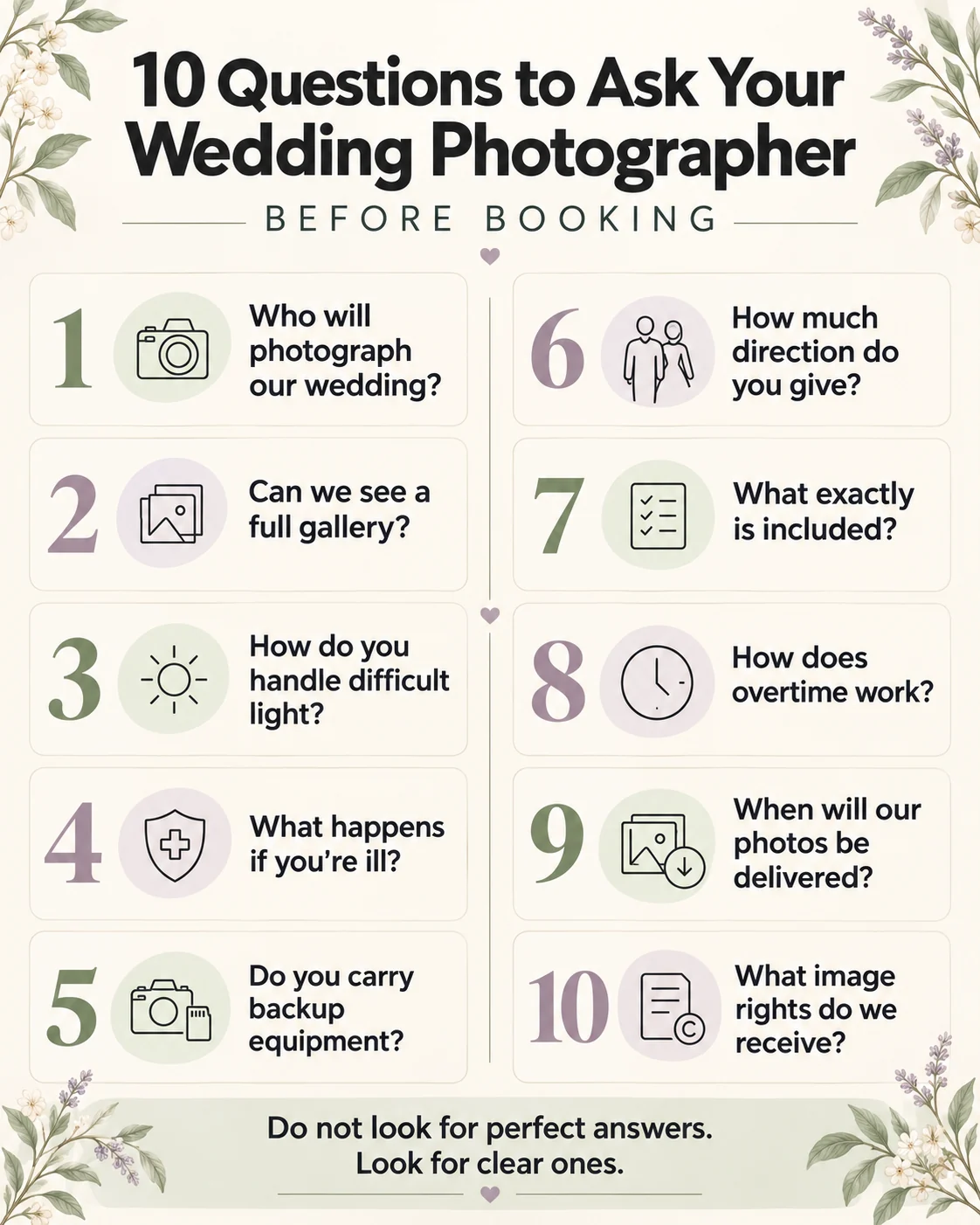
| Who will actually photograph our wedding? | Studios sometimes use associate photographers | A clear name or assignment process |
| Can we see a full wedding gallery? | Shows consistency | A representative wedding, ideally with similar conditions |
| How do you handle difficult light? | Receptions and ceremonies are not always beautifully lit | Confidence working indoors, with flash and in mixed light |
| What happens if you are ill? | Tests contingency planning | A clear replacement or backup process |
| Do you carry backup equipment? | Cameras and equipment can fail | Redundancy for essential equipment |
| How much direction do you normally give? | Changes how being photographed feels | An approach that matches your preference |
| What is included in this package? | Prevents misunderstandings later | Clear written inclusions and extras |
| How is overtime handled? | Weddings often run late | A defined process and price |
| When will we receive the photographs? | Sets expectations | A clear delivery process and timeframe |
| What rights do we receive? | Affects printing and sharing | Clear personal-use or other licence terms |
| How long will our gallery remain available? | Online storage may not be permanent | A stated access period |
You are not looking for rehearsed "correct" answers. You are looking for clear answers that make sense for your wedding.
Pay Attention to How It Feels to Work With Them
Photography is unusually personal. Your photographer may be in the room while you get ready, beside you during family photographs and only a few metres away during some of the most emotional moments of the day.
Notice how the consultation feels.
Do they listen before offering an opinion? Do they ask what matters to you? Can they explain limitations without becoming defensive? Do you feel comfortable telling them that you dislike a particular type of photograph?
Communication before booking is not a perfect test of what someone will be like on the day, but repeated confusion or vague answers are worth paying attention to.
Wedding Photographer Red Flags, and What Isn't Necessarily One
Wedding advice online can turn every minor difference into a warning sign. In reality, some situations are genuine reasons for concern and others just need another question.
| Situation | How seriously to take it | What to do |
|---|---|---|
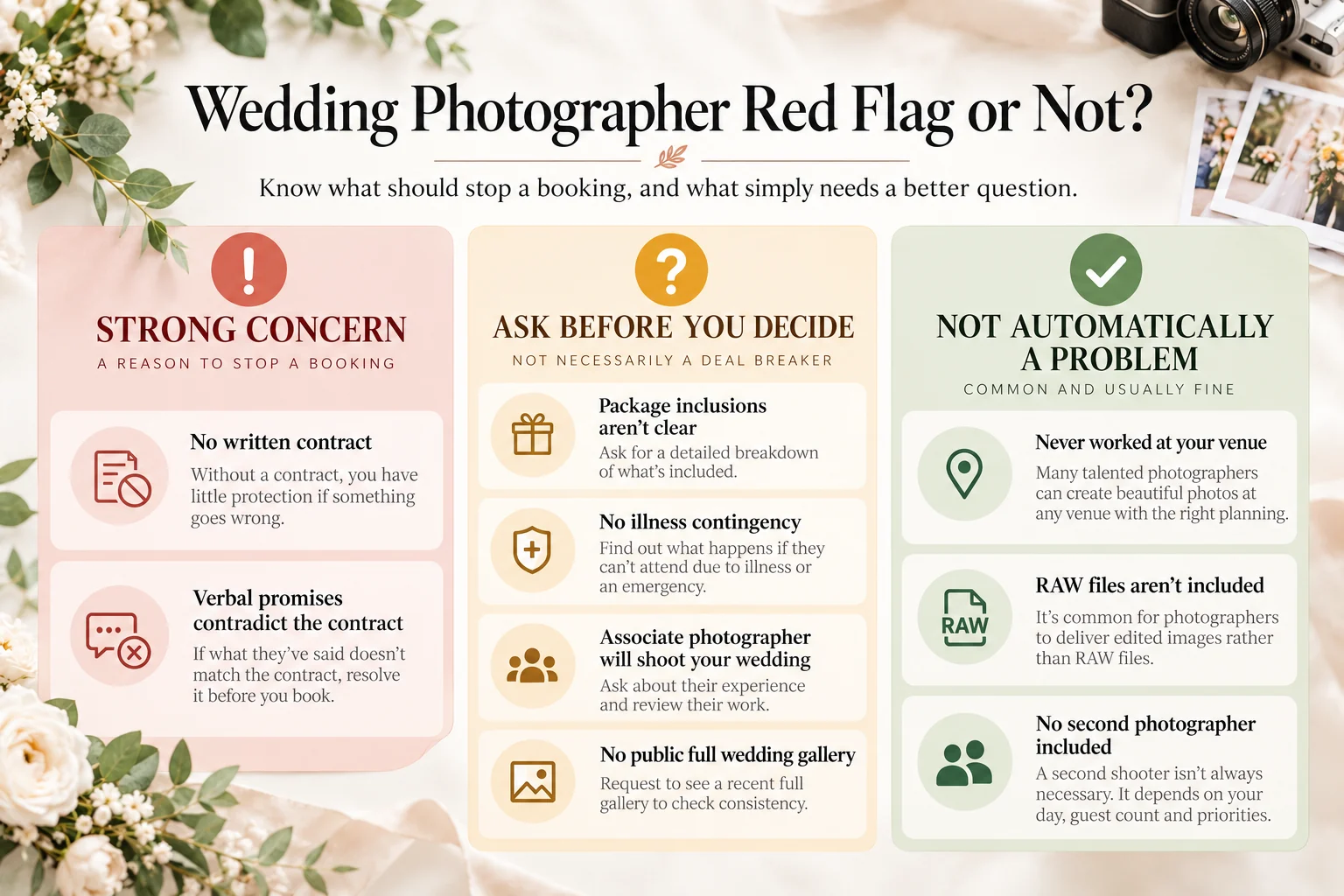
| No written contract | Strong concern | Do not rely on verbal promises |
| Package inclusions are unclear | Concern | Ask for an itemised written explanation |
| No clear contingency if they cannot attend | Investigate carefully | Ask exactly what happens |
| Verbal promises contradict the contract | Strong concern | Resolve them before signing |
| No public full gallery | Not automatically a problem | Ask to see a private representative gallery |
| They have never worked at your venue | Not automatically a problem | Ask how they prepare for new locations |
| RAW files are not included | Usually normal | Confirm what finished files you receive |
| An associate will photograph the wedding | Not automatically a problem | Review that person's work |
| No second photographer is included | Not automatically a problem | Decide whether your timeline needs one |
Venue familiarity can help, but it should not outrank photographic skill. An experienced professional should be able to assess an unfamiliar location and adapt.
The same applies to RAW files. Many photographers regard the edited images as the finished product, so concentrate on what you will actually receive and whether that matches your expectations.
How Many Hours of Wedding Photography Do You Need?
There is no universal answer. Start with the moments you want photographed and build the coverage around your timeline.
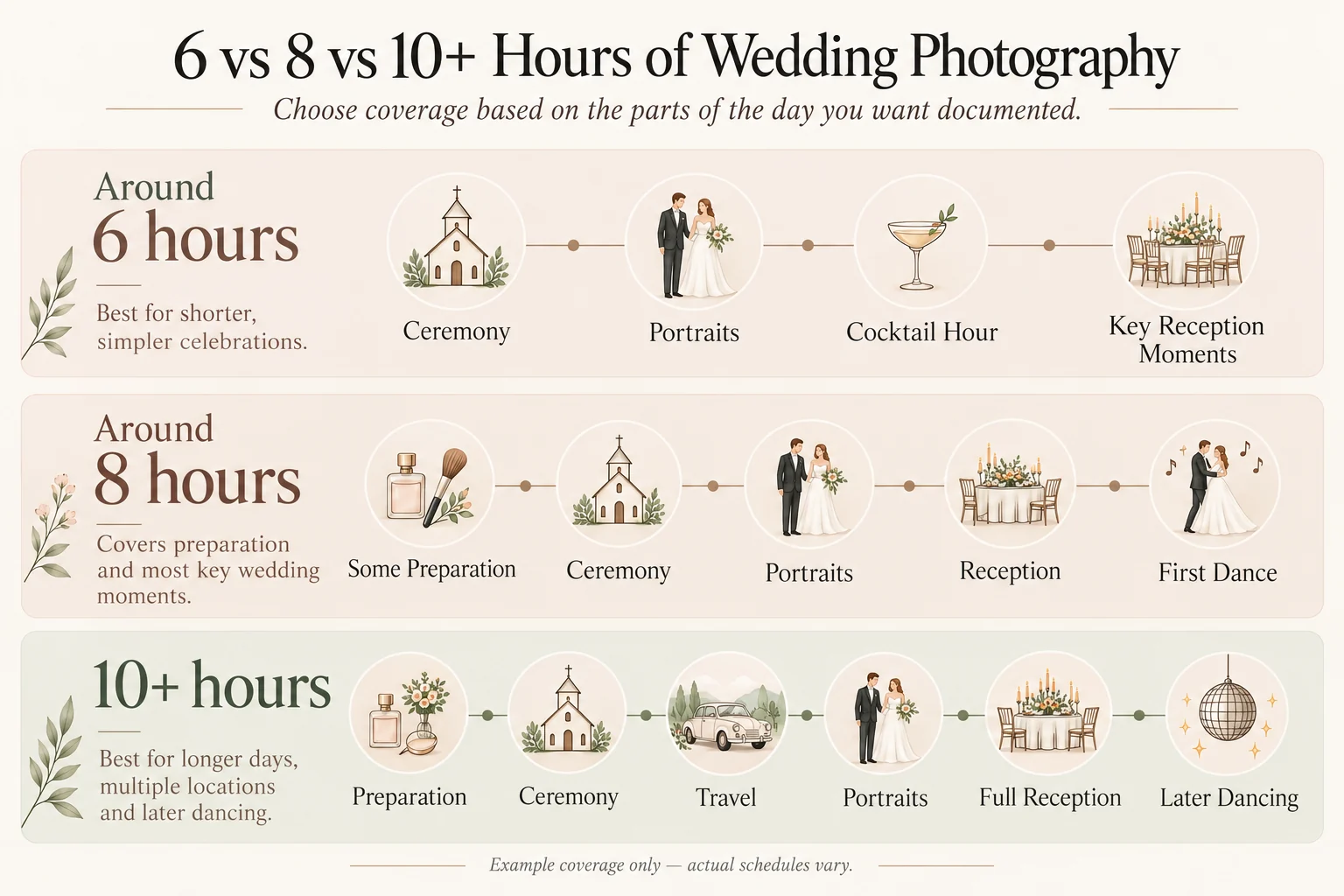
| Example | May work well for | Likely priorities |
|---|---|---|
| Around 6 hours | Shorter or simpler celebrations | Ceremony, portraits and key reception moments |
| Around 8 hours | Many full wedding days | Some preparation through the main reception events |
| 10+ hours | Long or multi-location weddings | More preparation and later evening coverage |
These are examples, not package recommendations.
Think about whether you want both partners getting ready photographed, how much travel is involved, whether you want the reception room before guests enter and how long you want dance-floor coverage.
Then ask photographers how they would cover that particular timeline.
Do You Need a Second Photographer?
A second photographer is most valuable when two useful photographs need to be made at the same time.
That might include both partners preparing in different locations, two ceremony perspectives, large venues or complicated schedules where one photographer cannot reasonably move between everything.
For a smaller wedding taking place largely in one location, the extra coverage may matter much less.
Instead of deciding from guest count alone, ask your lead photographer a simple question:
What would a second photographer capture at our wedding that you could not?
Their answer should make the value much clearer.
What Should Be in a Wedding Photography Contract?
Read the contract before paying a retainer, and compare it with everything you were told during the consultation.
Depending on the photographer and jurisdiction, relevant details may include:
- wedding date and locations;
- photographer or photography company;
- coverage hours;
- package deliverables;
- payment schedule;
- retainer or deposit terms;
- cancellation and postponement;
- what happens if the photographer cannot attend;
- travel and overtime charges;
- delivery timeframe;
- image-use permissions;
- marketing permissions;
- albums or prints;
- online gallery availability.
If something influenced your decision to book, it is reasonable to check that the written agreement reflects it.
Who Owns Your Wedding Photos?
Paying for photography does not necessarily transfer copyright to the couple.
In the United States, the photographer is generally the initial copyright owner, subject to legal and contractual exceptions. UK guidance likewise generally treats the creator as the first copyright owner, although circumstances can change that position.
What matters to most couples is the licence included in the contract: can you download the images, print them, share them online and send them to family?
Copyright law varies by jurisdiction, so use official guidance or qualified legal advice if you have a specific legal concern.
How to Choose Between Two Wedding Photographers
Sometimes the difficult part is not finding a good photographer. It is choosing between two of them.
At that point, stop asking which photographer is objectively "best". Compare each one against the wedding you are actually planning.
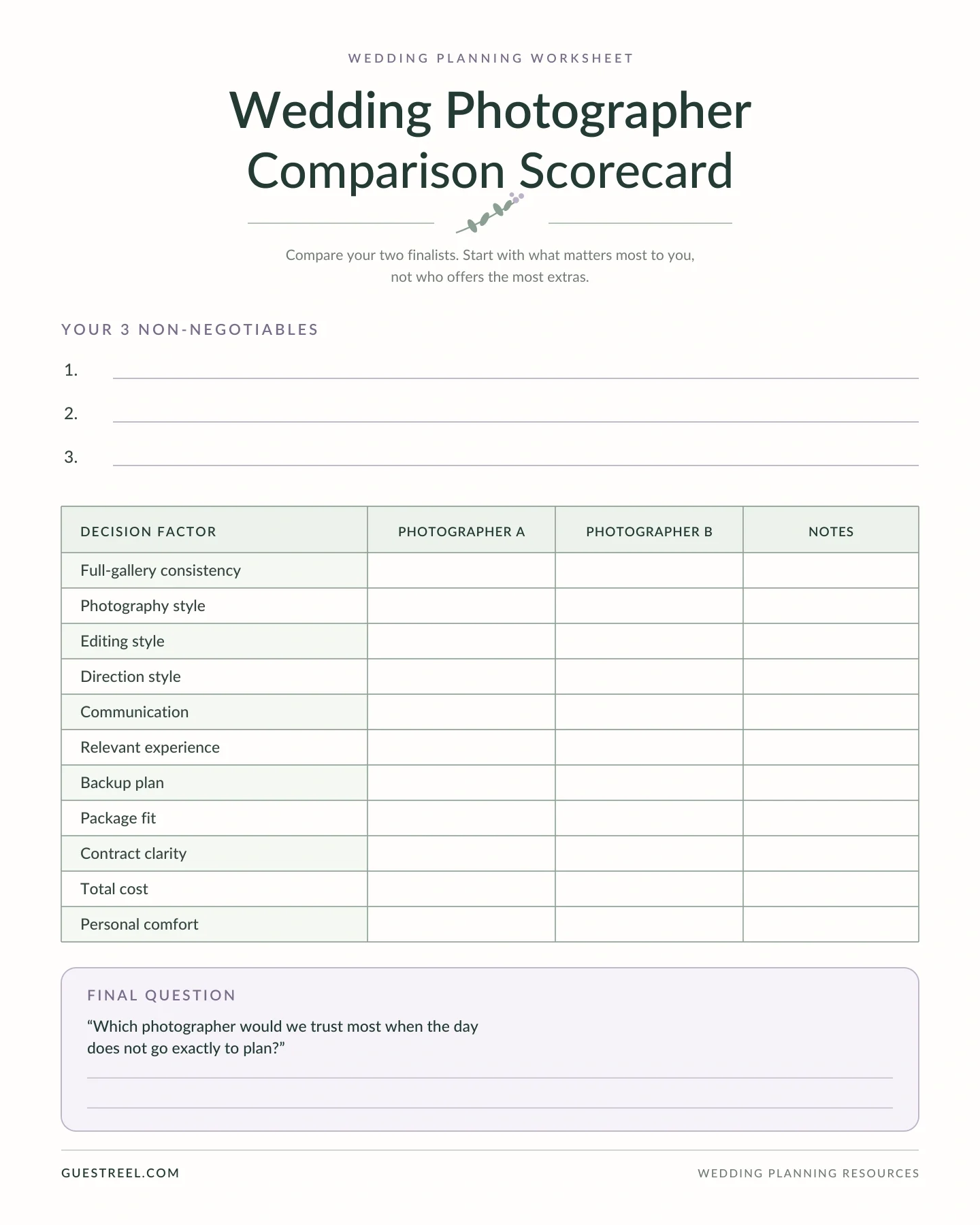
| Decision factor | Photographer A | Photographer B | Your notes |
|---|---|---|---|
| Full-gallery consistency | |||
| Photography style | |||
| Editing | |||
| Amount of direction | |||
| Communication | |||
| Relevant lighting experience | |||
| Backup arrangements | |||
| Package fit | |||
| Contract clarity | |||
| Total cost | |||
| Personal comfort |
Decide which factors are non-negotiable before you compare.
If natural documentary coverage is your priority, an included album should not outweigh a photographer whose work fits you much better.
Once both finalists meet your standards for quality, reliability and budget, comfort and trust are perfectly reasonable tie-breakers.
What to Plan After You Have Booked
You do not need to dictate every photograph. You do need to give your photographer information they could not reasonably know on their own.
Share the Real Timeline
Include preparation locations, ceremony timings, travel, the drinks reception, speeches, first dance and any planned exits or surprises.
If something unusual will happen and you want a photograph of it, tell them.
Make Family Photographs Easier
Prepare the family combinations that genuinely matter, particularly if your families include divorced parents, blended households, elderly relatives, mobility requirements or sensitive relationships.
That lets the photographer organise groups without asking you to solve family logistics while everybody is waiting.
Explain Personal and Cultural Traditions
If your wedding includes cultural, religious or family traditions the photographer may not know, explain what will happen and who is important.
Good preparation is more useful than assuming they will recognise the moment as it happens.
Keep Your Priority-Shot List Short
A huge Pinterest checklist can become counterproductive.
Tell your photographer about the people, details or moments that are genuinely important to you, then give them room to do the job you hired them for.
For inspiration without turning your photographer's day into a rigid shot list, see our guide to wedding photo ideas and essential shots.
Your Photographer Cannot Be Everywhere, and That Is Fine
Your wedding photographer is there to create the deliberate, professionally photographed record of the day. Your guests see something different.
While you are having portraits taken, somebody at the bar may capture your grandparents laughing. A friend may film a ridiculous moment on the dance floor. Someone sitting behind your parents may photograph their reaction during the ceremony.
Those pictures do not replace professional photography. They fill in a different part of the story.
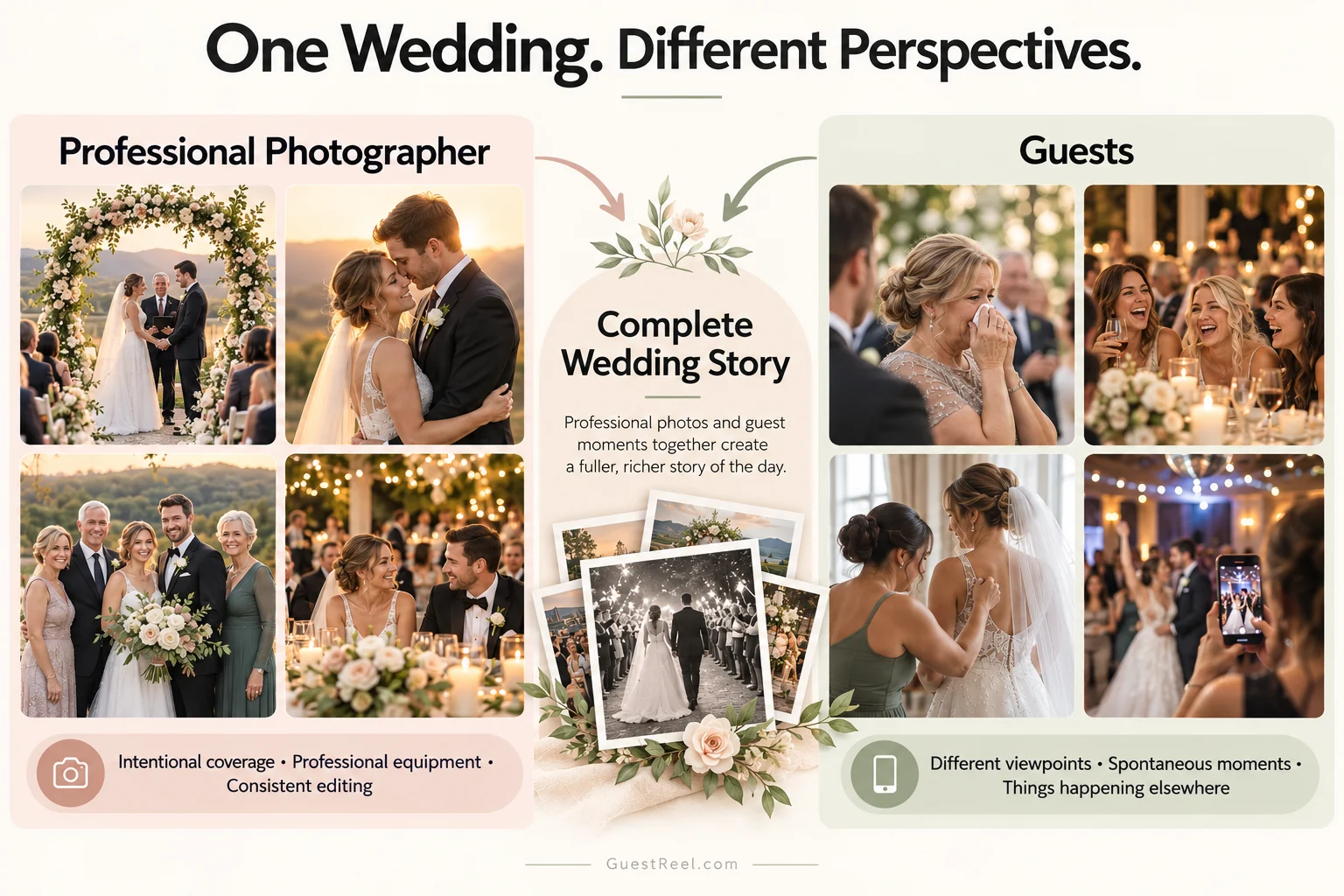
If those guest perspectives matter to you, decide how you will collect them before the wedding. Otherwise photographs often stay in individual camera rolls, messages and shared albums until somebody remembers to send them.
Our guide to collecting wedding photos and videos from guests compares the main options, including QR-code tools, shared albums, cloud folders and messaging apps.
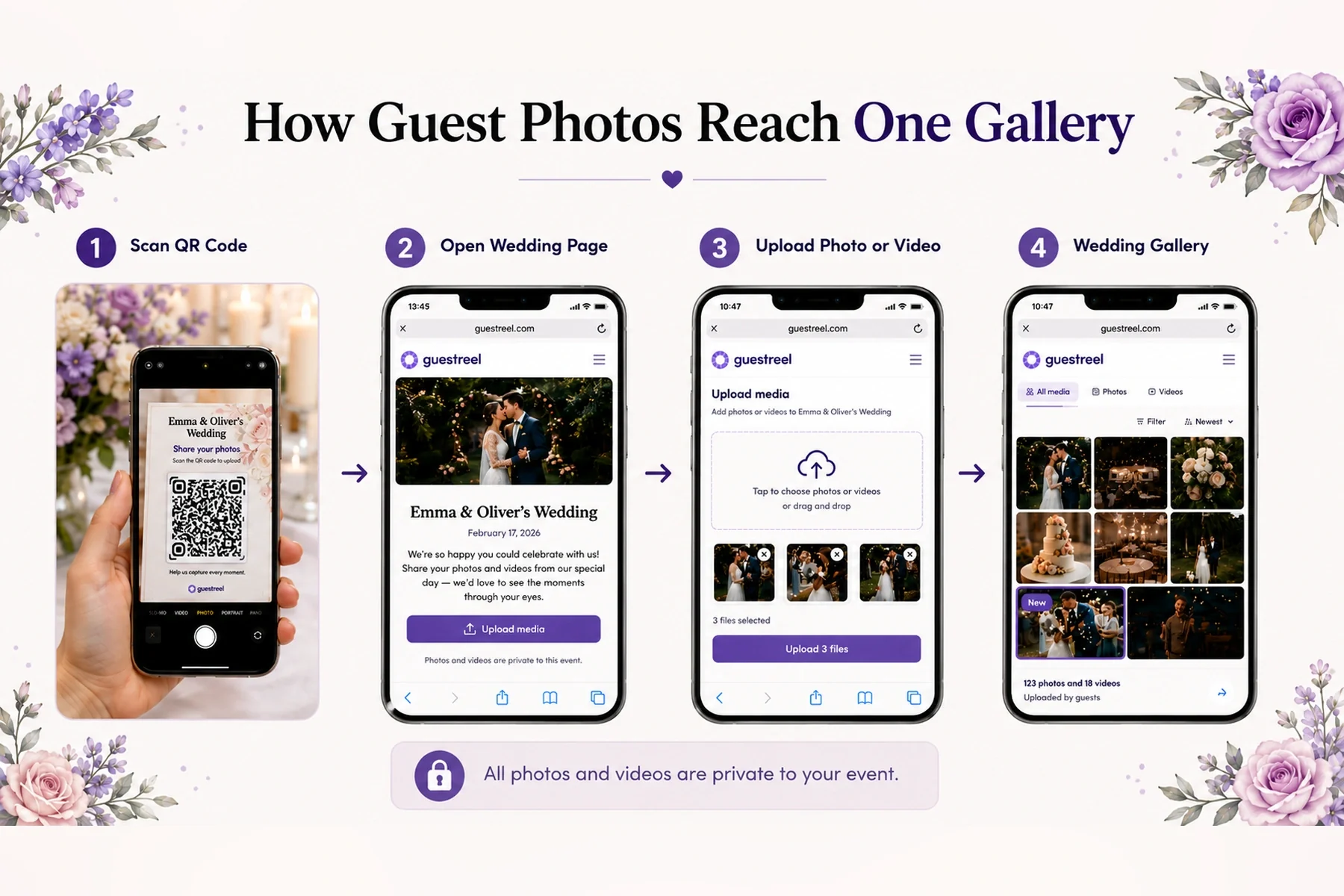
Guestreel is one option designed specifically for this. With Guestreel wedding photo sharing, guests scan a personalised QR code and upload photos and videos through their browser, with no app or account required. The files collect in one private event gallery and can be downloaded together afterwards.
If you want to understand the mechanism in more detail, see how QR code photo sharing works.
Before You Book: One Final Check
You do not need the photographer who ticks the most boxes on paper. You need one who gets the important ones right.
Before you commit, check that:
- you like their full galleries as well as their highlights;
- their shooting and editing style match what you want;
- you are comfortable with how they communicate and direct people;
- you know who will photograph your wedding and what happens if they cannot;
- package costs and extras are clear;
- delivery expectations are written down;
- you have read the contract;
- you feel comfortable trusting them with the day.
A great Instagram feed may get someone onto your shortlist. Consistency, clarity and trust are what should get them booked.
Frequently asked questions
How far in advance should you book a wedding photographer?
Start looking once your wedding date and venue are confirmed. Availability varies by photographer, location, season and day of the week, so there is no single deadline that applies to every wedding. If a specific photographer matters to you, enquire early rather than relying on a general booking rule.
Should you ask to see a full wedding gallery?
Yes. A full or near-complete gallery gives you a much better view of consistency than selected portfolio images. Look at indoor photographs, family groups, reception lighting and guest candids as well as portraits of the couple.
Does a photographer need to have worked at your venue before?
No. Familiarity can help, but experience at your exact venue is not essential. More important is whether the photographer can assess new locations, work confidently in difficult light and prepare properly for your timeline.
Do wedding photographers give you RAW files?
Many do not. RAW files are unfinished source files, while photographers generally deliver a curated set of edited photographs as the final product. Confirm the file format, resolution and usage rights included in your own package before booking.
How many wedding photos should you expect?
There is no standard number. It depends on coverage, the size and structure of the wedding and the photographer's working style. Ask how they normally deliver a wedding like yours and look at a full gallery to understand the likely quantity and variety.
How long does it take to receive wedding photos?
Delivery varies between photographers and can also change during busy periods. The useful number is not an industry average but the timeframe written into your agreement. Ask whether previews, the full gallery and any albums have different delivery schedules.
Who owns the copyright to wedding photos?
Copyright depends on jurisdiction and contract. In common US and UK circumstances, the photographer is generally the initial copyright owner, although exceptions exist. Check your contract for the licence you receive to download, print and share the finished photographs.
Written by Linda DoWrites Guestreel’s planning guides.