How to Write Wedding Invitations: Wording, Etiquette & Examples for Every Situation
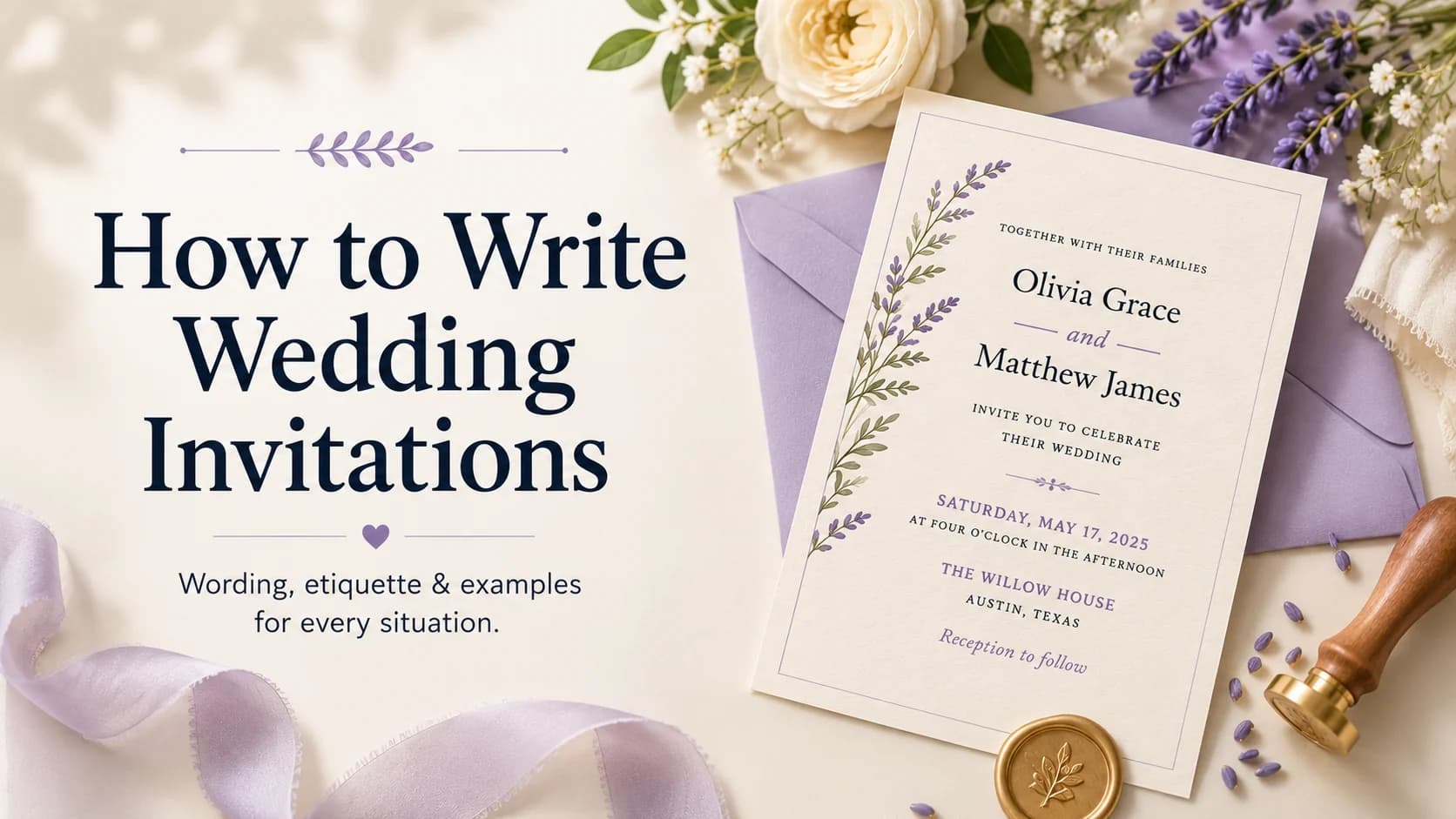
A wedding invitation needs to answer a few basic questions quickly: who is getting married, when and where it is happening, and what guests need to do next.
How formally you say it is up to you. A traditional church wedding might use fully written dates and classic wording; a garden party or city-hall celebration can sound much more relaxed. Printed and digital invitations follow the same basic principles: be clear, be accurate and make the wording sound like the wedding you are actually planning.
What Should a Wedding Invitation Include?
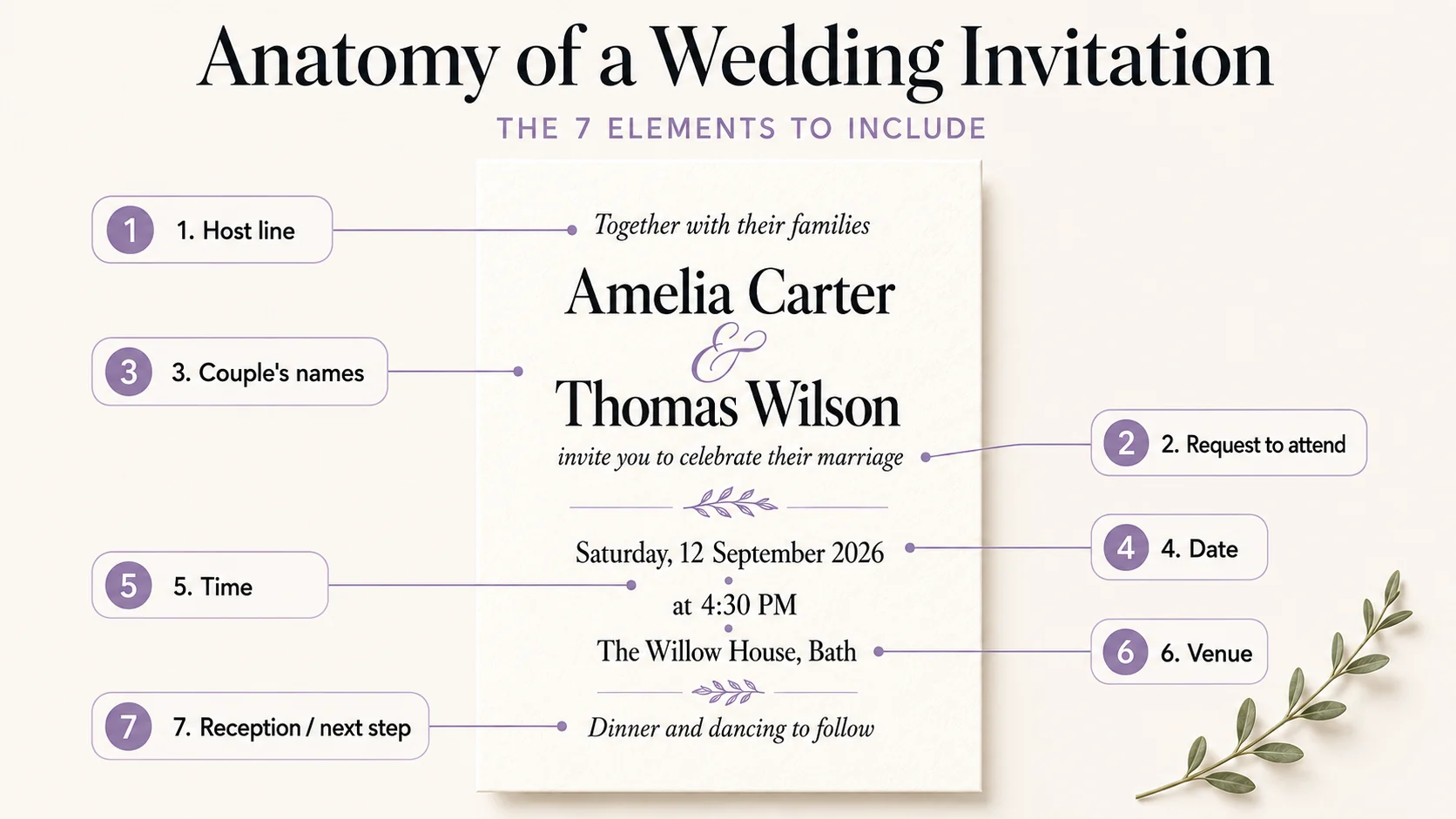
Most wedding invitations contain seven elements:
- Host line — who is extending the invitation, if anyone is being named.
- Request line — the actual invitation to attend.
- Couple's names — clearly identify who is getting married.
- Date — ideally including the day of the week.
- Time — the ceremony start time.
- Venue — the ceremony location.
- What happens next — reception information or directions to further details.
You do not need to fit hotel information, transport, parking, your registry and the entire weekend schedule onto the same card. Those details usually belong on a separate card or wedding website.
How to Write a Wedding Invitation in 7 Steps
1. Decide Whether You Need a Host Line
Traditional invitations begin by naming the people hosting the wedding. Historically, that was often the bride's parents. Today, one family, both families, the couple themselves or a combination of people may be hosting.
Typical openings include:
- Mr. and Mrs. Daniel Carter request the pleasure of your company…
- Together with their families…
- Together with their parents…
- Amelia Carter and Thomas Wilson invite you to celebrate…
You can also leave out a separate host line and begin with the couple's names.
A useful distinction: the host line acknowledges who is extending the invitation. It does not need to operate as an accounting statement showing exactly who paid for the wedding.
2. Choose the Request Wording
This is the line that actually invites people.
Traditional formal wording often uses "request the honour of your presence" for a ceremony in a house of worship and "request the pleasure of your company" for other venues. That distinction is part of traditional Emily Post etiquette rather than a requirement for every modern wedding.
More relaxed alternatives include:
- invite you to celebrate their marriage
- would love you to join them as they get married
- invite you to celebrate with them
- joyfully invite you to their wedding
Read the line aloud. If it sounds far more formal than the wedding itself, loosen it.
3. Add the Couple's Names
The couple's names should be immediately noticeable.
Traditional heterosexual invitations often put the bride's name first, but modern couples do not need to follow a gender-based order. Use the order that sounds most natural, looks best in the design or reflects how you normally present yourselves.
A formal invitation might use:
Amelia Grace Carter
and
Thomas Edward Wilson
A relaxed invitation might simply say:
Amelia & Tom
Whichever approach you choose, keep the formality consistent. Full titles, fully written dates and highly ceremonial language can feel odd beside very casual naming, and vice versa.
4. Write the Date Clearly
Formal invitations traditionally spell the date out:
Saturday, the twelfth of September
two thousand twenty-six
A modern version could be:
Saturday, 12 September 2026
or:
Saturday, September 12, 2026
For weddings with international guests, avoid numeric-only dates such as 09/12/26. Depending on where someone lives, that could mean September 12 or December 9.
And before you send anything to print, check the calendar. The weekday and date need to match.
5. Add the Ceremony Time
Formal invitations often write the time in words:
at half after four o'clock
Modern invitations can use:
4:30 PM
or another time format your guests will understand.
Use the real ceremony start time. If guests need to arrive or be seated earlier, communicate that separately rather than quietly moving the ceremony time forward on the invitation.
6. Give the Venue
Include enough information for guests to identify the ceremony location confidently.
For example:
The Willow House
Bath, Somerset
or:
The Garden Estate
Austin, Texas
You rarely need driving directions on the main invitation. If guests need a full street address, parking instructions or transport details, move those to the details card or wedding website.
Check the venue's official spelling before approving the invitation.
7. Explain What Happens After the Ceremony
If the reception follows at the same location, one short line is usually enough:
Reception to follow
or:
Dinner and dancing to follow
If the reception takes place somewhere else, give guests the details on an enclosure card or website rather than forcing a second address into an already crowded invitation.
A Simple Wedding Invitation Wording Template
A basic invitation can follow this structure:
[Host names or opening]
[Request to attend]
[Couple's names]
[Day and date]
[Time]
[Venue]
[Reception wording or next step]
For example:
Together with their families
Amelia Carter and Thomas Wilson
invite you to celebrate their marriage
Saturday, 12 September 2026
at 4:30 PM
The Willow House, Bath
Dinner and dancing to follow
From there, you can make the language more traditional or more conversational without changing the essential information.
Formal, Modern and Casual Wedding Invitation Wording
The main difference is tone, not the information guests receive.
| Element | Formal | Modern | Casual |
|---|---|---|---|
| Opening | Hosts usually named | Family or couple | Couple may start directly |
| Request | "request the honour/pleasure…" | "invite you to celebrate…" | "come celebrate with us" |
| Names | Full names, sometimes titles | Usually full names | First names may be enough |
| Date and time | Usually written out | Either style | Numbers are common |
| Tone | Ceremonial | Polished and flexible | Conversational |
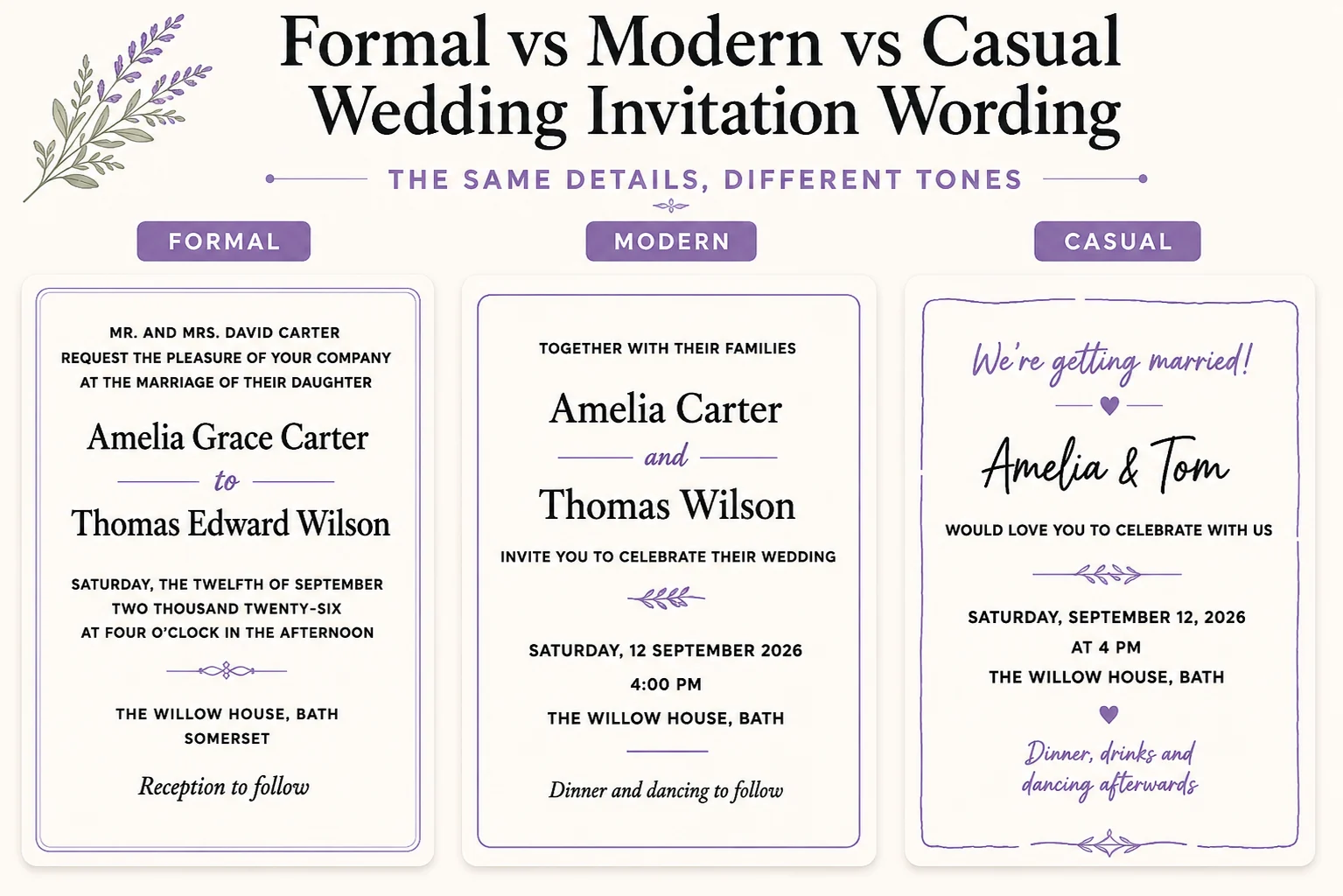
Formal Wedding Invitation Example
Mr. and Mrs. David Carter
request the pleasure of your company
at the marriage of their daughter
Amelia Grace Carter
to
Thomas Edward Wilson
Saturday, the twelfth of September
two thousand twenty-six
at four o'clock in the afternoon
The Willow House
Bath, Somerset
Reception to follow
Modern Wedding Invitation Example
Together with their families
Amelia Carter & Thomas Wilson
invite you to celebrate their wedding
Saturday, 12 September 2026
4:00 PM
The Willow House, Bath
Dinner and dancing to follow
Casual Wedding Invitation Example
We're getting married!
Amelia & Tom
would love you to celebrate with us
Saturday, September 12, 2026
at 4 PM
The Willow House
Dinner, drinks and dancing afterwards
Casual wording gives you more freedom, but it should never make the important details harder to find.
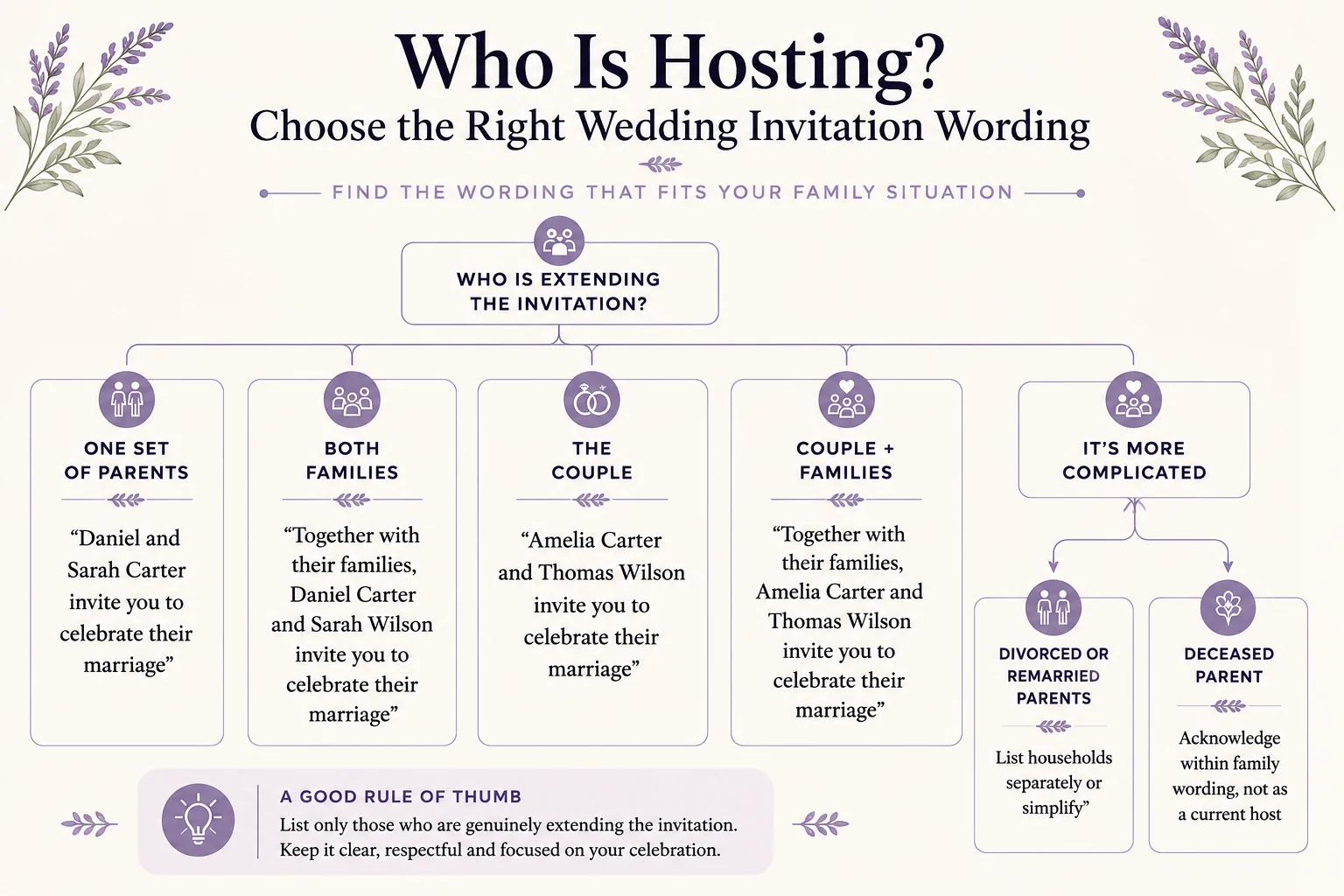
Wedding Invitation Wording Based on Who Is Hosting
The host line is often the part couples spend the most time worrying about, especially when family relationships or finances do not fit the traditional model.
One Set of Parents Hosting
A traditional version:
Mr. and Mrs. Daniel Carter
request the pleasure of your company
at the marriage of their daughter
Amelia Grace
to
Thomas Edward Wilson
A more contemporary version:
Daniel and Sarah Carter
invite you to celebrate the marriage of
Amelia Carter and Thomas Wilson
Both Families Hosting
You can name both families:
Daniel and Sarah Carter
and
Michael and Anna Wilson
invite you to celebrate the marriage of their children…
Or keep it shorter:
Together with their families
Amelia Carter and Thomas Wilson
invite you to celebrate their marriage
The second option is often cleaner when listing everyone would turn the top of the invitation into a family tree.
The Couple Hosting
If you are hosting the wedding yourselves, start with your names:
Amelia Carter and Thomas Wilson
invite you to celebrate their wedding
There is no need to add a parent host line solely because it is traditional.
Divorced or Remarried Parents
Divorced parents can be listed separately:
Sarah Carter
and
Daniel Carter
invite you to celebrate the marriage of their daughter…
If parents have remarried and you want to include stepparents, each household can be named separately.
If that becomes unwieldy, "Together with their families" is often the most graceful option.
Including a Deceased Parent
A deceased parent can be acknowledged without presenting them as a current host.
For example:
Amelia Carter, daughter of Sarah Carter and the late Daniel Carter
and
Thomas Wilson
invite you to celebrate their marriage…
Some couples prefer to honour a deceased parent in the ceremony programme, memorial display or another part of the wedding instead. There is no reason to force the acknowledgement onto the invitation if another placement feels more personal.
Wording for Weddings That Need Extra Explanation
Most weddings do not need a special wording formula. A few situations do need an extra line of clarity.
Religious or Church Weddings
If you are following traditional formal etiquette, "request the honour of your presence" is conventionally used for a ceremony in a house of worship.
Religious traditions may also have their own wording customs, so check with your officiant if you are unsure.
Destination Weddings
Keep the invitation itself concise:
Amelia & Thomas
invite you to celebrate their wedding
Saturday, 17 October 2026
Villa Aurora
Florence, Italy
Hotel options, airports, transfers and a multi-day itinerary belong on your wedding website or details card.
Reception-Only Celebrations
Do not leave guests wondering whether they were also invited to the ceremony.
Try:
Amelia and Thomas
were married in a private ceremony
and invite you to celebrate with them
at their wedding reception…
That one sentence removes the ambiguity.
What Goes on the Invitation, Details Card or Wedding Website?
A good invitation does not try to answer every question on one piece of paper.
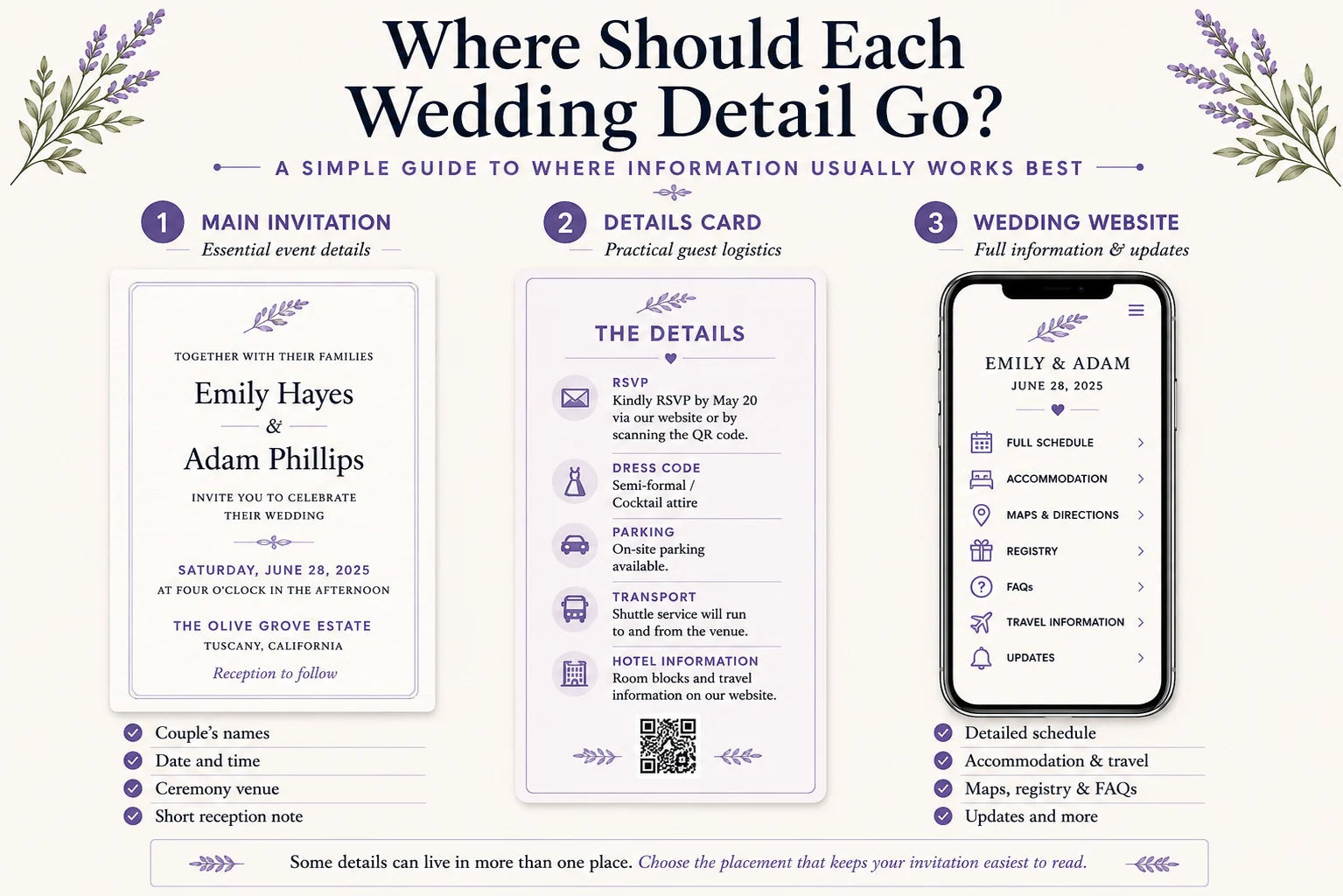
| Information | Main invitation | Details card | Wedding website |
|---|---|---|---|
| Couple's names | ✓ | ||
| Date and time | ✓ | ✓ | |
| Ceremony venue | ✓ | ✓ | |
| Short reception note | ✓ | ✓ | |
| RSVP instructions | Sometimes | ✓ | ✓ |
| Dress code | Sometimes | ✓ | ✓ |
| Hotel details | ✓ | ✓ | |
| Transport and parking | ✓ | ✓ | |
| Full weekend schedule | ✓ | ||
| Maps and directions | ✓ | ✓ | |
| Registry | ✓ | ||
| Longer FAQs | ✓ | ||
| Website or QR access | Sometimes | ✓ |
A practical rule is to keep the main invitation focused on attending the wedding. Put the logistics elsewhere.
If you are coordinating invitations alongside the rest of your planning, our wedding planning checklist covers the wider timeline.
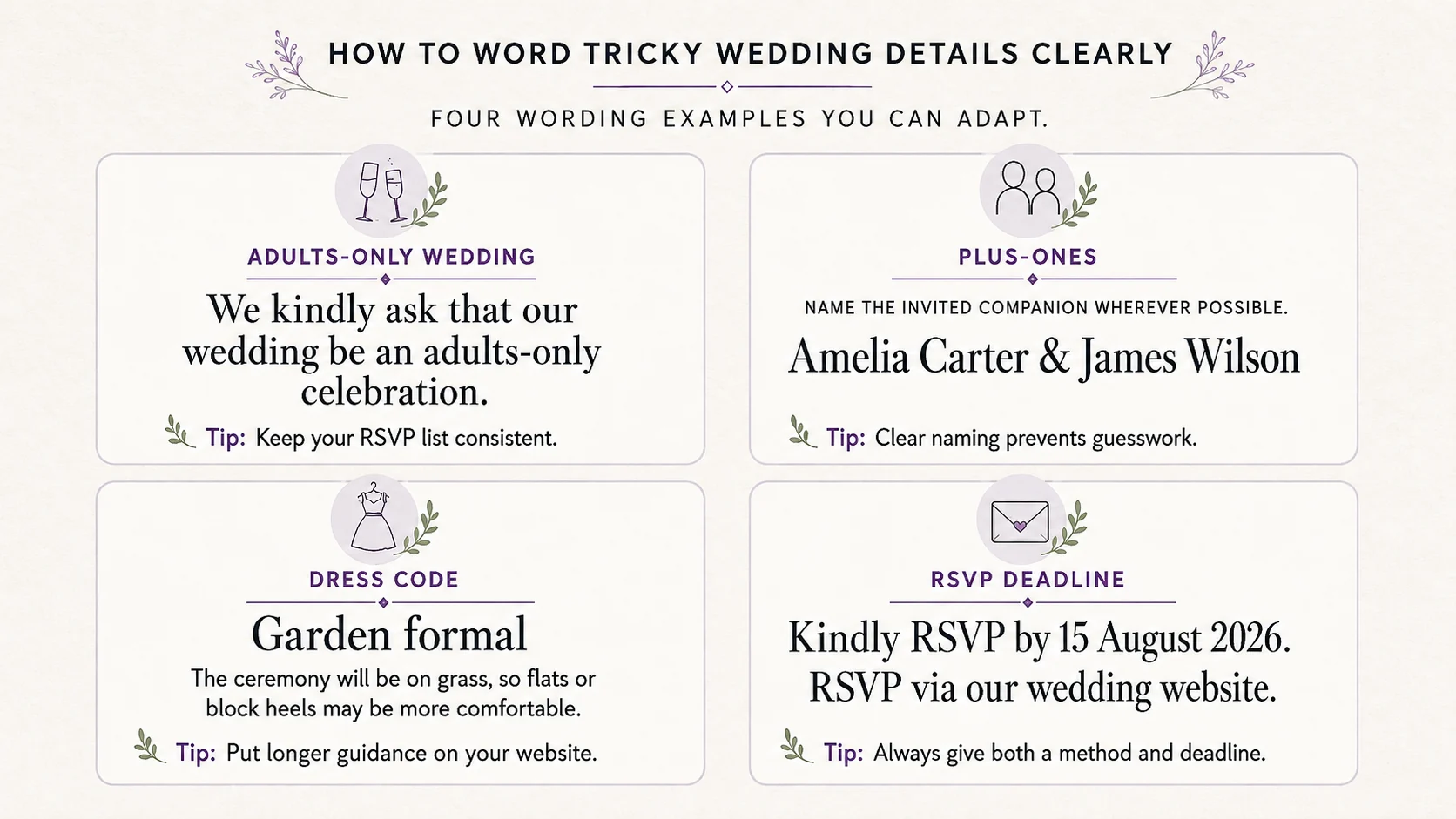
How to Word Tricky Details Clearly
The wording people find hardest is often not the formal etiquette. It is telling guests something potentially awkward without sounding cold.
How to Say the Wedding Is Adults Only
First, address the invitation only to the people who are actually invited and ensure your RSVP form matches.
If you also need a written note, keep it direct:
We kindly ask that our wedding be an adults-only celebration.
or:
Adults-only reception.
Clear, brief wording is usually more helpful than a long justification.
How to Handle Plus-Ones
Where possible, name the invited companion.
That removes far more uncertainty than a long paragraph explaining your plus-one policy. Your envelope and RSVP system should make it obvious exactly who is included.
If a guest does not have a plus-one, avoid vague wording that suggests they might.
How to Include the Dress Code
A short dress code can sit near the bottom of the invitation:
- Black tie
- Cocktail attire
- Garden formal
If guests need more context, use the details card or website:
Garden formal. The ceremony will be on grass, so block heels or flats may be more comfortable.
That is more helpful than expecting guests to decode the invitation design.
How to Write the RSVP Deadline
Use an actual date:
Kindly RSVP by 15 August 2026
Then make the method equally clear:
RSVP via our wedding website
or include a physical response card.
Set the deadline by working backwards from when your venue, caterer and other suppliers require final numbers rather than relying on a generic rule.
Where to Put Registry Information
Keep gift and registry information off the main wedding invitation. Traditional etiquette guidance recommends directing guests to a wedding website instead.
That keeps the invitation focused on the celebration, while anyone looking for registry information can still find it easily.
Should You Put a QR Code on a Wedding Invitation?
A QR code can be useful when it takes guests somewhere they need before the wedding, such as an RSVP page or wedding website.
If you use one:
- Say what it opens.
- Test it on more than one phone.
- Keep the destination page mobile-friendly.
- Provide a written URL as a backup where practical.
- Avoid covering the invitation suite in multiple competing QR codes.
Placement should match timing.
An RSVP code makes sense on the invitation because guests need it when they respond. A photo-sharing QR code is usually more useful at the wedding itself, where guests are actually taking photos.
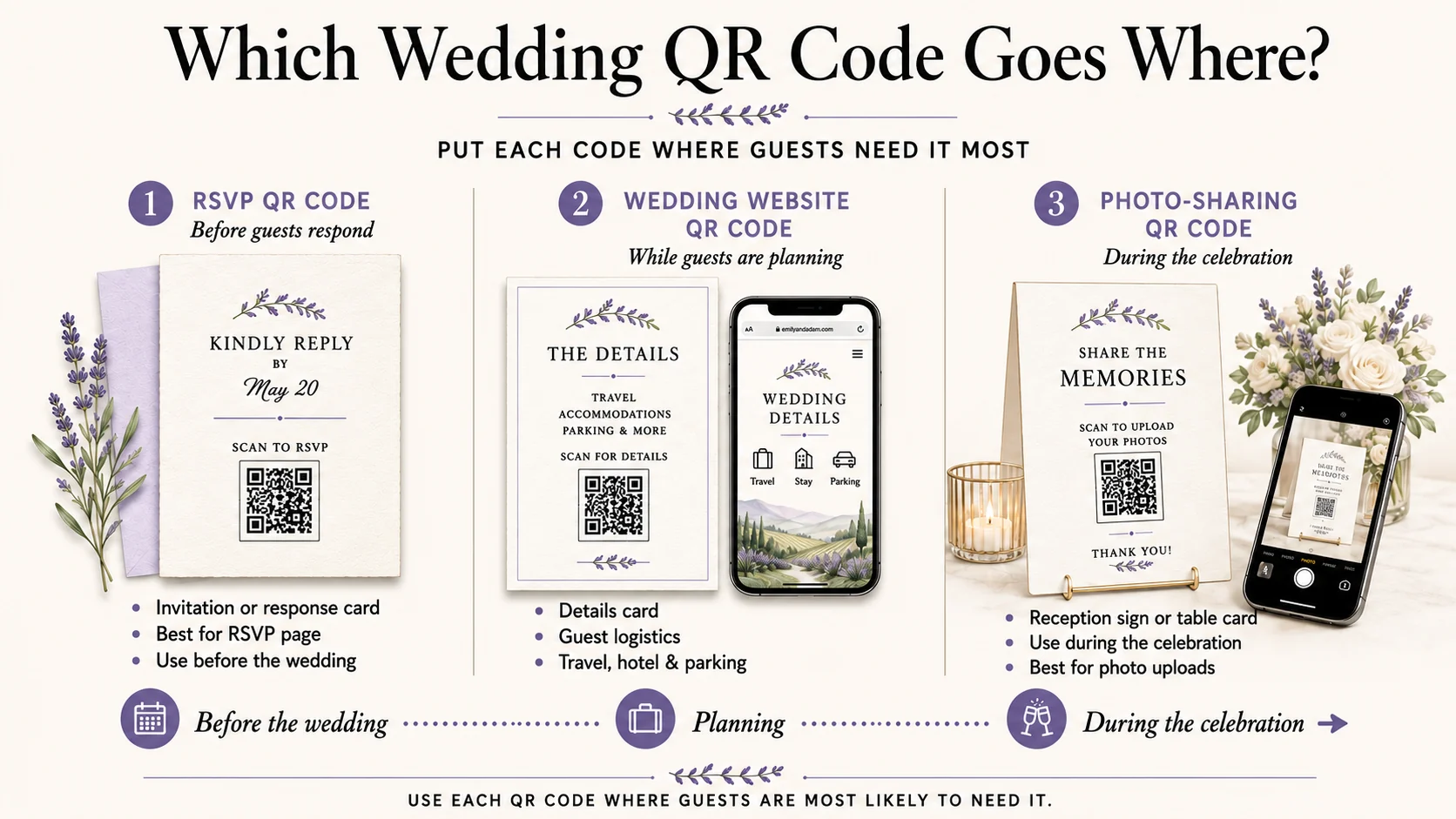
For example, Guestreel for weddings gives an event a personalized QR code that guests can use to upload photos and videos through their browser without downloading an app. If you plan to collect wedding photos from guests, putting that QR code on reception signs or table materials gives guests a timely prompt to use it.
Proof Your Wedding Invitation Before You Print or Send It
A beautifully worded invitation with the wrong date is still the wrong invitation.
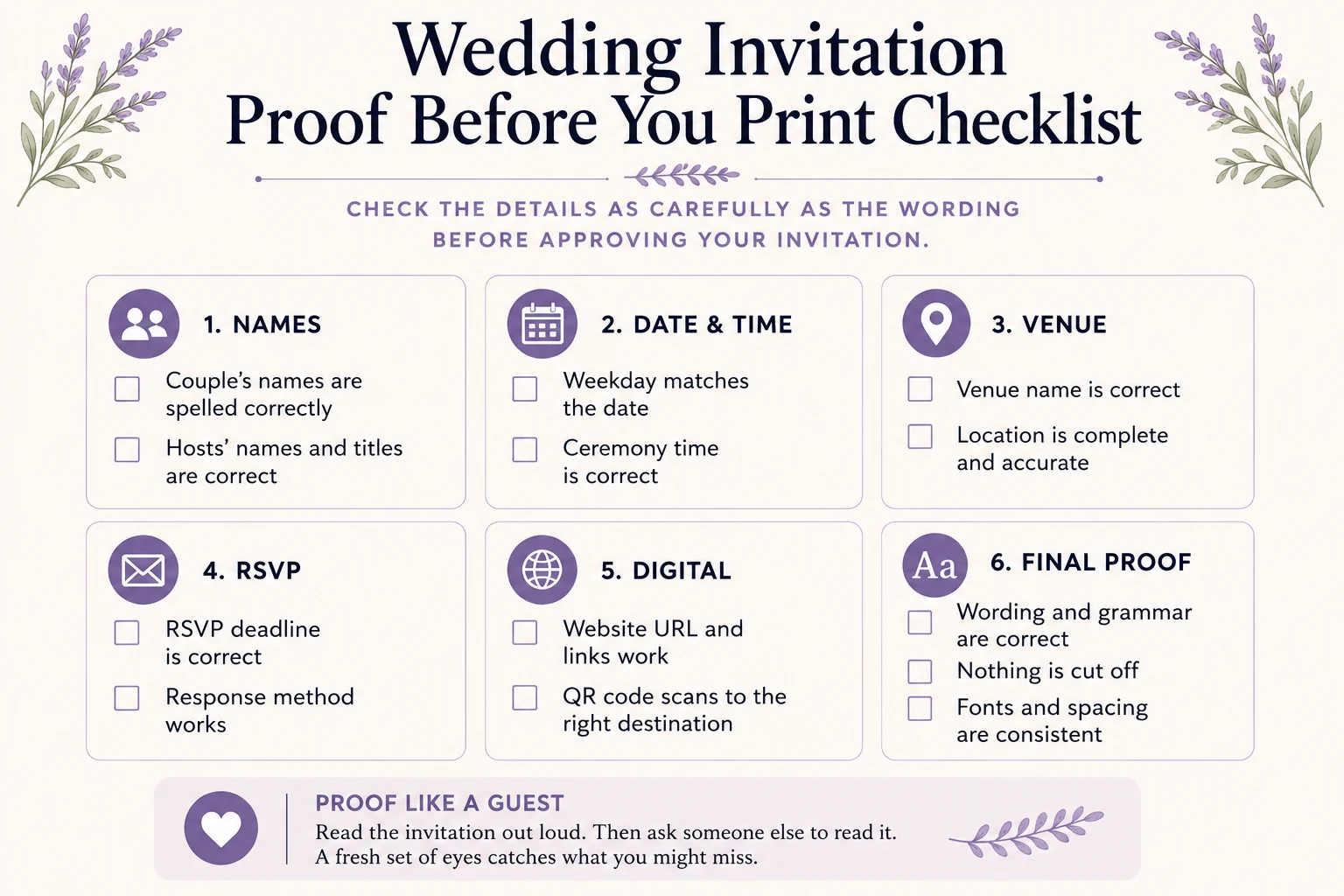
Run through this check before you approve the final version:
- Both partners' names are spelled correctly.
- Hosts' names and titles are correct.
- The weekday matches the calendar date.
- The month and year are correct.
- The ceremony time is correct.
- The venue uses its official name.
- The location is unambiguous.
- Ceremony and reception information cannot be confused.
- The RSVP method works.
- The RSVP deadline is correct.
- The wedding website opens correctly.
- Every QR code has been tested.
- Dress-code wording is clear if included.
- The invitation makes it clear who is invited.
Then give the final proof to someone who has not been looking at the design for weeks. Fresh eyes are much more likely to notice a missing word, wrong number or duplicated line.
Do not assume the printer or designer will know that a wedding detail is incorrect. They can proof the design; you need to proof the event information.
Frequently Asked Questions
Whose name goes first on a wedding invitation?
Traditional heterosexual invitations often put the bride's name first, but modern couples can choose either order. Same-sex couples can use alphabetical order, the order that sounds most natural or their usual order as a couple. Consistency matters more than following a gender-based formula.
Do wedding invitation dates and times have to be spelled out?
No. Writing dates and times in full is a convention of formal wedding invitations, not a requirement for every invitation. Modern and casual invitations commonly use numbers. Whatever style you choose, avoid ambiguous date formats and double-check the weekday against the date.
Do you put RSVP information on the wedding invitation?
You can, but it does not have to sit on the main card. A response card, details card or wedding website can keep the design cleaner. What matters is that guests can immediately see how to reply and when their response is due.
Where should the dress code go?
A short dress code such as Black Tie or Cocktail Attire can appear near the bottom of the invitation. If guests need additional explanation, put it on the details card or wedding website.
Can you put a QR code on a wedding invitation?
Yes. QR codes work well for an RSVP page, wedding website or another resource guests need before the event. Label the code clearly and test it before printing. For activities that happen during the reception, such as guest photo sharing, day-of signage is usually the more useful placement.
Should registry information go on the wedding invitation?
Traditional etiquette recommends keeping registry details off the main invitation. A wedding website is a better place for registry links because guests who want the information can find it without making gifts part of the invitation itself.
How do you include a deceased parent on a wedding invitation?
A deceased parent can be acknowledged in the family wording without presenting them as someone currently hosting the wedding. For example, you might describe one partner as "daughter of Sarah Carter and the late Daniel Carter." You can also honour the parent elsewhere in the wedding if that feels more natural.
Get the Wording Right, Then Proof the Facts
A wedding invitation does not need to follow every traditional rule to be correct. It needs to tell guests what they need to know, reflect the tone of the celebration and leave as little room for confusion as possible.
Once the wording is settled, proof the facts one final time before you print or send it.