Micro Wedding Ideas: 30 Creative Ways to Make an Intimate Wedding Feel Special
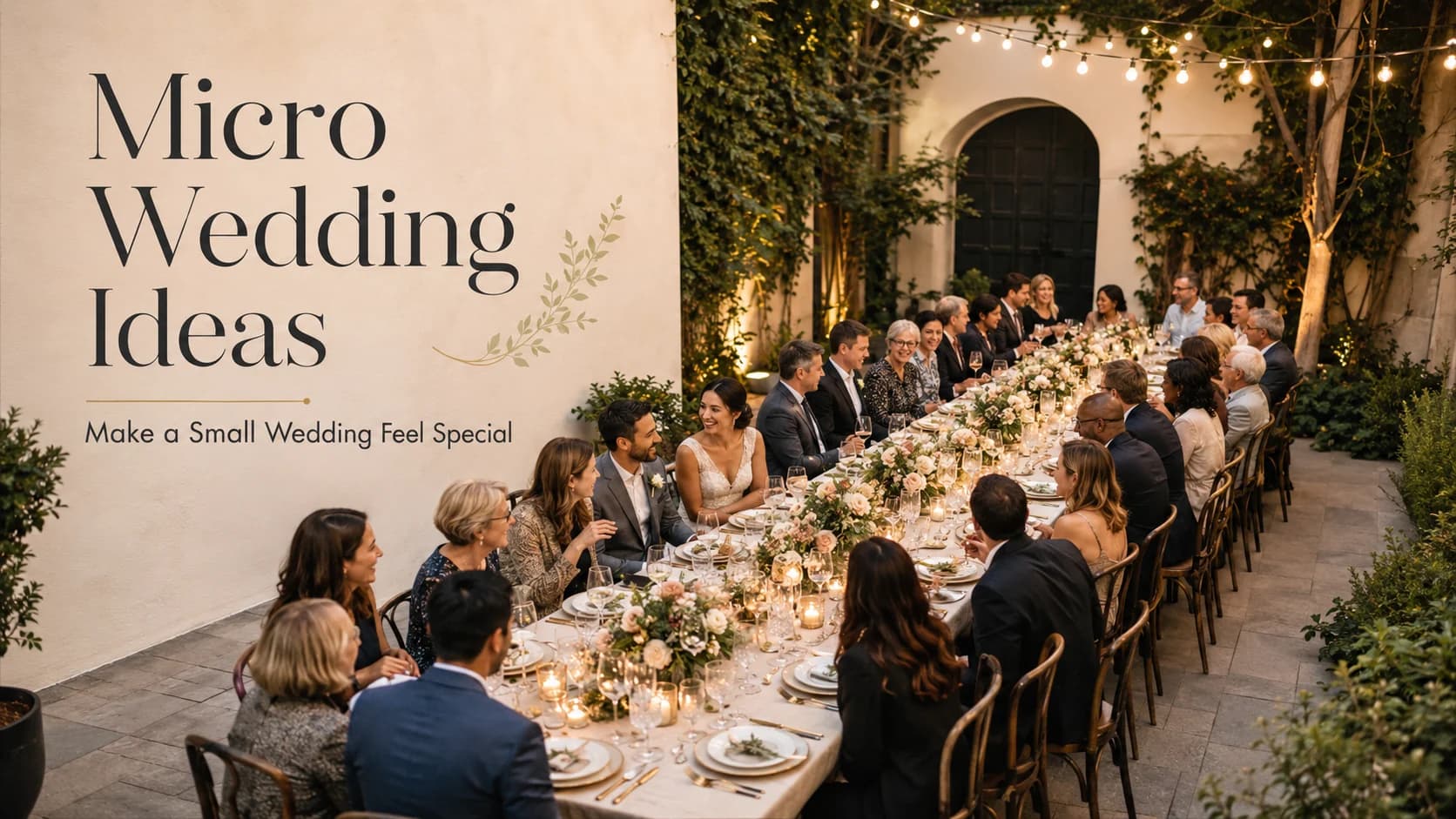
The best micro weddings do not feel like traditional weddings with half the guest list missing. They feel deliberately small.
With fewer people, you can seat everyone at one table, spend proper time with each guest, choose a restaurant instead of a ballroom, make the ceremony more personal and put the budget into the parts of the day you actually care about.
That is the real advantage of a micro wedding: you can design the celebration around intimacy instead of scale.
The short version? Set the guest list first, choose a space that suits it, then build the ceremony and reception around what works better with fewer people.
What Is a Micro Wedding?
A micro wedding is a small-scale wedding that still includes the core elements of a traditional celebration, usually a ceremony, invited guests and some form of reception.
There is no official guest-count definition. A commonly used benchmark is around 50 guests or fewer, although some planners reserve the term for much smaller celebrations. The Knot, for example, describes a micro wedding as typically having no more than 50 guests.
If you want a deeper breakdown of the terminology, see what a micro wedding is and how it differs from other small wedding formats.
| Wedding format | Typical approach | Main difference |
|---|---|---|
| Micro wedding | Small guest list, often around 50 or fewer | Keeps many elements of a full wedding on a more intimate scale |
| Small wedding | Broad term for a wedding with fewer guests than average | May still follow a fairly traditional wedding format |
| Elopement | Usually the couple alone or with very few guests | Focuses more heavily on the ceremony than hosting a full guest experience |
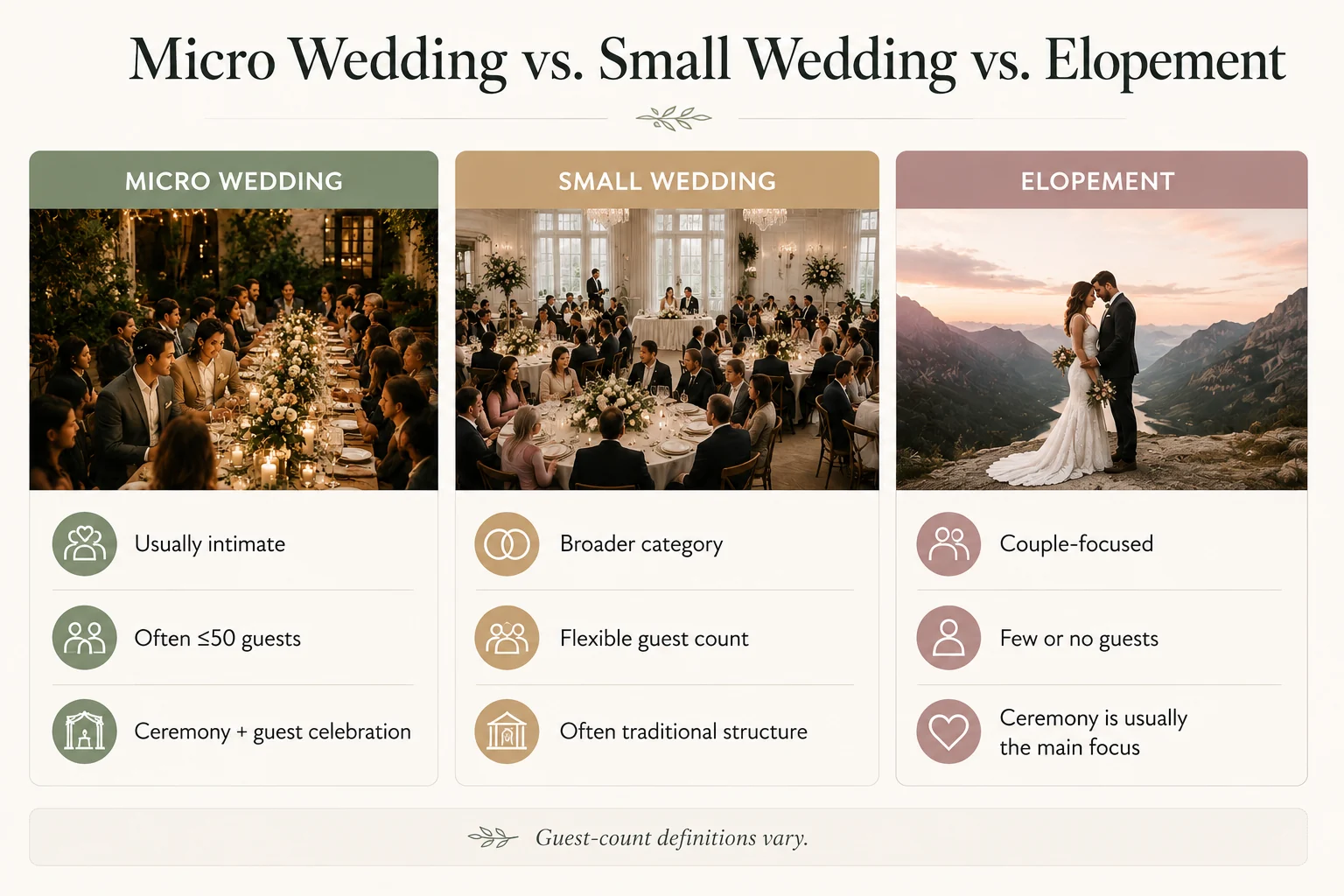
These are planning terms, not legal classifications.
Before Choosing Micro Wedding Ideas, Make These Three Decisions
Decor, food and entertainment are much easier to plan once you know exactly who is coming and what you want the day to feel like.
Set Your Guest Limit Before Building the List
Deciding on "around 20 people" sounds easy until parents, siblings, partners, grandparents and close friends start filling those places.
Set the maximum number your budget and preferred type of celebration can comfortably support first. Then build the list inside it.
This is also where micro weddings get difficult. Cutting a guest list from 100 to 25 does not mean excluding only distant acquaintances. You may have to leave out people you genuinely like.
If your list keeps growing from 20 to 30 to 45, ask whether keeping the wedding micro matters more than having those additional people there. The label should never become more important than the celebration itself.
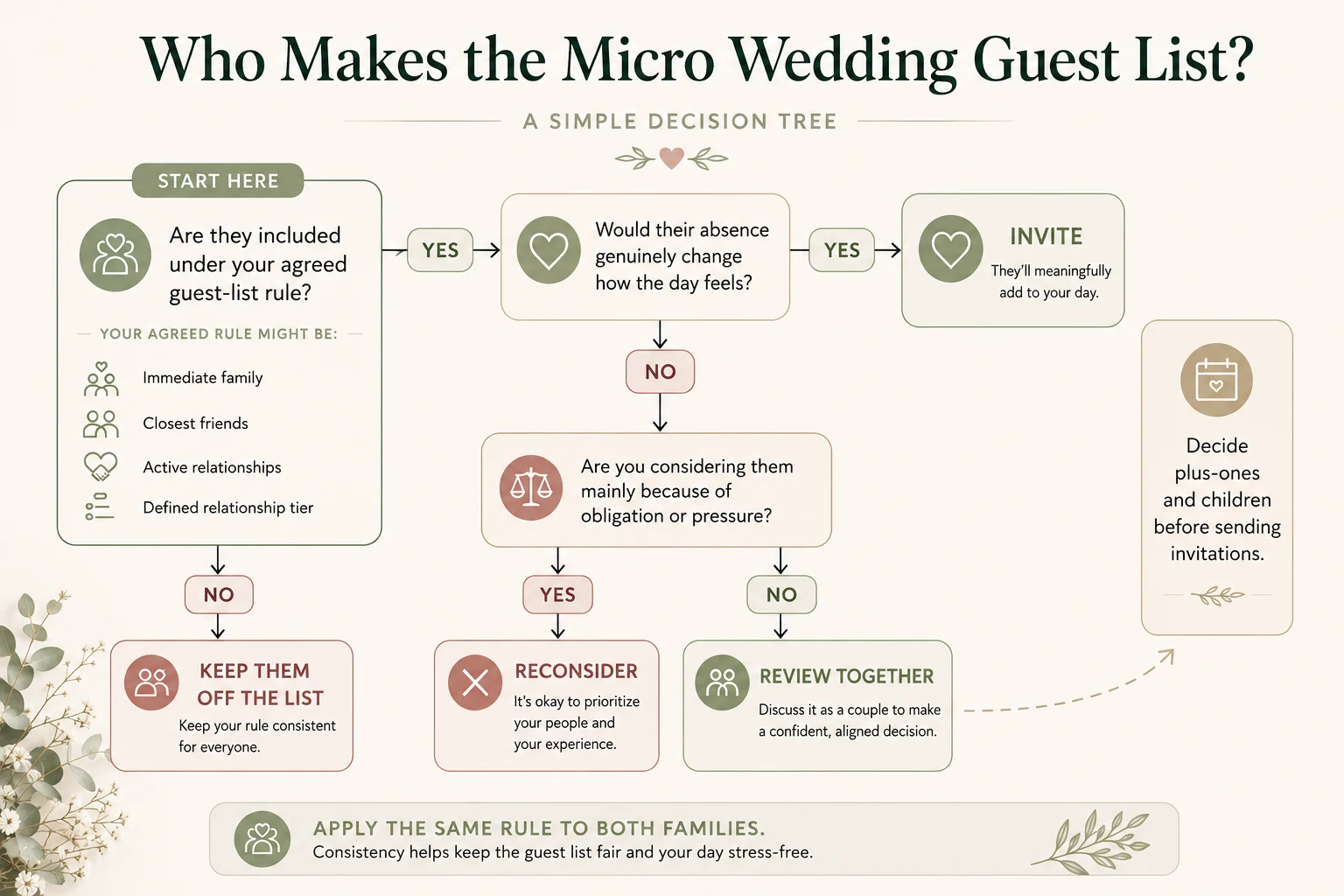
Create a Consistent Guest-List Rule
Instead of debating every person individually, agree on a rule with your partner.
That might mean inviting:
- Immediate family only
- Immediate family plus your closest friends
- People you both have an active relationship with
- People whose absence would genuinely change how the day feels
- A clearly defined relationship tier applied to both families
Decide your approach to plus-ones and children at the same time.
A consistent rule will not prevent every awkward conversation, but it stops the guest list becoming a series of one-off exceptions.
Separate Fixed and Per-Guest Costs
A smaller wedding can reduce the total bill, but not every cost shrinks when the guest list does.
Some expenses are largely fixed:
- Photography
- Wedding attire
- Certain venue fees
- Planning or coordination
- Ceremony costs
- Some entertainment
Others rise with each additional guest:
- Food
- Drinks
- Chairs and tableware
- Invitations
- Guest transport
- Favors
A more useful way to think about the budget is:
Fixed wedding costs + (per-guest costs × number of guests) + contingency = working budget
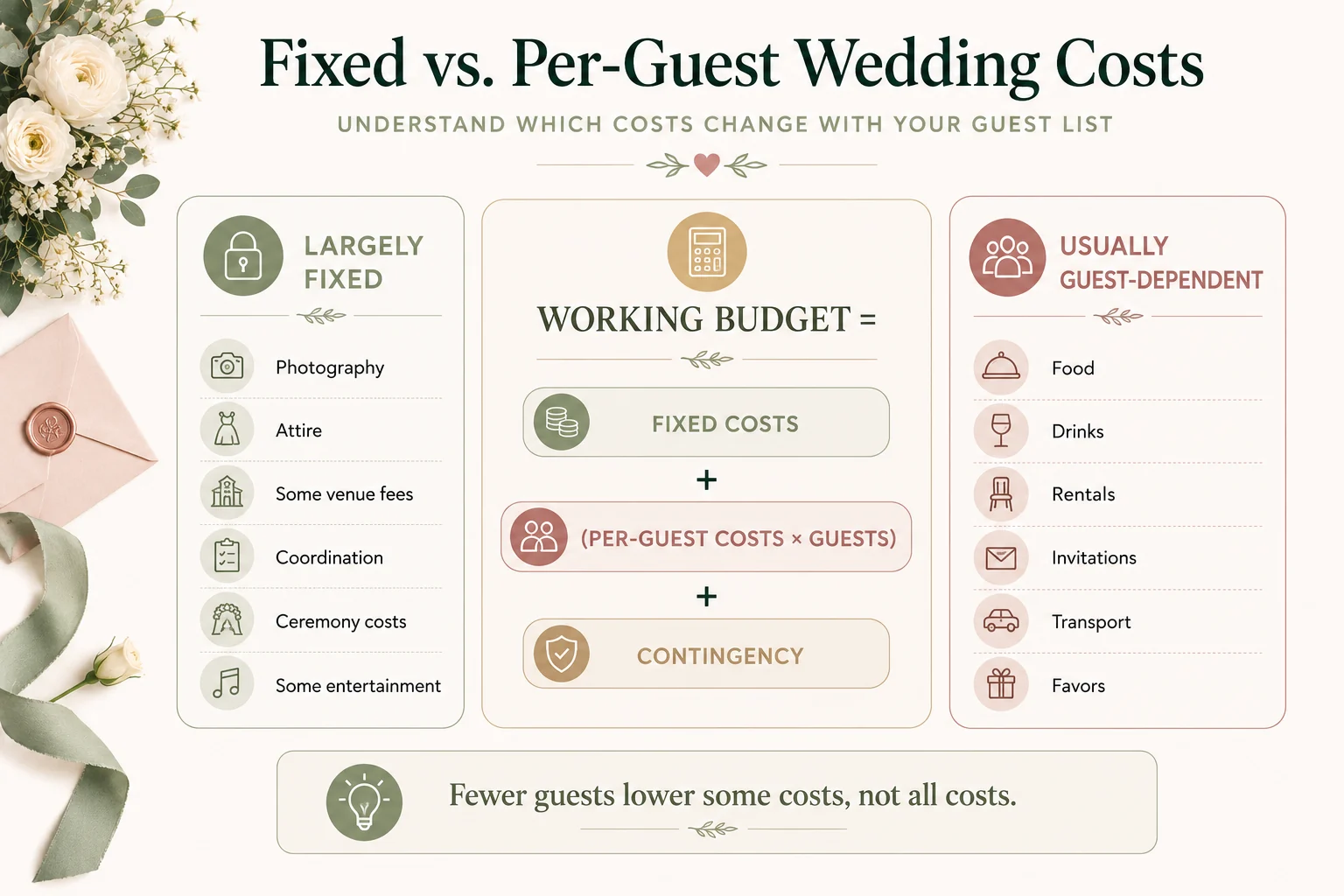
This is why cutting the guest list in half does not necessarily cut the wedding budget in half. For the wider planning process, work through a wedding planning checklist and timeline alongside your budget.
What Changes at 10, 20, 30 and 50 Guests?
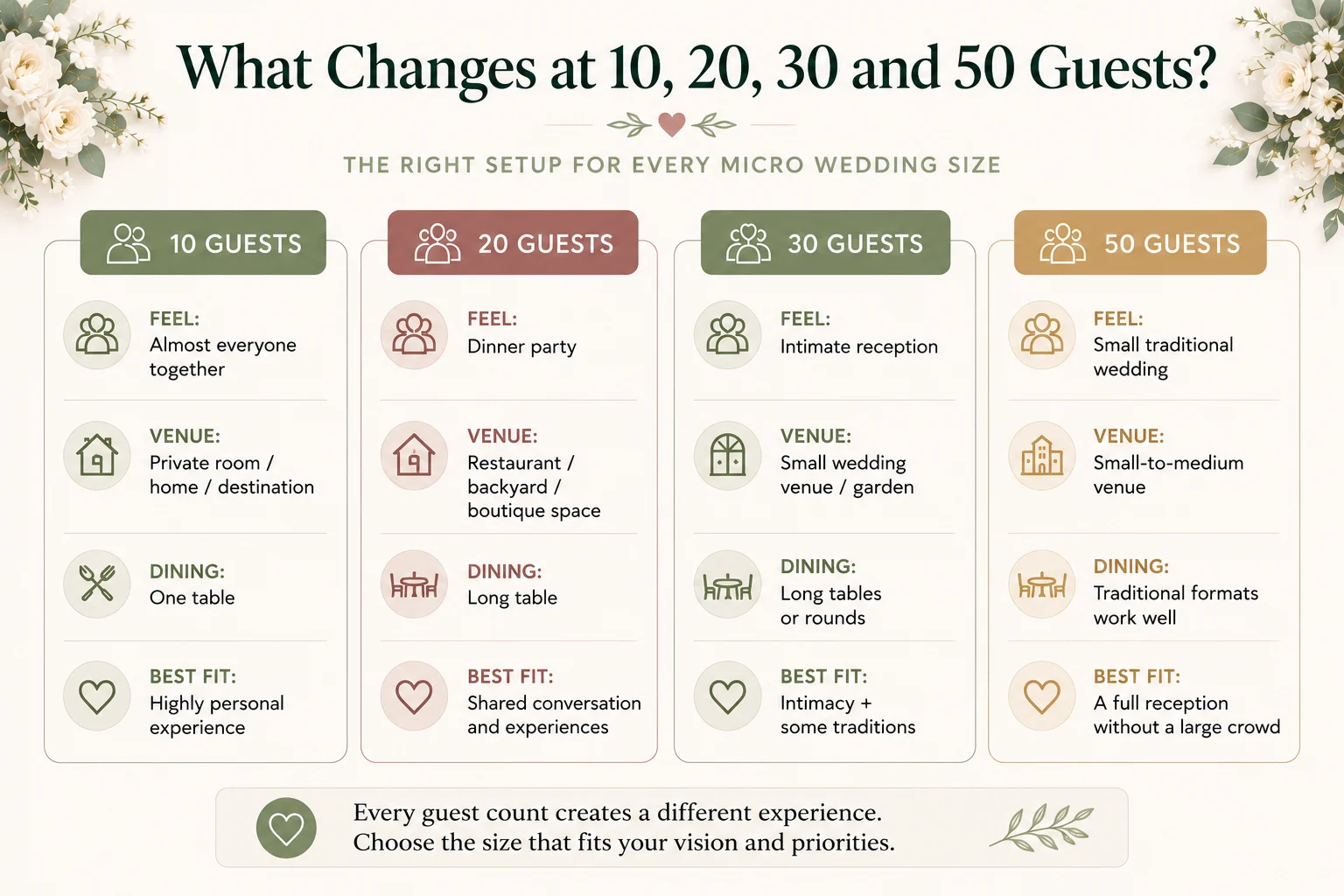
There is no magic format for a particular number of guests, but the scale changes what feels natural.
| Guests | Venue style | Dining | Entertainment | Best if you want... |
|---|---|---|---|---|
| Around 10 | Private dining room, home, garden, destination | One table or tasting menu | Conversation or one shared experience | Almost everyone together for most of the day |
| Around 20 | Restaurant, backyard, boutique venue | One long table or two smaller tables | Acoustic music, games, small dance area | An intimate dinner-party atmosphere |
| Around 30 | Small venue, restaurant buyout, garden | Long tables or several rounds | Live music or selected traditional reception elements | Intimacy without giving up the feel of a reception |
| Around 50 | Small-to-medium wedding venue | More traditional catering becomes practical | DJ, band and fuller reception formats | A small wedding that still feels fairly traditional |
Twenty guests around one table feels intimate. Twenty guests scattered across a ballroom built for 200 feels empty.
Choose the room and format for the group you actually have.
Micro Wedding Venue Ideas
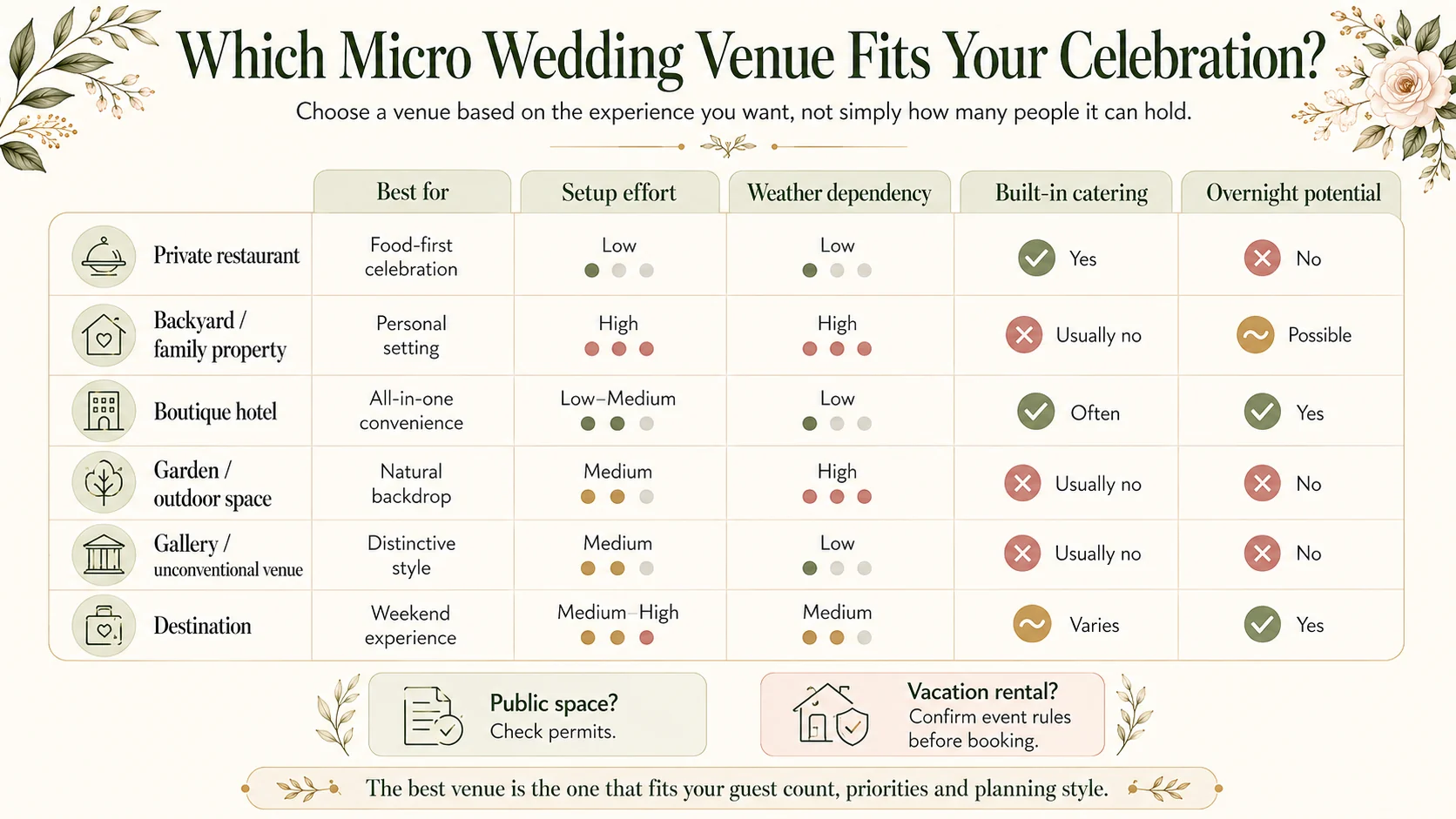
1. Reserve a Private Restaurant or Dining Room
A good restaurant removes several planning jobs at once: food, staff, furniture and often the bar.
It is especially attractive if dinner is meant to be the main event rather than something squeezed between the ceremony and dancing.
Ask about minimum spend, menu flexibility, accessibility, exclusivity, speeches, music and how long you can stay.
2. Celebrate at Home or in a Family Backyard
A family garden or backyard already has something most hired venues do not: personal history.
Just do not confuse familiar with effortless. Parking, toilets, catering access, power, rain cover, furniture, neighbors and cleanup still need a plan.
Choose a private property because you love what it adds to the wedding, not because you assume it will automatically be cheaper.
3. Book a Boutique Hotel or Inn
Small hotels and inns are useful when you want accommodation, dinner and the wedding itself close together.
Look for courtyards, private dining rooms, gardens and lounges rather than a ballroom designed for a much larger crowd.
4. Get Married in a Garden, Park or Outdoor Setting
A group of 15 or 25 opens up outdoor spaces that would be impractical for a large wedding.
Public does not mean unrestricted, though. Parks may limit furniture, amplified sound, photography equipment or group size, and permits may be required. In the United States, for example, wedding requirements vary between National Park Service locations, with some requiring a Special Use Permit. Check the relevant official park authority before making plans.
5. Look Beyond Traditional Wedding Venues
Galleries, conservatories, studios, rooftops and historic homes become much more realistic with a smaller group.
Just check the unglamorous details too: toilets, accessibility, catering access, weather backup and whether the space is actually permitted to host your event.
6. Turn It Into a Destination Weekend
Coordinating travel is considerably easier with 20 guests than 120.
Instead of packing everything into one afternoon, you might have dinner together the night before, the wedding the next day and brunch the following morning. More time together is often one of the biggest benefits of keeping the group small.
If you are considering a vacation rental, confirm that the specific property, host rules, platform terms and local regulations allow the gathering. Airbnb's current rules, for example, prohibit open-invite events and disruptive gatherings. Review the platform's policy before booking.
Micro Wedding Ceremony Ideas
7. Seat Guests in a Circle or Semicircle
Rows of chairs and a long aisle are optional.
With a small group, guests can sit around or partly around the ceremony so nobody feels far away. It works particularly well in gardens, courtyards and compact indoor spaces.
8. Write More Personal Vows
Speaking in front of 20 people can feel very different from speaking in front of 150.
If you want to include specific memories, private jokes or promises that sound like you rather than a wedding template, an intimate ceremony gives you room to do it.
If you need help getting started, use this guide to writing your own wedding vows.
9. Exchange Private Vows Before the Ceremony
Not everything meaningful needs an audience.
You can exchange personal vows privately earlier in the day, then use shorter vows during the ceremony. It gives you one moment that belongs completely to the two of you without removing the shared ceremony your guests came to witness.
10. Give Guests a Meaningful Role
With a small group, participation feels less like assigning jobs and more like including the people closest to you.
Someone might:
- Give a reading
- Perform a song
- Present the rings
- Share a short blessing or wish
- Contribute to a cultural or family ritual
Use the idea selectively. Not every guest needs a responsibility.
11. Rethink the Processional
Walk in together. Arrive from opposite sides. Have guests follow you into the ceremony space. Or skip the processional entirely.
A micro wedding is a useful excuse to ask which traditions genuinely matter to you and which ones you were keeping only because weddings usually have them.
Micro Wedding Reception and Food Ideas
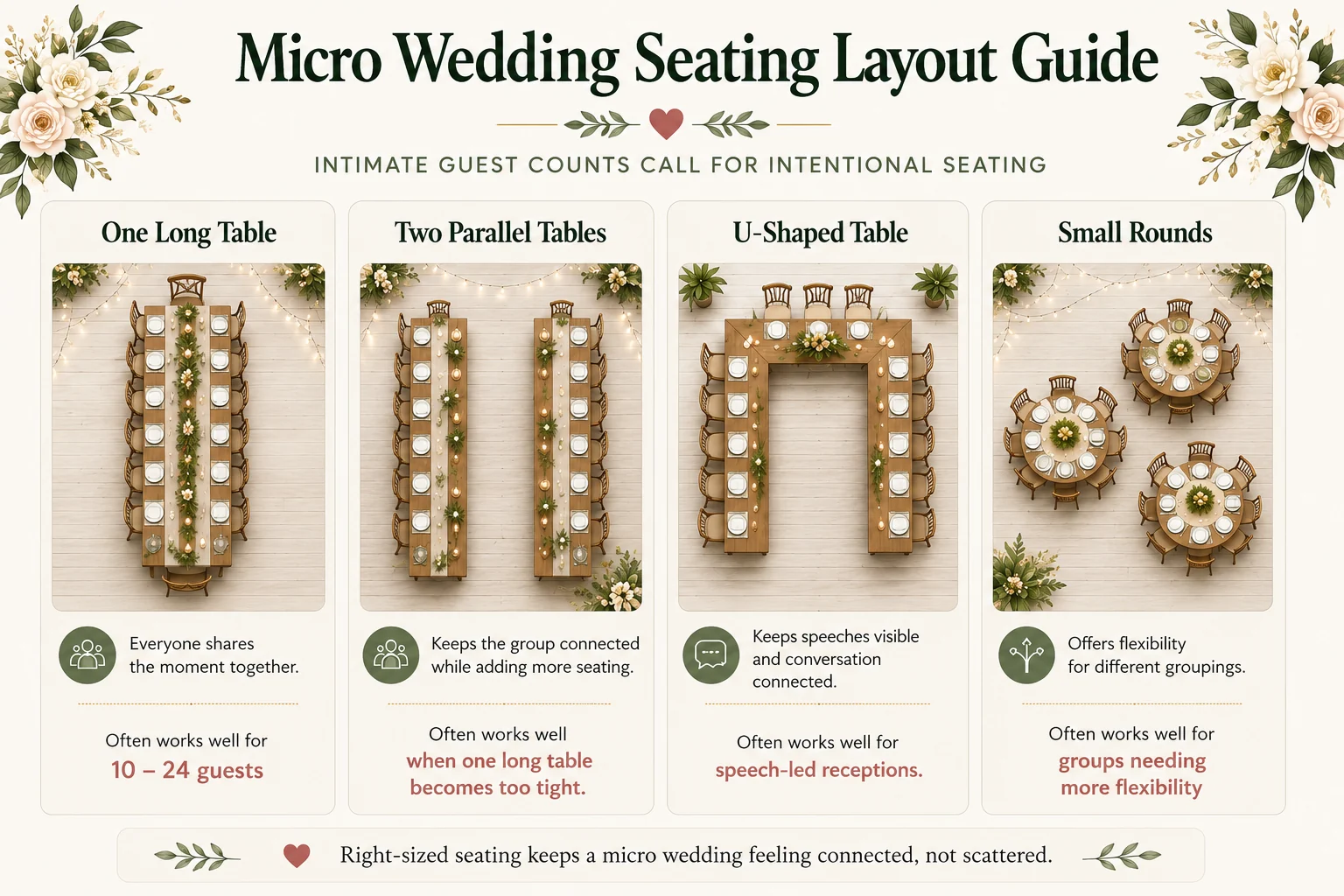
12. Seat Everyone at One Long Table
If your entire guest list fits comfortably around one table, start there before defaulting to traditional rounds.
One long table makes the room feel intentional, keeps the couple inside the conversation and becomes part of the visual design itself.
For a slightly larger group, two parallel tables or a U-shaped layout can create a similar effect.
13. Make Dinner the Reception
Dinner can be the reception.
A long meal, good food, stories, wine and a few thoughtful toasts may be all the entertainment your group needs.
For couples who love restaurants and conversation more than dance floors, this format rarely feels like a compromise.
14. Choose Brunch or Lunch
Nothing says a wedding has to begin in the late afternoon and finish at midnight.
A morning ceremony followed by brunch works beautifully for garden or city weddings. Lunch is a natural fit when you have booked a favorite restaurant and do not need to build the day around evening entertainment.
15. Serve Food Family-Style
Passing dishes around the table suits the communal feel of a small wedding and encourages conversation without requiring another organized activity.
Check that your table is wide enough for shared dishes before committing to the format.
16. Turn Dinner Into a Tasting Experience
Serving several carefully planned courses to 20 people may be realistic where doing the same for 120 is not.
If food matters to you, this is a good example of spending more per person while still keeping the overall guest-dependent budget under control.
17. Build the Reception Around Drinks and Small Plates
A formal three-course dinner is optional.
Cocktails, substantial small plates and relaxed seating can work well for a group that would rather move around and talk. Just provide enough real seating for anyone who needs it.
18. Choose One Great Dessert
A 25-person wedding does not need a cake designed to feed a ballroom.
Order a smaller cake in a flavor you actually love, serve a favorite local dessert or finish dinner with individual pastries. Fewer portions often means you can care more about what each one tastes like.
How to Make a Micro Wedding Feel Special, Not Small
Trying to make a 20-person wedding look like a 100-person wedding usually works against you.
Lean into what the smaller group makes possible.
19. Write a Note for Every Guest
Twenty handwritten notes is a project. One hundred and fifty is a production line.
Leave a short message at each place setting explaining why having that person there matters to you. It costs very little and feels far more personal than a generic favor.
20. Plan One Shared Experience
You do not need six activities. One good one is enough.
Depending on your group, that could be:
- A wine tasting
- A boat trip
- Karaoke
- Lawn games
- A bonfire
- A guided walk
- A cooking experience
- A next-day brunch
Pick something the people attending would genuinely enjoy, not something that merely looks good on a wedding checklist.
21. Open Up the Toasts
With fewer guests, speeches do not have to belong only to the traditional two or three people.
Invite a small number of friends or relatives to share a story or toast. Ask in advance and give everyone a rough time limit so dinner does not turn into an open microphone.
22. Take a Photo With Every Guest
At a 150-person wedding, photographing every guest with the couple can consume half the reception.
At a micro wedding, it is entirely realistic.
Take one photograph with the whole group, then a few smaller family and friendship combinations. Years later, that complete record of who was there may matter more than another perfectly styled detail shot.
23. Give Yourselves More Time Together
If guests are traveling, consider adding one relaxed moment outside the wedding itself.
Drinks the evening before or coffee the next morning gives everyone more time together without forcing additional entertainment into the reception schedule.
The point is not to create a three-day itinerary. It is to stop rushing.
Micro Wedding Entertainment and Decor Ideas
24. Choose Live Acoustic Music
A solo musician, duo or small ensemble fills a compact space without drowning out conversation.
That makes acoustic music particularly suited to ceremonies, drinks and dinner, when atmosphere matters more than volume.
25. Skip the Huge Dance Floor If Nobody Wants One
A dance floor is only an advantage if your guests actually want to dance.
If they do, keep it. If they do not, use the space for karaoke, live music, games, comfortable seating or simply a longer dinner.
There is no prize for reproducing every element of a large reception.
26. Put the Decor Budget in One or Two Places
With fewer tables and a smaller venue footprint, you do not need to spread the flower budget everywhere.
Put the impact where guests will notice it:
- The ceremony backdrop
- The dining table
- The entrance
- The bar
- A fireplace or architectural feature
One memorable arrangement often does more than dozens of smaller ones scattered around the room.
27. Use Lighting to Make the Space Feel Intentional
Candles, table lamps, lanterns and warm string lights can pull attention toward the parts of the venue guests are actually using.
The goal is not to hide the size of the room. It is to make the occupied area feel warm and complete.
Follow the venue's rules for candles, power and installations.
How to Capture a Micro Wedding From Every Perspective
28. Keep Professional Photography on the Priority List
A small wedding is still a once-only event.
Professional photography gives you consistent coverage of the ceremony, portraits, details and candid moments. With fewer guests competing for the photographer's attention, there may also be more room for relaxed portraits and spontaneous interaction.
29. Collect the Photos and Videos Your Guests Take
Your photographer sees the wedding professionally. Your guests see it personally.
Someone at the other end of the table might capture your grandmother laughing during dinner, friends getting ready together or a moment outside while the photographer is somewhere else.
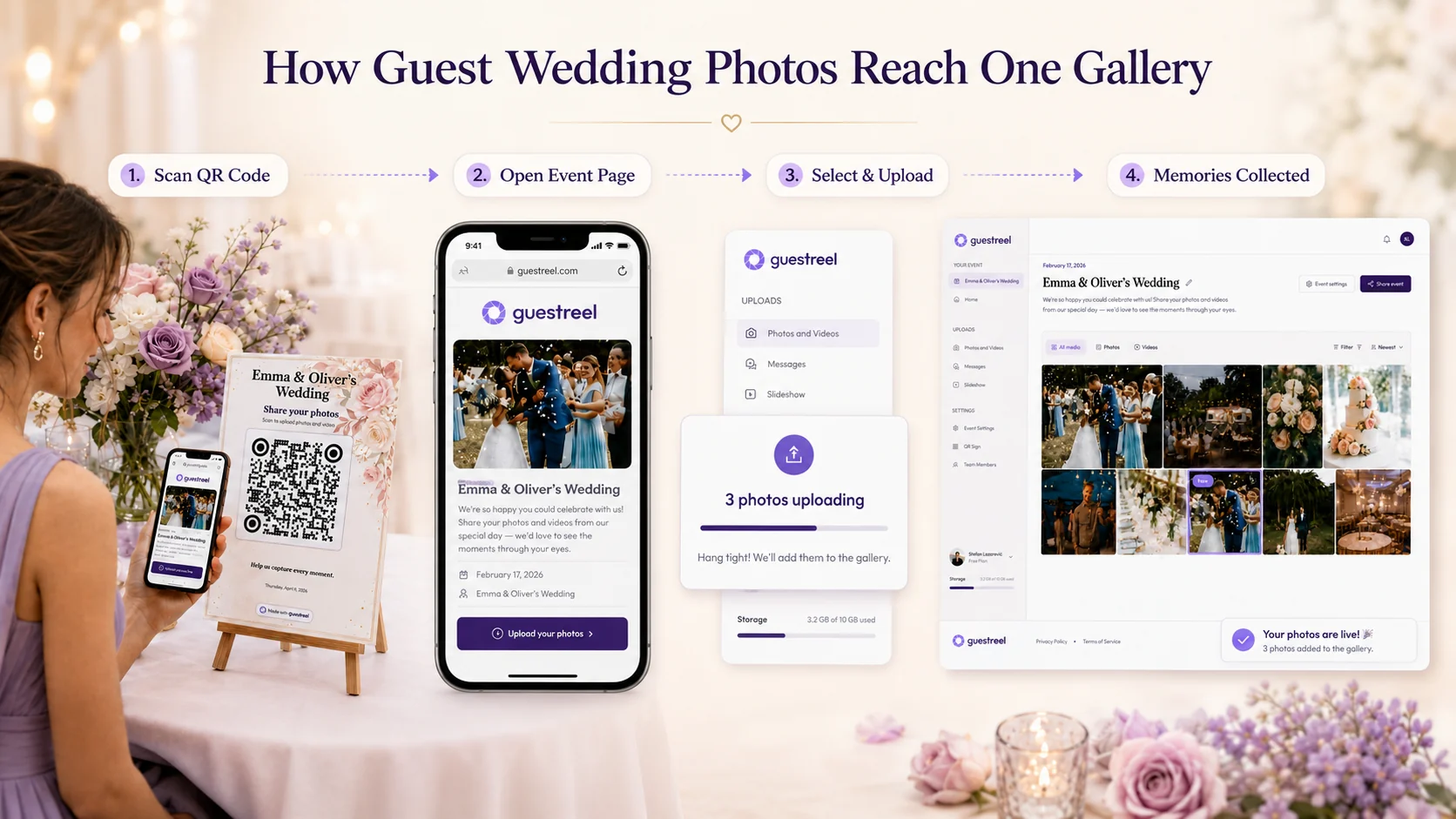
Decide before the wedding how those photos will reach you. Messaging apps, shared albums and QR-based upload tools all work differently, so choose the option your group is most likely to use.
If you want to avoid chasing photos through different chats afterward, read this guide to collecting wedding photos from guests.
Guestreel is one option designed specifically for this. Guests scan a personalized QR code and upload photos and videos through their browser, with no app download required, so the media is collected in one private event gallery. See how Guestreel works for weddings.
30. Back Up the Photos Afterward
Once the professional gallery and guest photos arrive, keep an additional copy somewhere you control.
Use folders that will still make sense years from now, and print the photographs you really care about. A digital gallery is useful. A photo you can still find in 20 years is better.
What Should You Spend More On at a Micro Wedding?
A smaller guest list gives you more control over where the money goes. It does not tell you what to value.
| Consider prioritizing | Consider reducing or skipping |
|---|---|
| Food you genuinely care about | Oversized catering quantities |
| Photography | Traditions you do not value |
| Guest comfort | Generic favors |
| A venue that suits the group | A ballroom designed for hundreds |
| Accommodation or transport when useful | Excess rental inventory |
| One memorable experience | Activities added only to fill time |
| A few strong decor moments | Decorations spread across unused space |
If dancing matters more than dinner, spend on the DJ. If you care deeply about food, book the restaurant you would never be able to afford for 120 guests.
The benefit is having choices.
Three Sample Micro Wedding Timelines
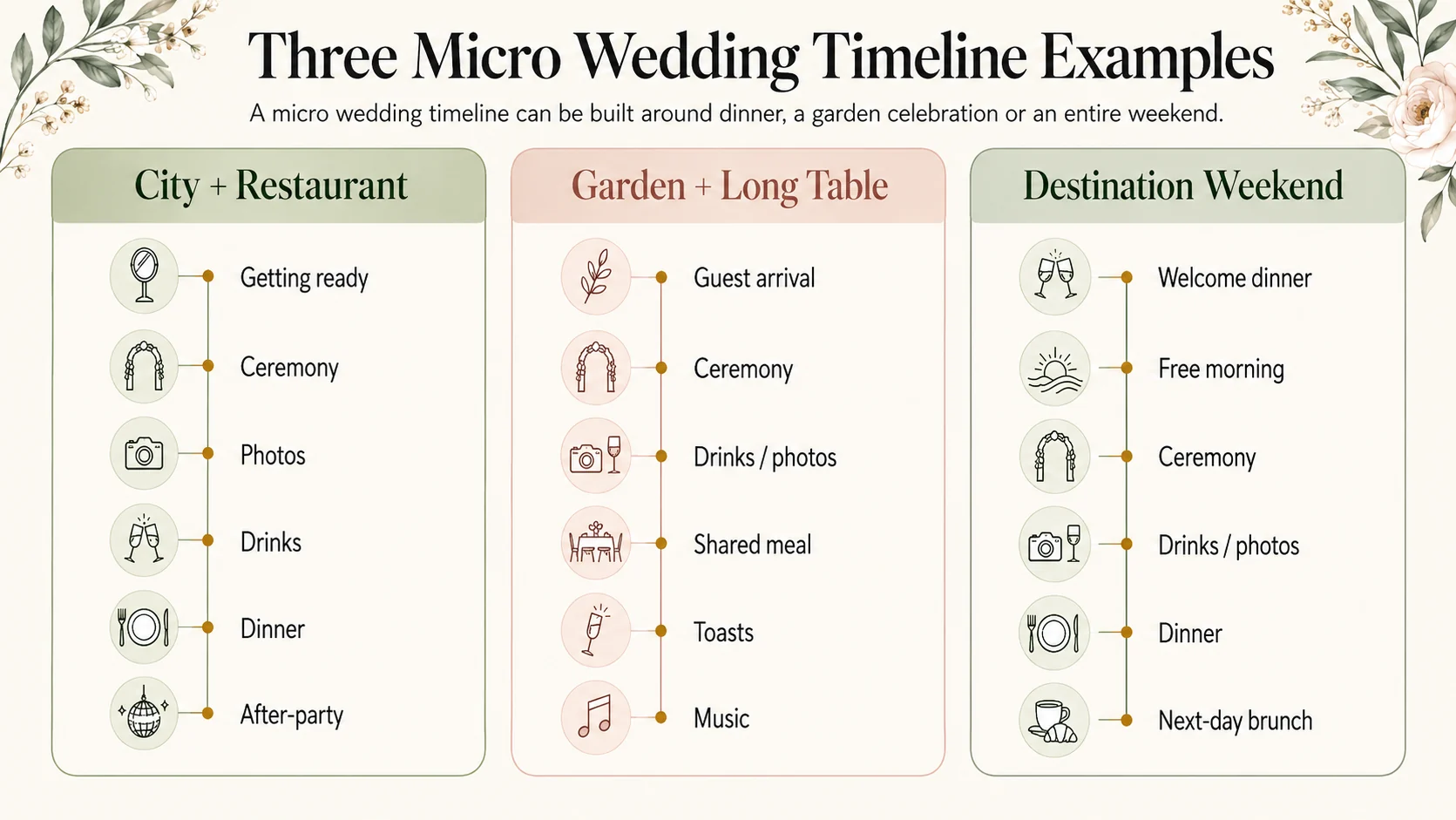
Use these as examples, then adjust for travel, photography, venue access, cultural traditions and whatever matters most to you.
City Ceremony and Restaurant Dinner
- 3:00 p.m. — Getting ready and photographs
- 4:00 p.m. — Ceremony
- 4:30 p.m. — Congratulations and group photographs
- 5:00 p.m. — Walk or travel to the restaurant
- 5:30 p.m. — Drinks
- 6:30 p.m. — Dinner and toasts
- 9:00 p.m. — Dessert, drinks or an informal after-party
This works particularly well when the meal is meant to be the center of the reception.
Garden Ceremony and Long-Table Reception
- 2:30 p.m. — Guests arrive
- 3:00 p.m. — Ceremony
- 3:30 p.m. — Drinks and photographs
- 4:30 p.m. — Shared meal
- 6:30 p.m. — Toasts and dessert
- 7:00 p.m. — Live music, games or dancing
- 9:30 p.m. — Final drinks
If most of the day is outside, plan the wet-weather version at the same time as the sunny one.
Destination Micro Wedding Weekend
- Day before — Welcome dinner or drinks
- Wedding morning — Free time
- 3:00 p.m. — Ceremony
- 4:00 p.m. — Photographs and drinks
- 6:00 p.m. — Dinner
- 8:00 p.m. — Music, drinks or a shared activity
- Next morning — Informal breakfast or brunch
The advantage is not having more events. It is having more unhurried time with the people you invited.
Common Micro Wedding Mistakes to Avoid
- Choosing a venue that is too large. A beautiful ballroom can still feel empty when it was designed for five times your guest count.
- Setting a number without setting a guest-list rule. That turns every invitation into a fresh negotiation.
- Assuming fewer guests automatically means cheap. Photography, attire and other fixed costs do not disappear.
- Keeping every wedding tradition by default. Use the ones you care about and leave the rest behind.
- Planning too many activities. A smaller group does not need to be entertained every minute.
- Forgetting practical logistics. Parking, toilets, weather, accessibility, food service and venue permissions still matter.
- DIYing everything because the wedding is small. Twenty handmade items still require materials, transport, setup and time.
- Trying to make the wedding look bigger. A micro wedding works best when intimacy is part of the design.
- Leaving guest photos until afterward. Decide how people will share them while everyone is still together.
For more planning pitfalls, see these wedding mistakes to avoid.
Frequently Asked Questions
How many guests is considered a micro wedding?
There is no universal cutoff, but around 50 guests or fewer is a commonly used benchmark. Some planners use "micro wedding" for much smaller groups. The exact label matters less than whether your guest count creates the intimate format you want.
How much does a micro wedding cost?
There is no reliable universal price. Location, venue, vendors and the experience you choose matter as much as guest count. Fewer guests can reduce catering and other per-person costs, while expenses such as photography, attire and some venue fees may remain largely fixed.
Is a micro wedding always cheaper than a traditional wedding?
No. Many couples spend less overall, but others redirect the savings into better food, accommodation, photography or a more distinctive venue. A smaller guest list gives you more flexibility over where the budget goes; it does not guarantee a low-cost wedding.
What is the difference between a micro wedding and an elopement?
A micro wedding usually includes a small invited group and a planned celebration around the ceremony. An elopement generally focuses more closely on the couple and may include no guests or only a handful. Neither term has one universal legal definition.
How do you choose who to invite to a micro wedding?
Set the maximum guest count first, then agree on one consistent rule with your partner. You might invite immediate family and closest friends, use relationship tiers or ask whose absence would genuinely change the day. Decide the plus-one and children policy before invitations go out.
How do you make a micro wedding feel special?
Design around the small group instead of trying to make the wedding look bigger. Choose a right-sized venue, personalize details for individual guests, plan a great meal or shared experience and leave enough time to actually be with the people you invited.
Do you need a DJ at a micro wedding?
Only if your group wants one. A DJ can work brilliantly for 30 or 50 guests who love dancing, while a 15-person dinner might suit acoustic music, karaoke, a playlist or no formal entertainment at all.
What is a good venue for 20 to 30 wedding guests?
Private restaurant rooms, boutique hotels, gardens, family properties and small event spaces are all strong options. Look for somewhere that feels naturally occupied at your actual guest count, then check accessibility, catering, weather, noise and event restrictions before booking.
Make the Small Guest List the Point
The best micro wedding does not feel like a large wedding with people missing. It feels designed for the people who are there.
Start with the guest list, choose a space that suits it, then spend your time and budget on the parts of the day you will actually care about.
Everything else is optional.