Outdoor wedding venue ideas range from botanical gardens and vineyards to beaches, private estates, forests, mountains and family backyards. The best venue is not necessarily the one with the most impressive view. It is the one that gives you the atmosphere you want and still works for your guests, suppliers, budget and weather plan.
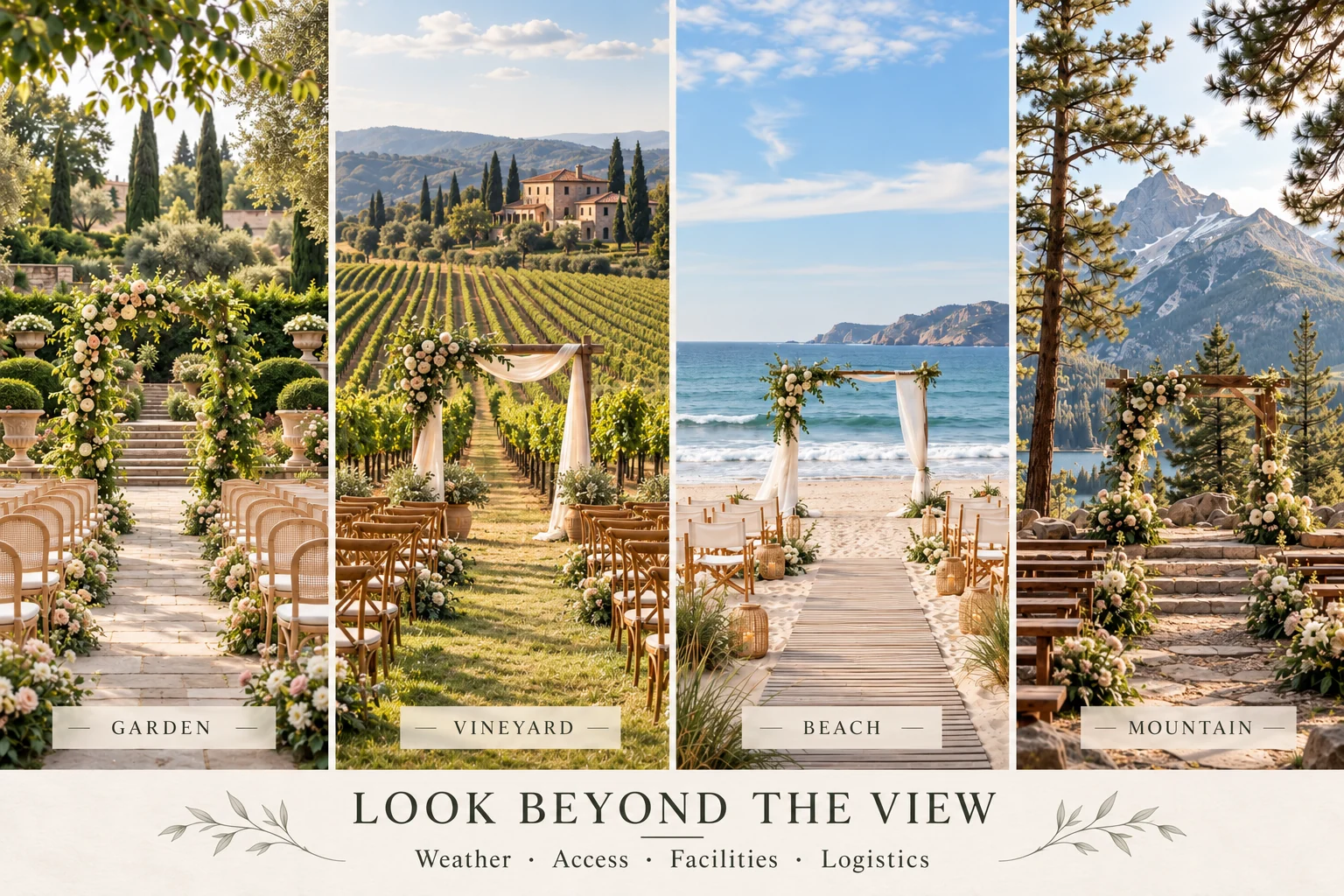
Start with the setting you love, then look beyond the photographs. Check the backup space, toilets, power, parking, accessibility, catering access and what happens if the ground is wet or the weather changes.
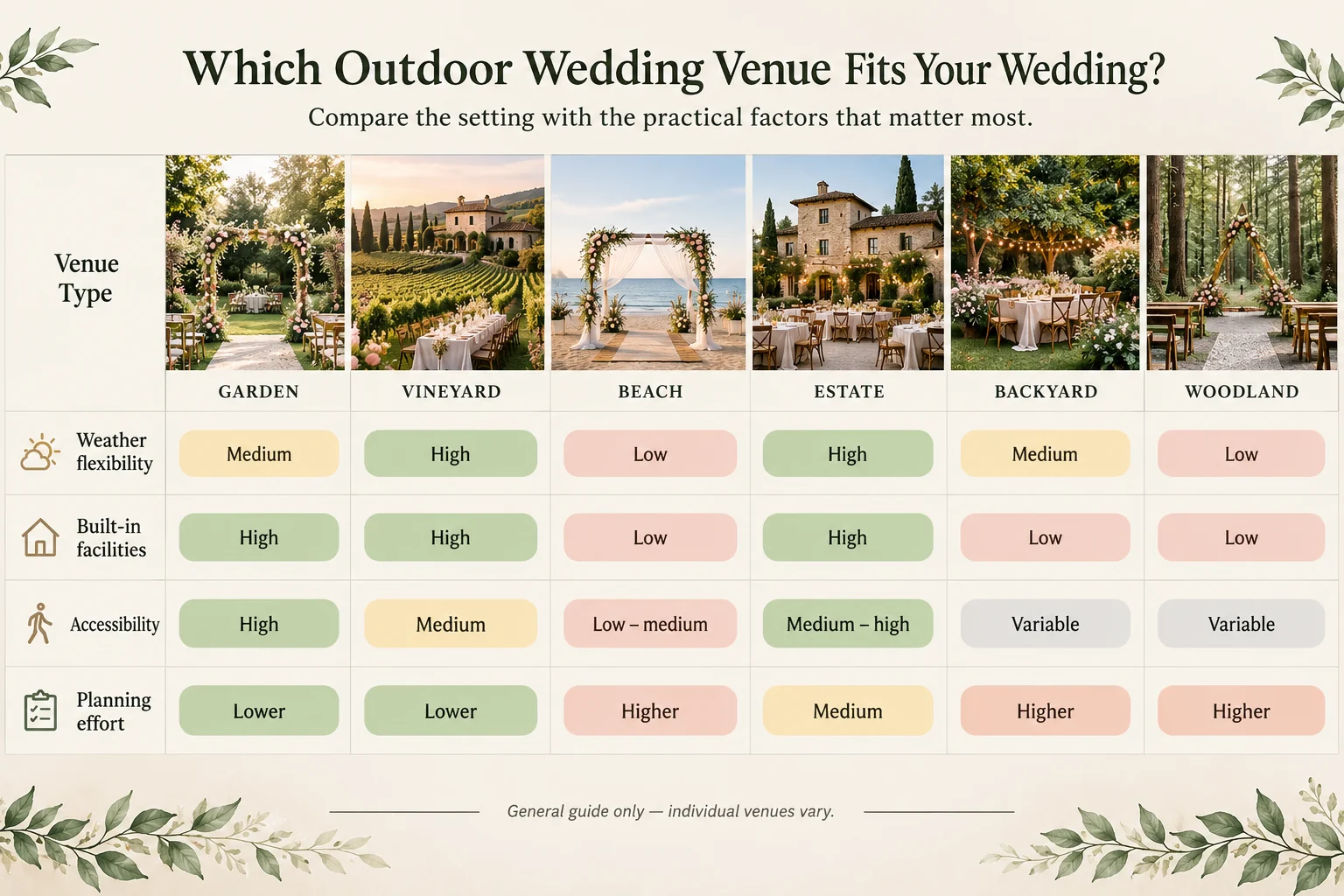
Outdoor Wedding Venues at a Glance
| Venue type | Best for | Biggest advantage | Main trade-off | Planning level |
|---|---|---|---|---|
| Garden | Romantic, classic weddings | Built-in natural beauty | Seasonal conditions | Usually simpler |
| Vineyard or winery | Elegant countryside weddings | Scenery plus established facilities | Transport can be limited | Usually simpler |
| Beach | Relaxed or destination weddings | Dramatic natural backdrop | Wind, access and weather | More involved |
| Private estate | Private, personalised celebrations | Flexibility and exclusivity | Inclusions vary widely | Moderate |
| Backyard | Intimate, personal weddings | Creative freedom | Extra infrastructure may be needed | More involved |
| Farm or barn grounds | Rustic countryside weddings | Character and open space | Terrain and transport | Moderate |
| Forest or woodland | Nature-led weddings | Immersive atmosphere | Access and infrastructure | More involved |
| Mountain or hilltop | Scenic destination weddings | Exceptional views | Exposure and accessibility | More involved |
| Lakefront or riverside | Relaxed scenic weddings | Water views | Safety and ground conditions | Moderate |
| Public park | Smaller, nature-focused ceremonies | Attractive public landscapes | Permits and public access | Moderate |
| Rooftop or courtyard | Urban outdoor weddings | City setting and convenience | Space, wind or noise limits | Usually simpler |
| Desert | Modern destination weddings | Distinctive landscape | Heat and remoteness | More involved |
| Campground or lodge | Weekend celebrations | Accommodation and social time together | Site logistics | Moderate to more involved |
These are broad comparisons rather than rules. A purpose-built woodland wedding venue may be far easier to organise than a large private garden with no event infrastructure.
13 Outdoor Wedding Venue Ideas
1. Garden or Botanical Garden
Best for: romantic, floral and classic weddings.
A garden already has much of the decoration built in. Mature trees, lawns, flower beds, fountains and architectural features can create ceremony backdrops and photography spots without needing elaborate styling.
The important word is seasonal. A garden shown covered in blossom on its website may feel very different six months later. If you can, look for photographs taken during the month of your wedding rather than relying only on a venue's best marketing images.
Also look down as well as around. Paved paths and firm surfaces are easier for guests to navigate than long stretches of grass, particularly after rain.
Before booking, ask which parts of the garden will be available exclusively to your wedding, what is normally in bloom, and where the event moves if the weather changes.
2. Vineyard or Winery
Best for: elegant countryside weddings where food, wine and scenery are part of the experience.
Vineyards work particularly well when you want an outdoor setting without starting with a completely blank site. Established wineries may already have terraces, indoor dining rooms, catering facilities, toilets and parking alongside the outdoor ceremony areas.
Do not judge the site only from golden-hour photographs. If your ceremony is planned for mid-afternoon, ask where the sun will actually be and whether guests will be sitting in direct sunlight.
Transport is another practical consideration. A beautiful winery outside town can become awkward at the end of the night if taxis are scarce or guests have been drinking. Check nearby accommodation and whether coaches or shuttles can reach the property comfortably.
3. Beach or Coastal Venue
Best for: relaxed weddings, destination celebrations and couples who want the landscape to provide most of the backdrop.
Few venues need less explanation than a beach. Sea, sky and open space create the setting naturally.
They also introduce details that photographs tend to hide: wind, waves, tides, soft sand, public access and distance from parking.
Stand where the ceremony would actually take place and listen. Wind and surf can make vows surprisingly difficult to hear, particularly for guests seated towards the back.
Accessibility matters too. Sand that feels manageable during a quick site visit may be difficult for someone using a wheelchair, a walking aid or formal footwear. Look for boardwalks, firm routes and practical drop-off points.
If the beach is public, confirm the rules with the relevant authority rather than assuming an area can be reserved or that chairs, arches, alcohol and amplified sound are permitted.
4. Private Estate
Best for: couples who want privacy, flexibility and several parts of the wedding to happen on one property.
A good private estate can give you separate spaces for the ceremony, drinks, dinner and evening celebration without asking guests to travel between venues.
The strongest estates also have somewhere genuinely useful to move indoors. A house, orangery, permanent marquee or covered terrace can make the difference between a flexible outdoor wedding and one that depends entirely on the forecast.
Check what the hire actually includes. "Exclusive use" does not necessarily mean tables, staff, power, catering facilities, accommodation or clean-up are part of the package.
5. Backyard or Family Property
Best for: intimate weddings with personal meaning and couples who are comfortable organising more of the event themselves.
Getting married at home can make the day feel deeply personal. You also have more control over how the space is used and fewer conventions dictating what a wedding venue should look like.
The mistake is assuming that a home automatically functions as an event venue.
A property that comfortably hosts Sunday lunch may struggle with a large catering team, dozens of cars, music equipment, extra toilets and a full evening reception.
Before getting attached to the idea, list everything the property already has and everything you would need to bring in. That may include:
- toilets;
- additional electricity;
- furniture;
- lighting;
- weather cover;
- catering equipment;
- flooring;
- parking or transport;
- rubbish removal.
A backyard wedding can be a wonderful choice because the location means something to you. It is a weaker choice when the main assumption is simply that using private property will cost less.
For a wider look at the financial trade-offs, our guide on how to cut wedding costs can help you compare savings against the things you would need to hire separately.
6. Farm or Barn With Outdoor Grounds
Best for: relaxed countryside weddings, rustic celebrations and couples who want both open space and a covered reception option.
Farm and barn venues can offer the best of both worlds: an outdoor ceremony and countryside views, with a permanent building close by for dinner and dancing.
Pay attention to the ground between those spaces. Gravel, farm tracks and grass can feel completely different after several hours of rain.
Imagine the venue from a guest's perspective rather than from the photographer's. Can an older relative get easily from the car park to the ceremony? Will guests walk across a field in the dark after the reception? Are the toilets inside the barn or somewhere else on the property?
If it is a working farm, ask whether animals, machinery or agricultural activity affect which areas guests can use.
7. Forest or Woodland
Best for: intimate weddings that prioritise nature and atmosphere over traditional venue styling.
A woodland clearing can feel almost architectural. Tall trees create height and enclosure, filtered light softens the setting, and the environment needs very little decoration.
But woodland beauty can disguise how much infrastructure is missing.
Before thinking about flowers or signage, find out how guests and suppliers reach the ceremony site. Then check power, lighting after dark, toilets, catering access, mobile reception and emergency vehicle access.
Look closely at the terrain too. Tree roots, mud, slopes and narrow paths can turn a short walk into a significant accessibility issue.
8. Mountain or Hilltop
Best for: scenic destination weddings and couples who want the landscape to be a major part of the experience.
Mountain venues deliver views that are difficult for almost any other location to match.
They can also be unforgiving.
An exposed ceremony location needs a weather plan that goes beyond keeping guests dry. Wind, temperature changes and storms can all affect whether an outdoor space remains comfortable or safe.
Transport deserves equal attention. Find out how coaches, taxis, suppliers and guests with limited mobility reach the site. A spectacular lookout loses some of its appeal if a significant part of the guest list cannot access it comfortably.
9. Lakefront or Riverside
Best for: relaxed outdoor weddings with water views but without the full exposure of a beach.
Lakefront lawns and riverside venues can work beautifully for ceremonies, drinks and sunset receptions.
Walk the venue imagining it full of guests rather than empty. Where will children be relative to the water? Are there unlit edges or docks? What does the lawn feel like after rain? Where do insects tend to be most noticeable in the evening?
If a dock or narrow waterfront terrace is part of the ceremony plan, ask about comfortable capacity rather than judging the space from photographs.
10. Public Park or National Park
Best for: smaller ceremonies, nature-focused weddings and couples happy to work within public-space restrictions.
Public parks can give you access to extraordinary landscapes without hiring a traditional wedding venue. In exchange, you usually have less control over the wider environment.
Other visitors may still be present, and rules can vary significantly between locations.
In the United States, national parks generally require a special use permit for weddings, and each park sets its own conditions. Glacier National Park, for example, requires a permit for every ceremony regardless of group size.
The same principle applies elsewhere: check the official authority responsible for the specific park, beach or public land rather than relying on a general wedding guide.
11. Rooftop, Terrace or Courtyard
Best for: city weddings where you want outdoor atmosphere without asking guests to travel far from hotels and transport.
A rooftop gives you the skyline. A courtyard gives you more shelter. Both can bring outdoor character into an otherwise urban wedding.
On a rooftop, the view may win you over in five minutes. Give the floor plan longer.
Ask how your actual guest count fits once tables, a bar, entertainment, catering areas and circulation space are included. If furniture has to be moved between the ceremony, drinks and dinner, find out who manages the changeover and how long it takes.
Wind is also more than a comfort issue. Ask what happens to floral installations, candles, signage and temporary structures when conditions are breezy.
12. Desert Landscape
Best for: modern, minimalist and destination weddings built around an unusual natural setting.
A desert landscape can make even a simple ceremony feel distinctive because the surroundings do most of the visual work.
That simplicity is deceptive from a planning perspective.
Shade, drinking water, transport and changing temperatures need attention from the start. Guests can experience very different conditions between an afternoon ceremony and an evening reception after the sun disappears.
Remote desert locations also need a clear operational base. Know where catering happens, where the toilets are, how vehicles access the site and where everyone goes if the weather becomes unsafe.
13. Campground, Lodge or Glamping Site
Best for: weekend weddings, festival-style celebrations and couples who want guests to spend more time together.
These venues can turn a wedding into a full weekend rather than a single evening. Guests can stay nearby, share breakfasts or activities and avoid travelling home immediately after the reception.
Not everyone will want to camp, though. Check what accommodation alternatives exist for older relatives, families with young children and anyone who would prefer a conventional hotel room.
Facilities also vary dramatically. A lodge with event staff, bathrooms and a commercial kitchen is very different from renting a field with cabins nearby.
Clarify noise limits, power, lighting, showers, toilets, catering access and what the venue expects guests to do with their belongings before checkout.
Fully Outdoor vs Indoor/Outdoor: Which Wedding Venue Is Better?
For most couples, the useful question is not simply "Do we want an outdoor wedding?"
It is:
How much weather and infrastructure risk do we want to manage ourselves?
| Venue format | Main advantage | Main limitation | Best suited to |
|---|---|---|---|
| Fully outdoor | Maximum use of the landscape | Greatest exposure to changing conditions | Couples with a robust shelter and weather plan |
| Outdoor ceremony + indoor reception | Outdoor atmosphere with simpler evening logistics | Ceremony still needs a backup | Traditional wedding timelines |
| Indoor/outdoor hybrid | Guests can move naturally between both | Less of a completely outdoor feel | Couples prioritising flexibility |
| Raw outdoor site | Maximum creative control | Most infrastructure must be organised | Highly customised events with strong planning support |
A backup space only counts as a good backup if your wedding can actually happen there.
If the venue tells you it has an indoor option for bad weather, see it. Ask how many seated guests it holds, where the ceremony would go, whether catering still works and what happens to the planned reception layout.
How to Choose the Right Outdoor Wedding Venue
The scenery gets a venue onto your shortlist. The details decide whether it should stay there.
Start With Comfortable Capacity, Not Maximum Capacity
A lawn that can physically hold 150 chairs may not comfortably support 150 guests once you add aisles, musicians, an arch, accessibility space and room for people to move.
Ask venues to show you photographs or floor plans from weddings close to your expected guest count.
If the venue's maximum capacity is also your guest list, look particularly closely at how crowded the real setup feels.
For the broader selection process, our wedding venue planning guide covers how to define your priorities, evaluate venues and ask the right questions before booking.
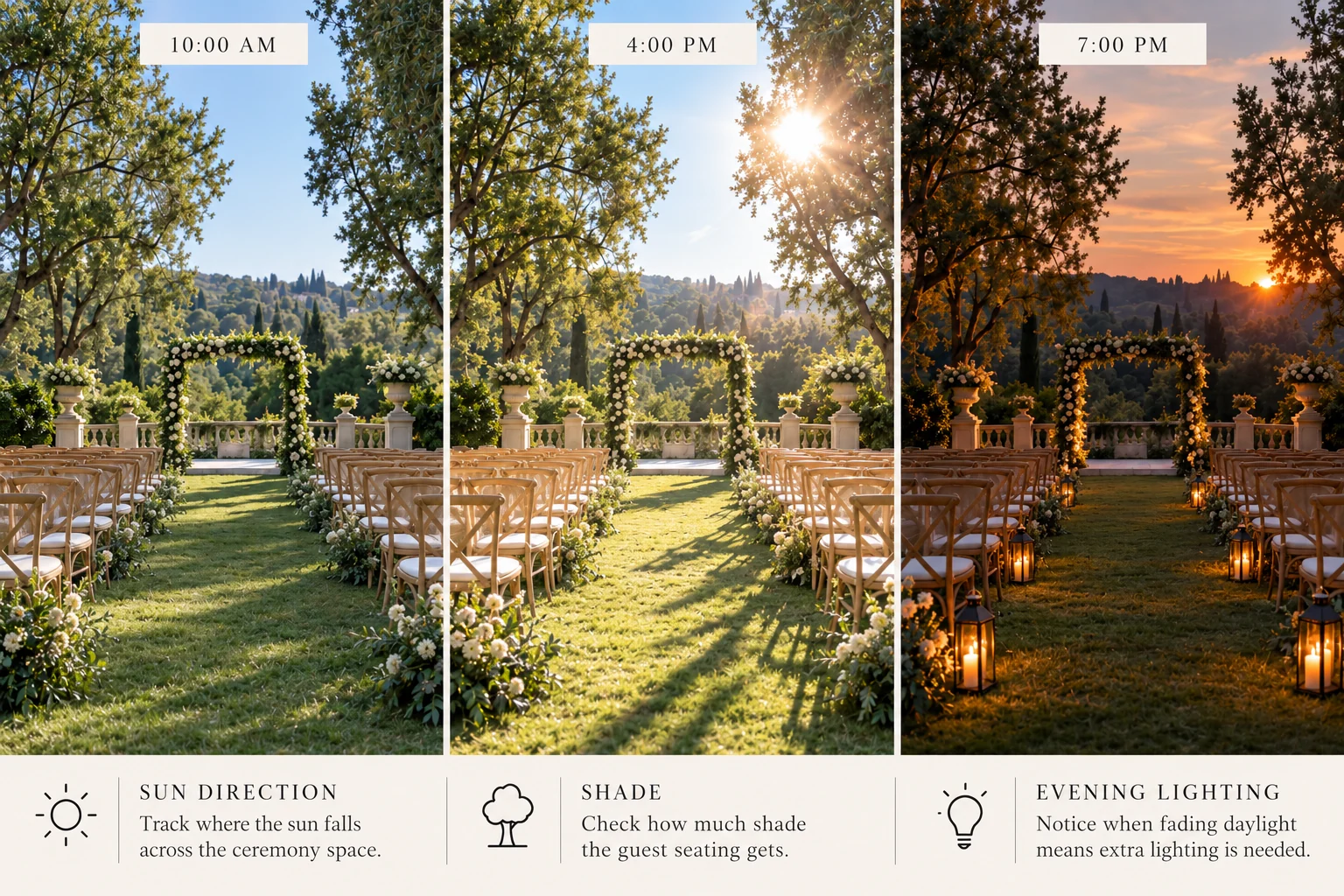
Visit at the Time Your Wedding Will Actually Happen
A venue can feel completely different at 4pm than it does during a 10am tour.
If possible, visit around your planned ceremony time or ask for photographs taken then. Look at:
- where the sun will be;
- whether guests will face direct sunlight;
- how much natural shade exists;
- traffic or surrounding noise;
- temperature changes as evening approaches;
- lighting once the sun sets;
- activity from neighbouring venues or public areas.
Near water, notice wind and insects. In the countryside, listen for roads, farm equipment or nearby events.
These details are easy to miss on a quick tour and difficult to redesign around later.
Compare the Whole Cost, Not Just the Hire Fee
A low venue fee does not necessarily mean a lower-cost wedding.
Compare what each location requires before it can host your event. A raw outdoor site may need:
- a tent or marquee;
- tables and chairs;
- toilets;
- generators;
- lighting;
- flooring;
- catering equipment;
- transport;
- event staff;
- clean-up.
An established venue may charge more upfront but already include much of that infrastructure.
Judge Plan B as Seriously as Plan A
If you would be deeply disappointed to hold the wedding in the backup location, treat that as part of the venue decision now.
Walk through the wet-weather version of the day:
- Where does the ceremony move?
- Where do guests wait beforehand?
- Can drinks still happen comfortably?
- Does dinner stay in the planned location?
- Can suppliers work without rebuilding the event from scratch?
- Can guests move between spaces without getting soaked?
"We have a tent" is not a full weather plan. Neither is "there's a room inside" if that room cannot comfortably hold everyone.
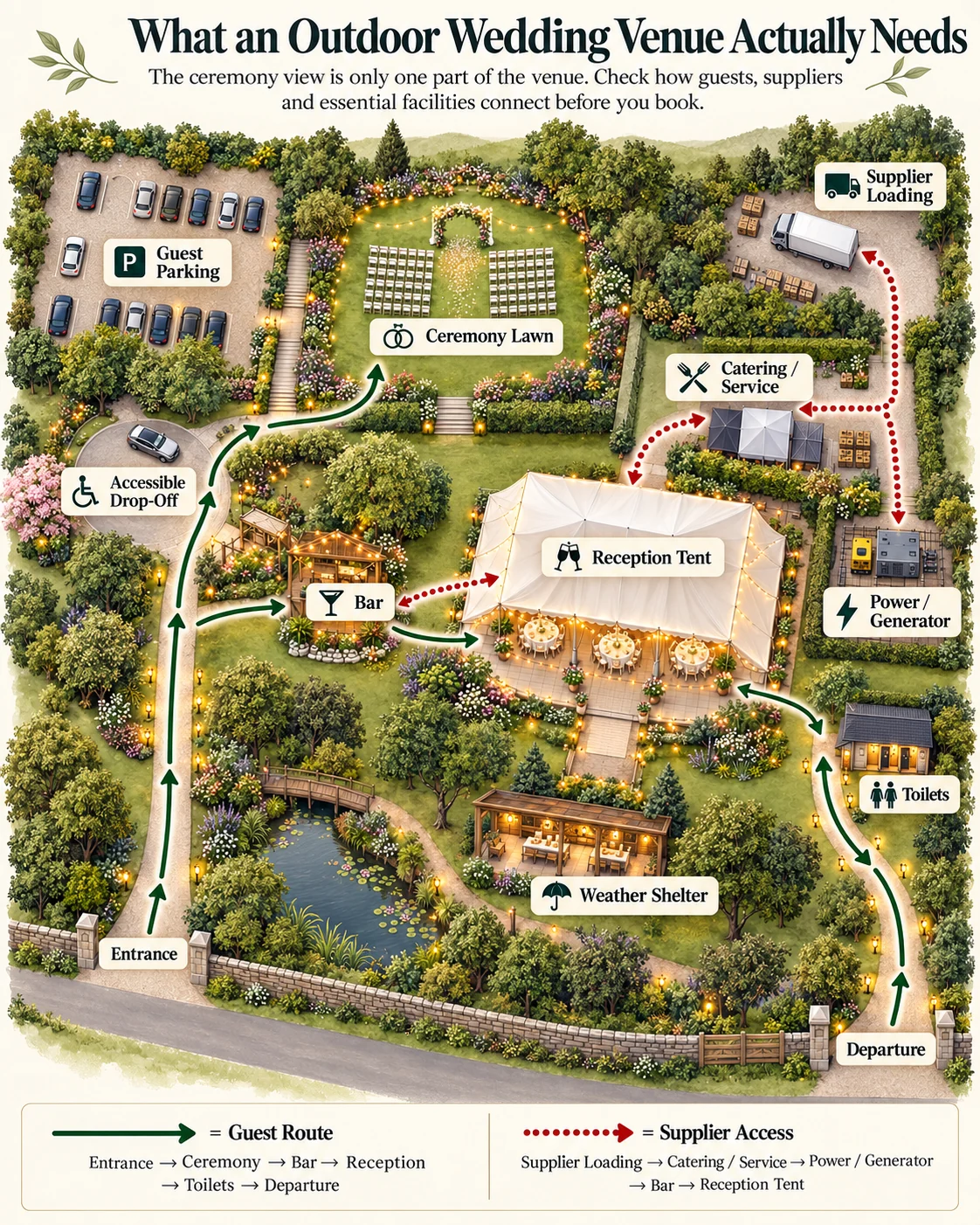
Walk the Route Your Guests Will Actually Use
Do not inspect only the ceremony location.
Walk:
Arrival → ceremony → drinks → dinner → toilets → departure
A gravel slope that seems minor in flat shoes can feel very different to a grandparent using a walking stick, a wheelchair user or someone crossing it in formal shoes after dark.
Look for steps, soft ground, loose gravel, narrow gates, steep slopes and long distances between important areas.
Check the Infrastructure Your Suppliers Need
A venue may look perfect to a guest and create serious problems behind the scenes.
Ask your caterer, DJ, band and other key suppliers what they need, then check the venue against those requirements.
Questions worth resolving include:
- Where can caterers prepare and wash up?
- What electrical supply is available?
- Can generators be used if required?
- Is drinking water available?
- Where do suppliers unload?
- How far must equipment be carried?
- Is there enough light for suppliers packing down after dark?
These are not glamorous questions. They are exactly the sort that prevent avoidable problems later.
Outdoor Wedding Infrastructure Checklist
Use this as a quick reference when comparing venues.
| Area | What to confirm |
|---|---|
| Weather | Exact backup location and decision process |
| Power | Supply for catering, music and lighting |
| Water | Drinking water and catering access |
| Toilets | Location and accessibility |
| Catering | Preparation, service and refrigeration facilities |
| Parking | Capacity and distance from the event |
| Transport | Coach, taxi and drop-off access |
| Accessibility | Practical routes through the whole event |
| Lighting | Paths, toilets, parking and outdoor areas after dark |
| Sound | Amplified music rules and finishing times |
| Supplier access | Loading, setup and breakdown arrangements |
| Ground | Drainage and condition after wet weather |
| Connectivity | Mobile signal and available Wi-Fi |
| Privacy | Public access, neighbours and simultaneous events |
This checklist is particularly useful when comparing a purpose-built wedding venue with a backyard, field or other raw outdoor site. The second option may offer more freedom, but you need to understand what that freedom requires you to organise.
It is also worth reviewing these wedding mistakes to avoid before signing a venue contract, particularly around budgets, guest communication and day-of logistics.
What Should an Outdoor Wedding Weather Plan Include?
Rain is only one weather problem. Depending on the venue and season, wind, lightning, flooding, heat or cold can matter just as much.
The U.S. National Weather Service's Event Ready guidance for outdoor events encourages organisers to work out in advance how people will be alerted, how long it will take everyone to reach shelter and when that decision needs to be made.
For a wedding, turn those principles into a plan everyone involved understands.
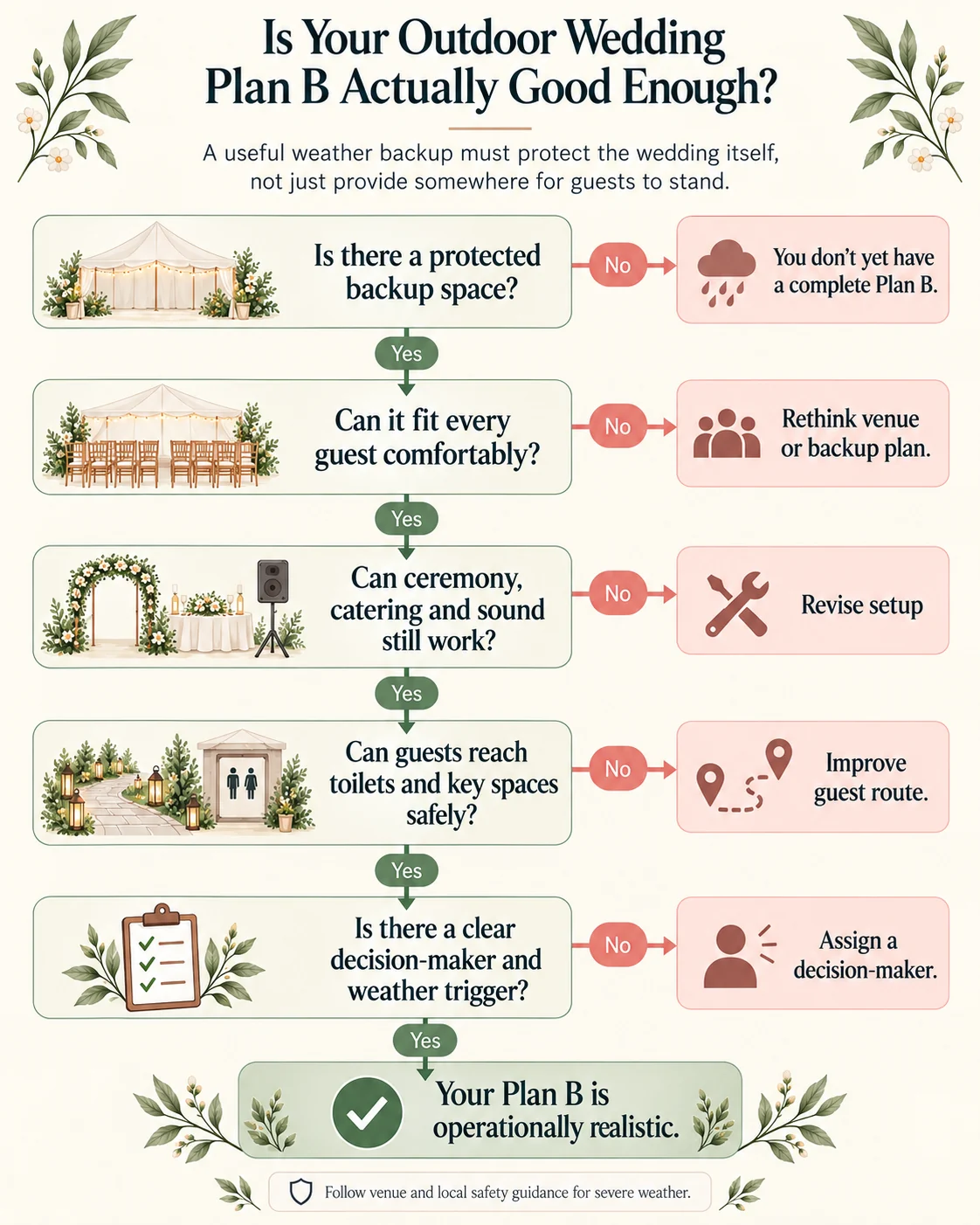
Know Which Conditions Could Change the Day
Ask the venue what weather has affected previous events there.
A sheltered courtyard, lakeside lawn and exposed mountain ceremony do not have the same risks.
Agree in advance which conditions would trigger a move indoors, delay or other change rather than improvising once guests are arriving.
Know Where Everyone Goes
A marquee may handle rain, but not every temporary structure is suitable for every weather condition.
Ask the venue or rental company what the structure is designed to withstand and where people should shelter during more serious weather.
Safety comes before preserving the outdoor setup.
Decide Who Makes the Call
Someone needs clear responsibility for:
- monitoring conditions;
- deciding whether to change the plan;
- notifying suppliers;
- communicating any change to guests.
That person may be the venue coordinator, planner or another designated organiser. What matters is deciding before the wedding rather than debating it on the day.
Make Sure Plan B Still Feels Like a Wedding
Check more than whether everyone fits under cover.
Can people sit comfortably? Does the sound setup still work? Can catering continue? Can guests reach the toilets without crossing an exposed area? Is there somewhere sensible for photographs?
A Plan B that preserves the important parts of the celebration will feel far less like a compromise if you actually need it.
Guest Comfort and Accessibility
Outdoor weddings put the environment into the guest experience, so think about the full journey rather than only the ceremony backdrop.
Terrain and Routes
Check how guests get from parking or drop-off to every important part of the event.
For individual guests with specific needs, practical information from the venue is often just as important: where they can be dropped off, which routes avoid steps and how close the accessible toilet is.
Exact accessibility requirements vary by venue and jurisdiction, so confirm applicable requirements with the venue and the relevant local authority.
Shade, Shelter and Seating
Think about where guests will spend time between the scheduled moments too.
An hour-long drinks reception with nowhere to get out of direct sun may be more uncomfortable than the ceremony itself.
Check whether natural shade exists and what can be added if necessary.
Transport Home
Remote estates, farms and countryside venues can be difficult at the end of the night when taxis are limited.
If many people are staying in the same area, a coach or shuttle may make the experience easier for guests and reduce uncertainty after the reception.
Do You Need a Permit for an Outdoor Wedding?
You might. The answer depends on the exact location and the rules that apply there.
Public parks, beaches, protected landscapes and other public spaces may regulate:
- ceremonies;
- group sizes;
- amplified sound;
- alcohol;
- decorations;
- temporary structures;
- vehicles;
- photography;
- event times.
In US national parks, for example, a special use permit is generally required for weddings, and individual parks set their own conditions, from group sizes and time limits to rules on chairs, arches and amplified sound.
Do not rely on a generic permit price or assume every public park works the same way. Check the official website or authority responsible for the exact site before paying deposits or printing invitations.
12 Questions to Ask Before Booking an Outdoor Wedding Venue
Bring these questions to your venue tour.
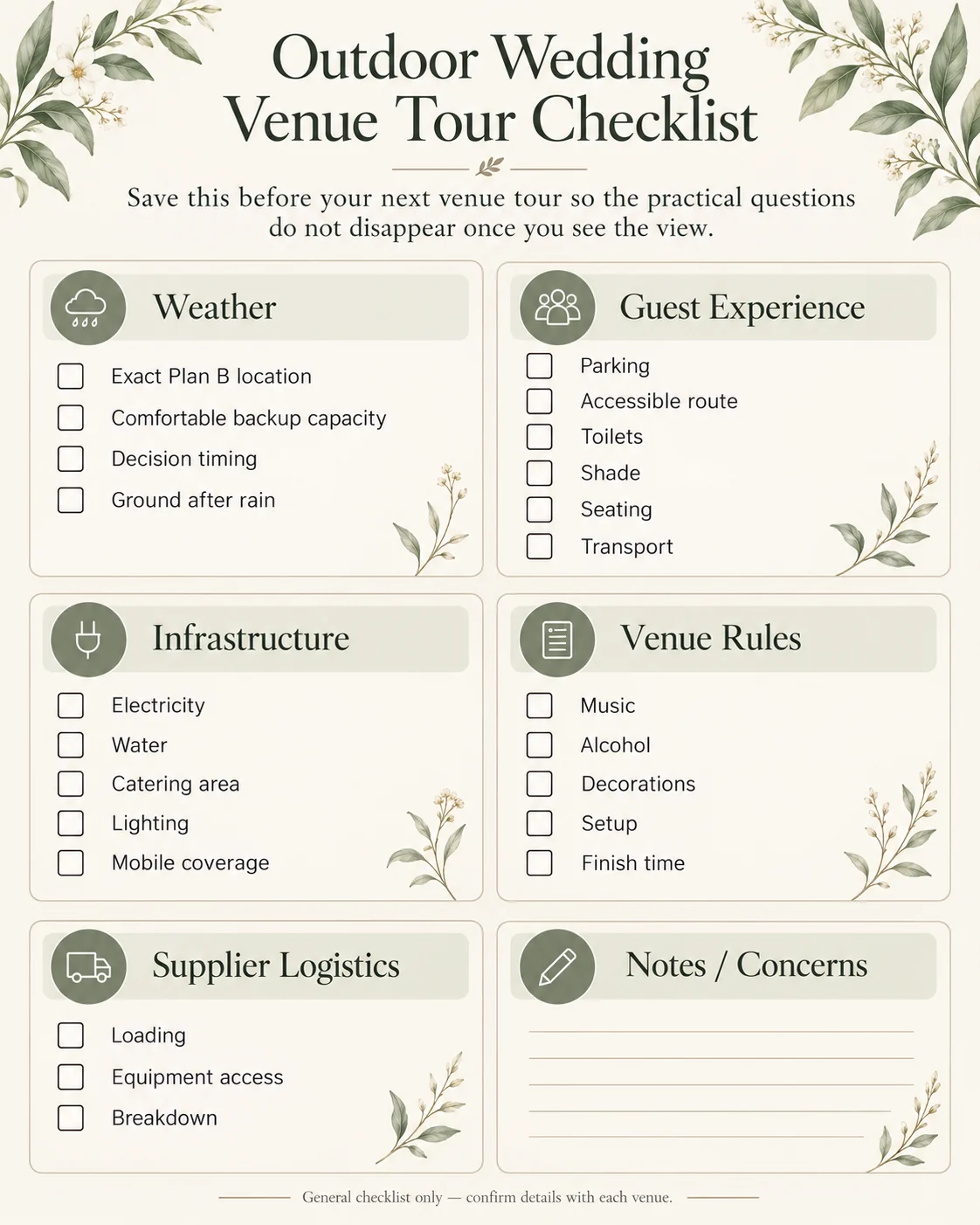
- What exactly is the bad-weather backup, and can we see it?
- Does that space comfortably fit our whole guest list?
- Is the backup included in the booking price?
- Who decides when the weather plan is activated?
- What electricity and water are available?
- Where are the toilets, and what accessible facilities are available?
- Can guests reach every major part of the wedding without difficult terrain?
- Where do caterers and other suppliers load and work?
- What restrictions apply to music, alcohol, decorations and finishing time?
- How does parking work, and would guest transport be useful?
- What happens to the ceremony or reception area after prolonged rain?
- What mobile signal or guest Wi-Fi is available around the venue?
The last question is easy to overlook. Test your own phone rather than relying entirely on the answer, especially at large rural properties where reception can change from one part of the grounds to another.
Planning the Guest Experience at an Outdoor Venue
Once you know the venue works operationally, think about what guests need to know before they arrive.
That might include:
- directions between different areas;
- parking or shuttle instructions;
- footwear guidance for grass, sand or uneven ground;
- accessible drop-off information;
- reminders about evening temperatures;
- clear lighting and signage after dark.
If you have a large property, also think about the moments happening outside your own field of view. Friends may be catching up near the bar while children are playing on the lawn and another group is taking photographs somewhere else entirely.
Those are often the parts of a wedding that guests capture themselves.
If you want those photos afterwards, Guestreel's QR code photo sharing lets guests scan a personalised code and upload photos and videos through their phone browser without downloading an app or creating an account. The uploads collect in one private gallery rather than disappearing into separate group chats and camera rolls.
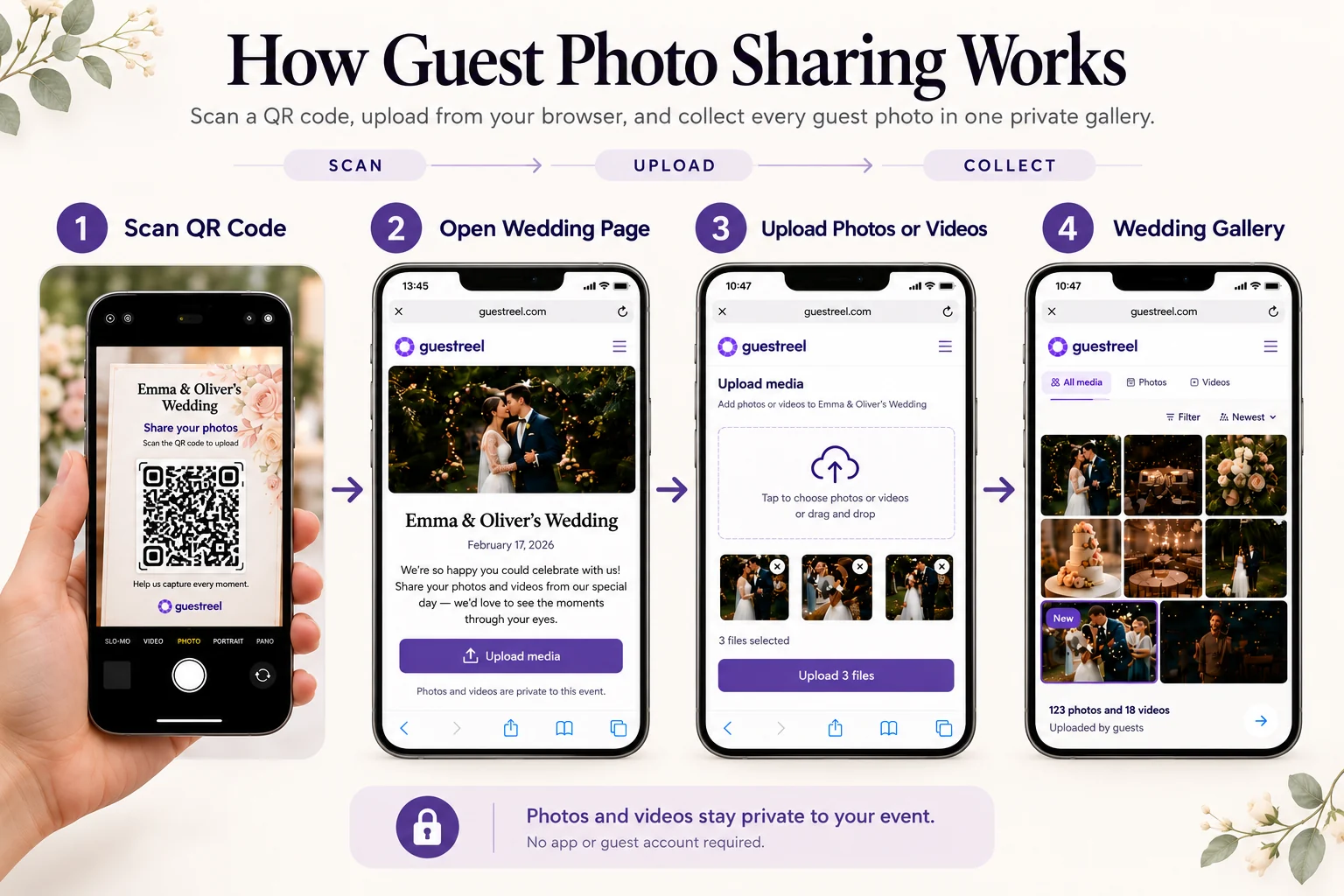
At an outdoor venue, the QR code could sit on reception tables, at the bar or beside the guestbook rather than adding another task to the ceremony itself. If venue internet is inconsistent, test the guest upload flow there in advance and keep your event link available so guests can contribute when they have a reliable connection.
For more ways to capture those extra perspectives, see our guide to collecting wedding photos from guests.
Choose a Venue That Works Beyond the Photographs
A memorable outdoor venue needs more than a beautiful ceremony backdrop.
Shortlist the places that genuinely suit your style, then compare them using the same practical criteria: comfortable capacity, weather backup, accessibility, infrastructure, transport, restrictions and total cost.
If you still love a venue after walking the guest route, seeing Plan B and asking the unglamorous questions about toilets, power and wet ground, you are in a much stronger position to book it with confidence.
Frequently asked questions
Are outdoor wedding venues cheaper?
Not automatically. A venue with a low hire fee can become expensive if you need to bring in toilets, power, furniture, lighting, flooring, catering facilities or weather cover. Compare the total cost of making the venue event-ready, not just the initial rental price.
What is the best outdoor wedding venue for a small wedding?
Gardens, courtyards, private estates, backyards and smaller waterfront properties can all work well for intimate weddings. Focus on scale: a smaller space that feels lively with your guest count will usually work better than a vast venue that feels half empty.
What is the best backup plan for an outdoor wedding?
A good backup is a weather-protected space that can comfortably accommodate everyone while preserving the essentials of the wedding. Check seating, catering, accessibility, sound, guest movement and supplier access rather than considering shelter alone.
Do you need a permit for an outdoor wedding?
Possibly, particularly on public or protected land. Requirements vary by location, so check directly with the park authority, council, land manager or other official body responsible for the exact site.
Is a backyard wedding cheaper than hiring a venue?
It can be, but there is no guarantee. Private property may require you to hire facilities a conventional wedding venue already provides, including toilets, power, furniture, lighting, catering equipment and weather cover.
How do you keep guests comfortable at an outdoor wedding?
Choose a venue with appropriate access, seating, toilets and shelter first. Then plan for the conditions specific to the location, such as sun, heat, wind, cold, insects, wet ground or long walking distances.
What should you check when touring an outdoor wedding venue?
Inspect the areas guests and suppliers will actually use: the weather backup, walking routes, toilets, catering space, parking, power supply, lighting and loading access. If possible, visit around the same time of day as your planned ceremony so you can judge sunlight, shade and noise more realistically.
Written by Linda DoWrites Guestreel’s planning guides.