Wedding Venue Planning Guide: How to Choose the Right Venue
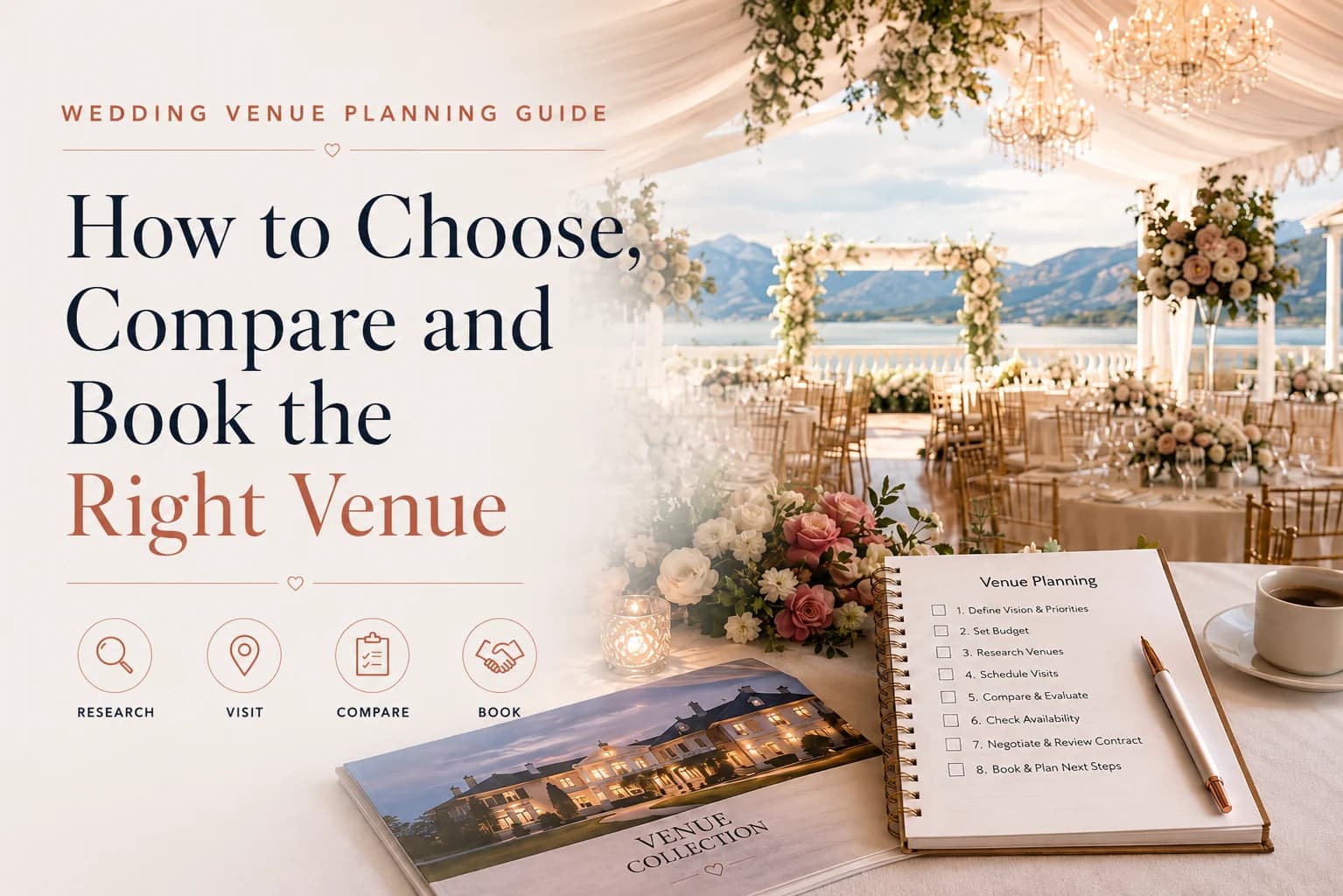
Wedding venue planning is the process of defining your guest count, budget, location and practical requirements, then researching, touring, comparing and booking a space that can support your wedding safely and comfortably.
The right venue is not necessarily the most impressive one. It is the venue that fits your priorities without creating unacceptable compromises in cost, capacity, accessibility or logistics. If you are still mapping out the wider process, our wedding planning checklist and timeline shows where the venue fits among every other decision.
Wedding Venue Planning at a Glance
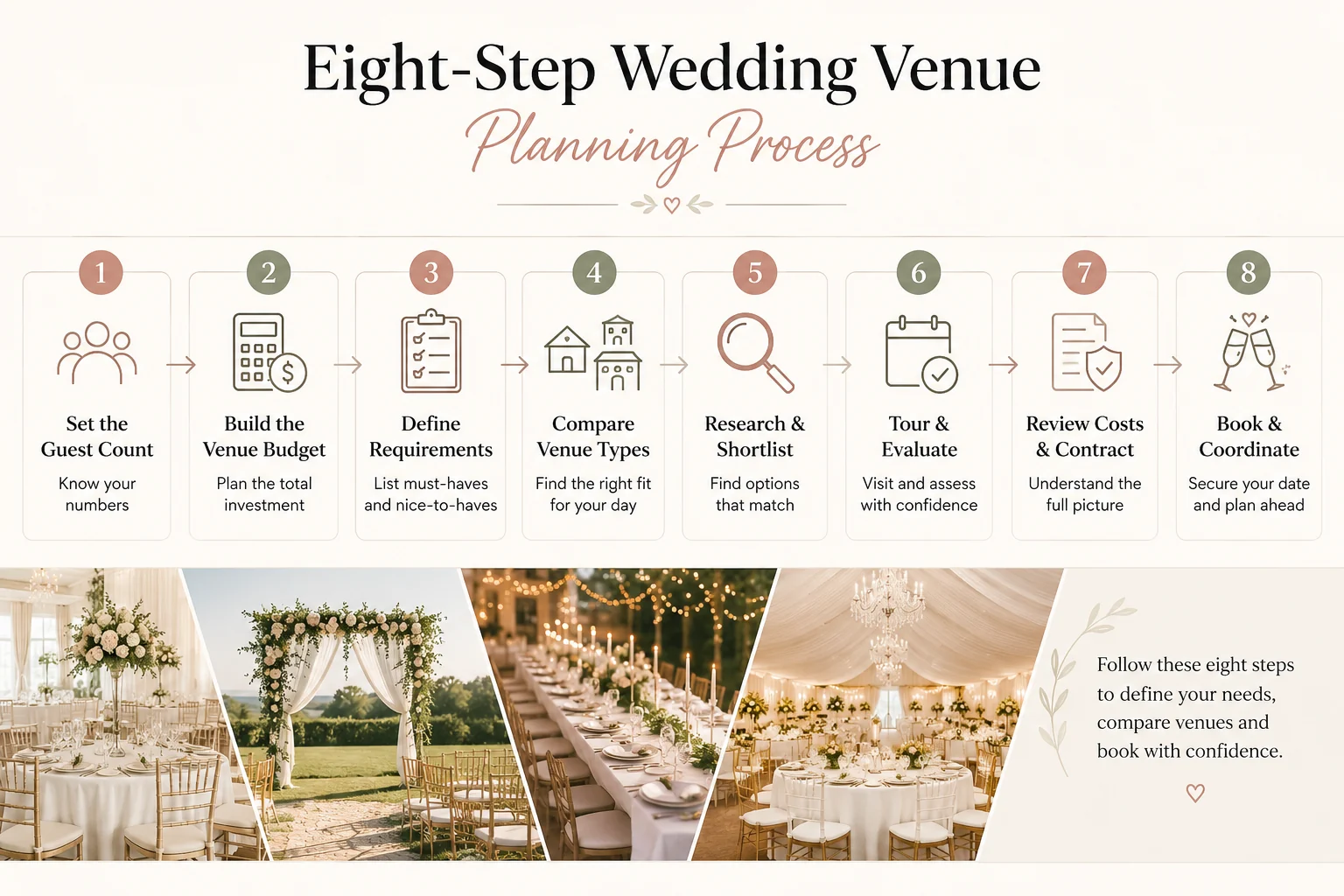
Use this eight-step process to move from an initial idea to a confident booking:
- Set a realistic guest-count range.
- Calculate your complete venue budget.
- Define your location, style and non-negotiables.
- Compare suitable venue types.
- Research and shortlist potential venues.
- Tour, document and score each option.
- Compare the true costs and contract terms.
- Book the venue and begin coordinating the details.
Before contacting venues, agree on five basics:
- Your maximum invitation count
- Your preferred location or travel radius
- Your total venue budget
- One or more acceptable dates or seasons
- The requirements you will not compromise on
These decisions prevent you from spending time touring venues that cannot accommodate your wedding.
Step 1: Set a Realistic Guest Count
Your guest count determines which venues are suitable, how much catering may cost and how the rooms will need to be arranged.
Start with the maximum number of people you may invite, not the number you expect to attend. A venue must be able to accommodate everyone who receives an invitation unless you already have reliable attendance information.
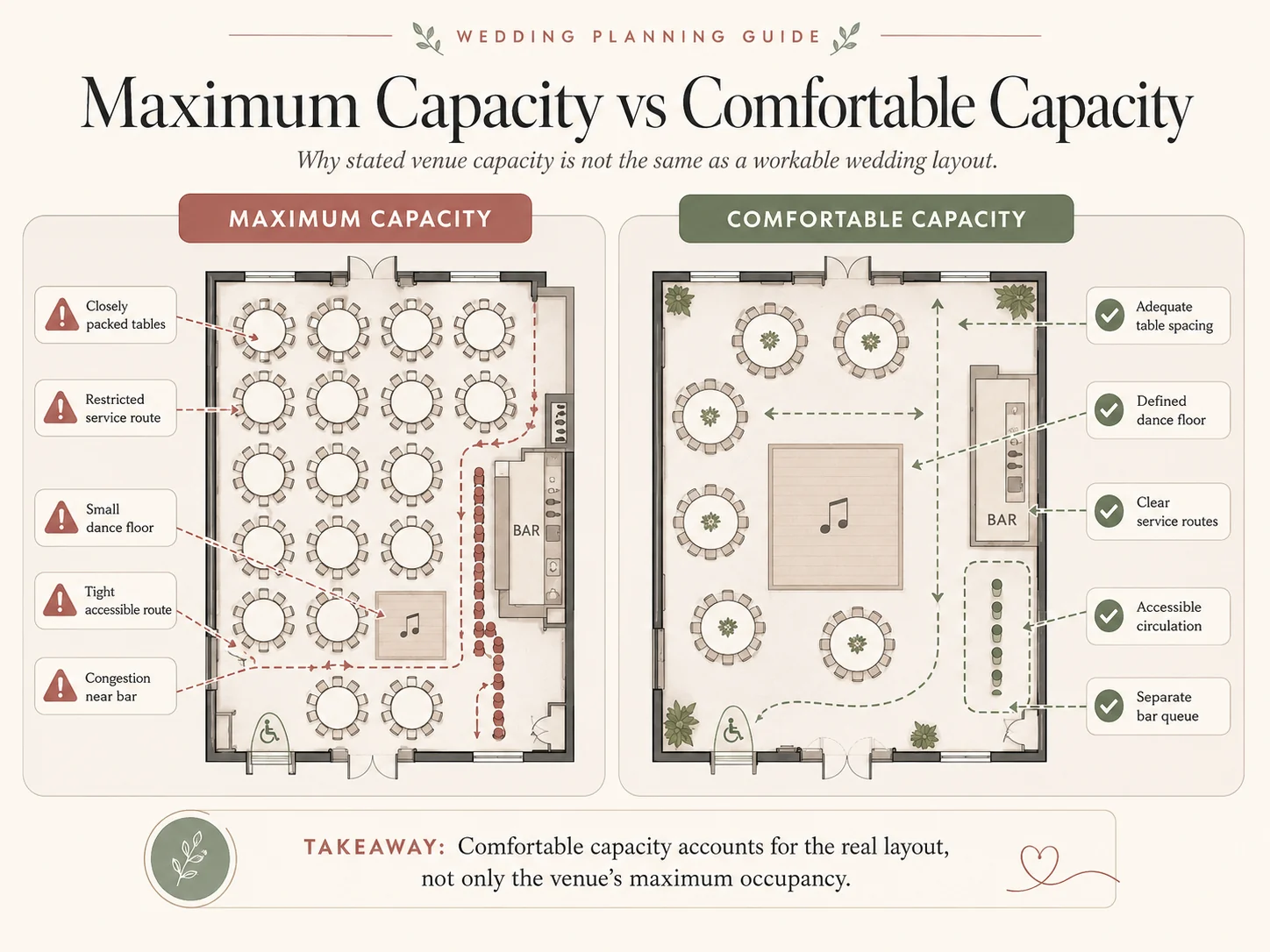
Maximum capacity is not the same as comfortable capacity
A venue's published maximum may describe the number of people legally permitted inside the room. It does not always reflect the number who will fit comfortably once the wedding layout includes:
- Dining tables and chairs
- A dance floor
- A band, DJ or stage
- A bar
- A buffet or food stations
- Accessible routes
- Service areas
- Space between tables
- Décor or installations
Ask the venue to show you a floor plan for your approximate guest count. If possible, request photos from a real wedding with a similar layout.
Ask these questions before adding a venue to your shortlist:
- What is the seated capacity for the ceremony?
- What is the seated capacity for dinner?
- Does that capacity include a dance floor?
- Where will entertainment, catering and the bar be positioned?
- What happens to capacity if the ceremony must move indoors?
- Are vendors and staff included in the stated occupancy limit?
- Can the venue provide a sample floor plan for our guest count?
A room that technically fits everyone may still feel crowded. The goal is a layout that allows guests and staff to move comfortably throughout the event.
Step 2: Build Your Complete Venue Budget
Do not compare venues using the hire fee alone. Compare the total amount each venue requires you to spend before it can host the wedding you are planning. If money is tight, our guide on how to cut wedding costs can help you free up budget for the space that matters most.
What a venue quote may include
Inclusions vary significantly. A quote may cover only the space, or it may include:
- Tables and chairs
- Linens and tableware
- Catering
- Bar service
- Event staff
- Cleaning
- Security
- Setup and breakdown
- Lighting or sound equipment
- A getting-ready room
- Ceremony furniture
- A venue coordinator
Ask every venue for an itemised proposal based on the same estimated guest count, event duration and service requirements.
Site fee versus food and beverage minimum
A site fee is the charge for using the venue or specific spaces.
A food and beverage minimum is the minimum amount you must spend on catering and drinks. It is not necessarily the final catering bill, and taxes, service charges or staffing costs may be added separately.
Some venues use both.
Common wedding venue fees to investigate
Ask whether the quote includes:
- Taxes
- Service charges and gratuities
- Mandatory staffing
- Security
- Cleaning
- Furniture and tableware
- Linen
- Ceremony setup
- Room changes between the ceremony and reception
- Corkage
- Cake cutting
- Outside catering or vendor fees
- Parking or valet service
- Heating, cooling or generators
- Insurance
- Overtime
- Early access
- Setup and breakdown time
- Damage deposits
- Transport between venue areas
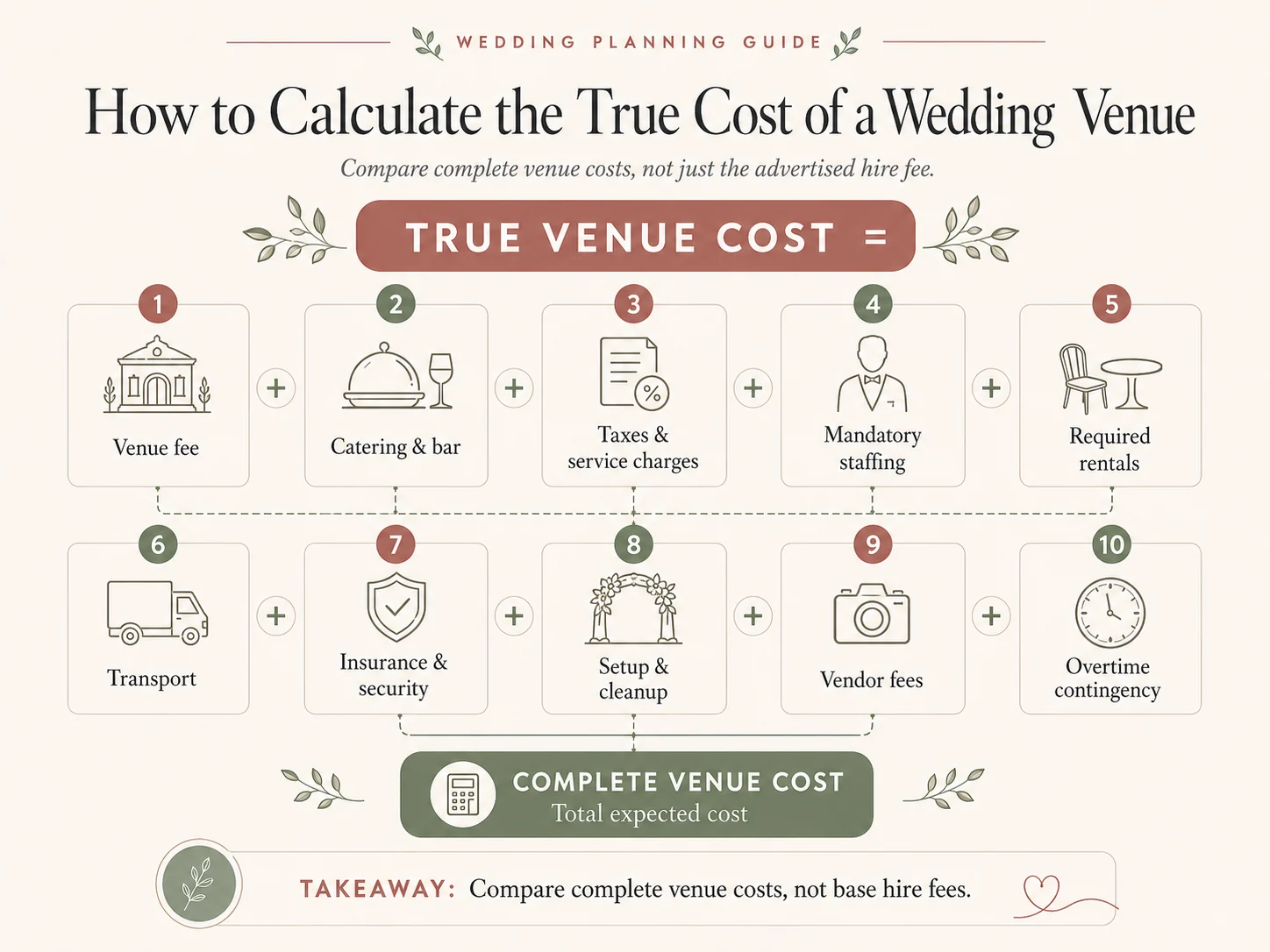
Calculate the true venue cost
Use the same formula for every venue:
True venue cost = venue fee + catering and bar + taxes and service charges + mandatory staff + required rentals + transport + insurance + security + setup and cleanup + outside-vendor fees + likely overtime
A hypothetical comparison
Venue A charges less to hire but requires external catering, furniture, tableware, lighting, staff and transport.
Venue B has a higher initial price but includes those services.
Venue A is not automatically the more affordable choice. Add every required cost before comparing the two offers.
Keep a separate contingency in your overall wedding budget rather than spending your full limit on the initial venue quote.
Step 3: Define Your Venue Requirements
A clear requirements list helps you assess venues based on your wedding rather than being distracted by features you do not need.
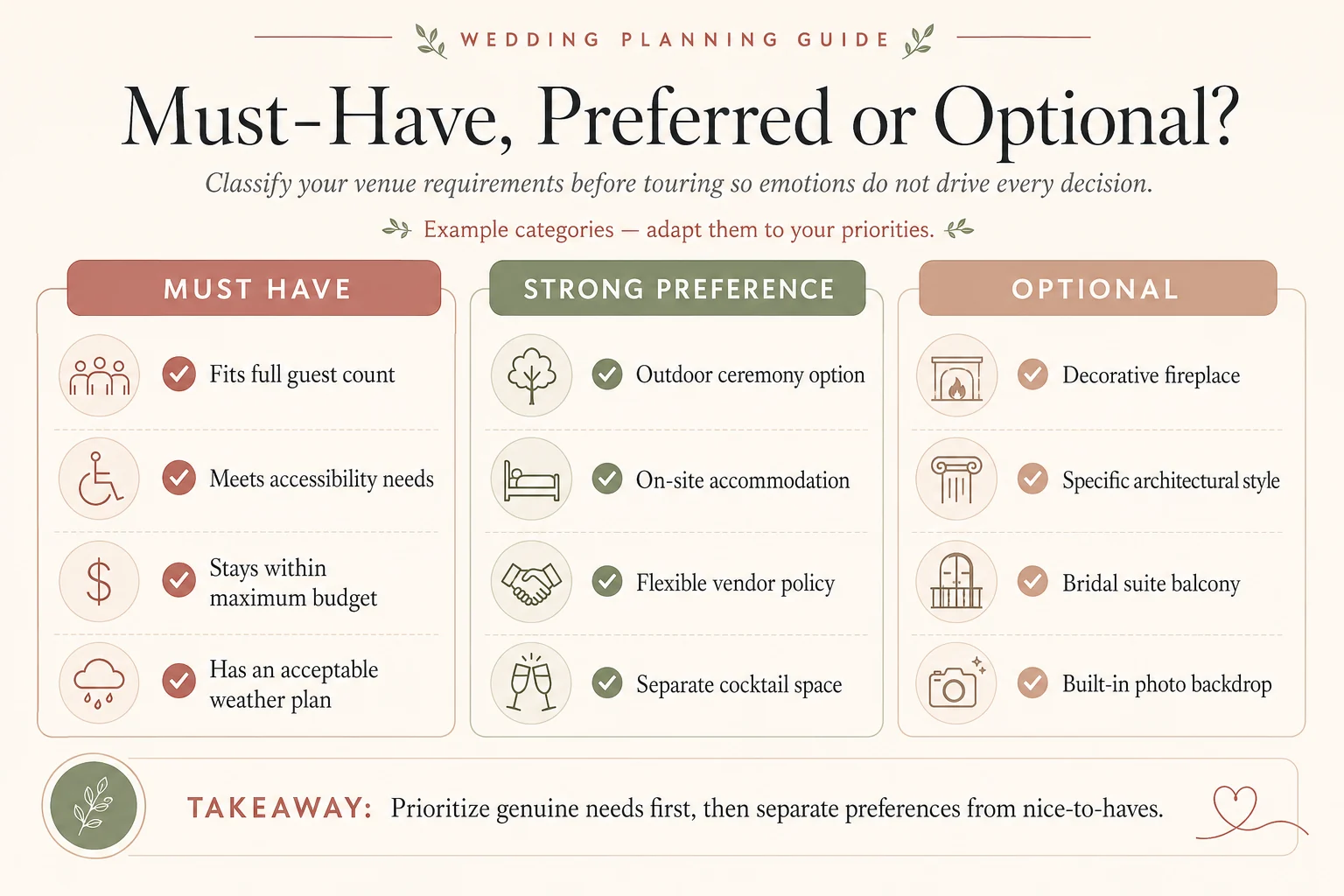
Divide your requirements into three groups:
| Priority | Meaning | Example |
|---|---|---|
| Must have | The venue is unsuitable without it | Step-free access |
| Strong preference | Valuable, but open to compromise | Outdoor ceremony space |
| Optional | Pleasant but not decision-critical | Decorative fireplace |
Location and travel
Consider the complete guest journey, not only the venue address.
Review:
- Travel time for most guests
- Access by road or public transport
- Nearby accommodation
- Taxi or rideshare availability
- Shuttle requirements
- Parking capacity
- Safe collection points
- Travel between the ceremony and reception
- Local events that could affect traffic or accommodation
For a destination wedding, check how guests will reach the area from the nearest airport or major station.
Wedding style and atmosphere
Choose a venue that supports the look and experience you want without requiring excessive transformation.
A historic house may suit a formal celebration. A restaurant may work well for a food-led wedding. A garden or vineyard may fit an outdoor-focused event but require stronger weather planning — see our outdoor wedding venue ideas for inspiration.
Do not choose a venue solely because a different wedding looked attractive there. Evaluate how the space will work with your guest count, priorities and budget.
Accessibility and guest comfort
Walk through the venue from the perspective of guests with different needs.
Review:
- Step-free entrances
- Accessible parking and drop-off points
- Routes between event spaces
- Lifts where required
- Accessible restrooms
- Seating options
- Distance between major areas
- Lighting and signage
- Temperature control
- Shade and shelter
- Quiet areas
- Support for service animals
- Accommodation for dietary, sensory or mobility needs
Accessibility laws and venue obligations vary by country and jurisdiction. In the United States, official accessibility requirements are set out through the Americans with Disabilities Act and related standards; couples elsewhere should consult the relevant local authority or qualified professional.
Step 4: Compare Wedding Venue Types
Different venue types shift work and cost between the couple, venue and external vendors.
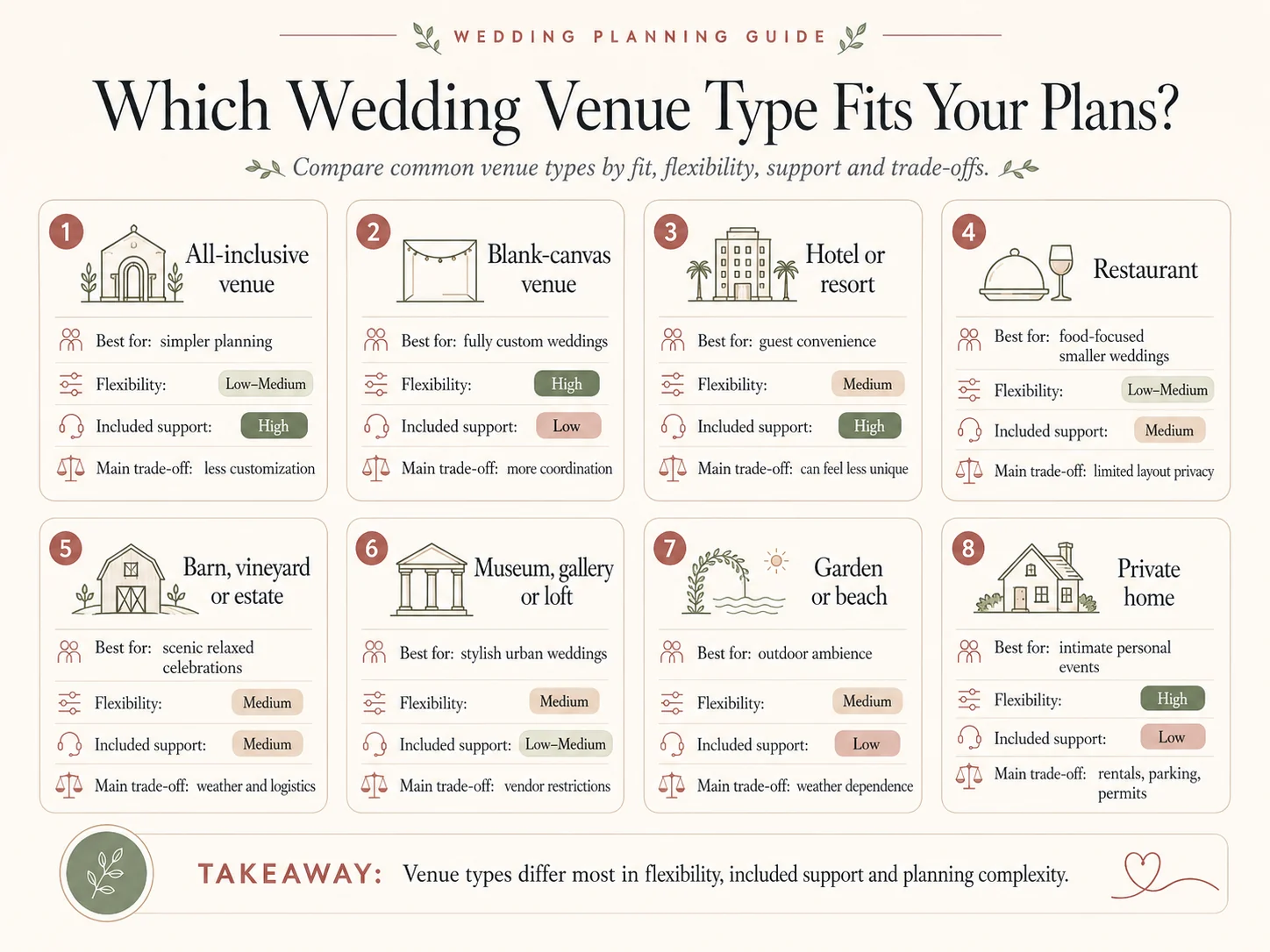
| Venue type | Often best for | Main advantage | Main consideration |
|---|---|---|---|
| All-inclusive venue | Couples wanting fewer suppliers | Services and rentals may be bundled | Less flexibility |
| Blank-canvas venue | Highly personalised weddings | Greater creative control | More suppliers and coordination |
| Hotel or resort | Weddings with travelling guests | Accommodation and event spaces together | Packages may be restrictive |
| Restaurant | Food-focused or smaller weddings | Existing kitchen, staff and atmosphere | Limited room transformation |
| Barn, farm or vineyard | Relaxed or rural celebrations | Strong setting and outdoor potential | Transport and weather planning |
| Museum, gallery or loft | Modern or distinctive weddings | Built-in visual character | Production or décor restrictions |
| Garden or beach | Outdoor ceremonies | Natural surroundings | Weather, access and infrastructure |
| Private home | Intimate or personal events | Familiar, flexible setting | Rentals, permits, parking and neighbours |
All-inclusive versus blank-canvas venues
An all-inclusive venue may provide catering, furniture, staff and event coordination. This can reduce the number of suppliers you need to manage.
A blank-canvas venue gives you more freedom but may require you to arrange almost everything separately. Include delivery, setup, collection and staffing costs when comparing it with a full-service option.
Neither model is universally better. Choose based on the amount of control, coordination and financial uncertainty you are willing to manage.
Step 5: Research and Shortlist Venues
Use several sources rather than relying on one directory or social platform.
Useful research sources include:
- Wedding venue directories
- Google Maps
- Wedding planners
- Photographers' portfolios
- Local wedding groups
- Venue social profiles
- Recent reviews
- Recommendations from vendors
- Real wedding features
Large venue platforms can help couples filter spaces by style, location and capacity, but confirm all important information directly with the venue. A trusted wedding photographer is often an excellent source of venue recommendations, since they work in many spaces.
Assess reviews critically
Look for repeated patterns rather than reacting to one unusually positive or negative review.
Pay particular attention to comments about:
- Communication
- Unexpected charges
- Food and service
- Cleanliness
- Weather-plan execution
- Staff support
- Accessibility
- Noise restrictions
- Event timing
- Problems that occurred and how the venue responded
Recent reviews are usually more relevant to the venue's current staff, policies and condition.
Ask preliminary questions before booking a tour
Confirm:
- Availability
- Approximate capacity
- Starting price or minimum spend
- Catering policy
- Main restrictions
- Ceremony and reception options
- Weather backup
- Accessibility
- Whether multiple events may take place on the same day
A venue that fails a non-negotiable requirement does not need an in-person tour.
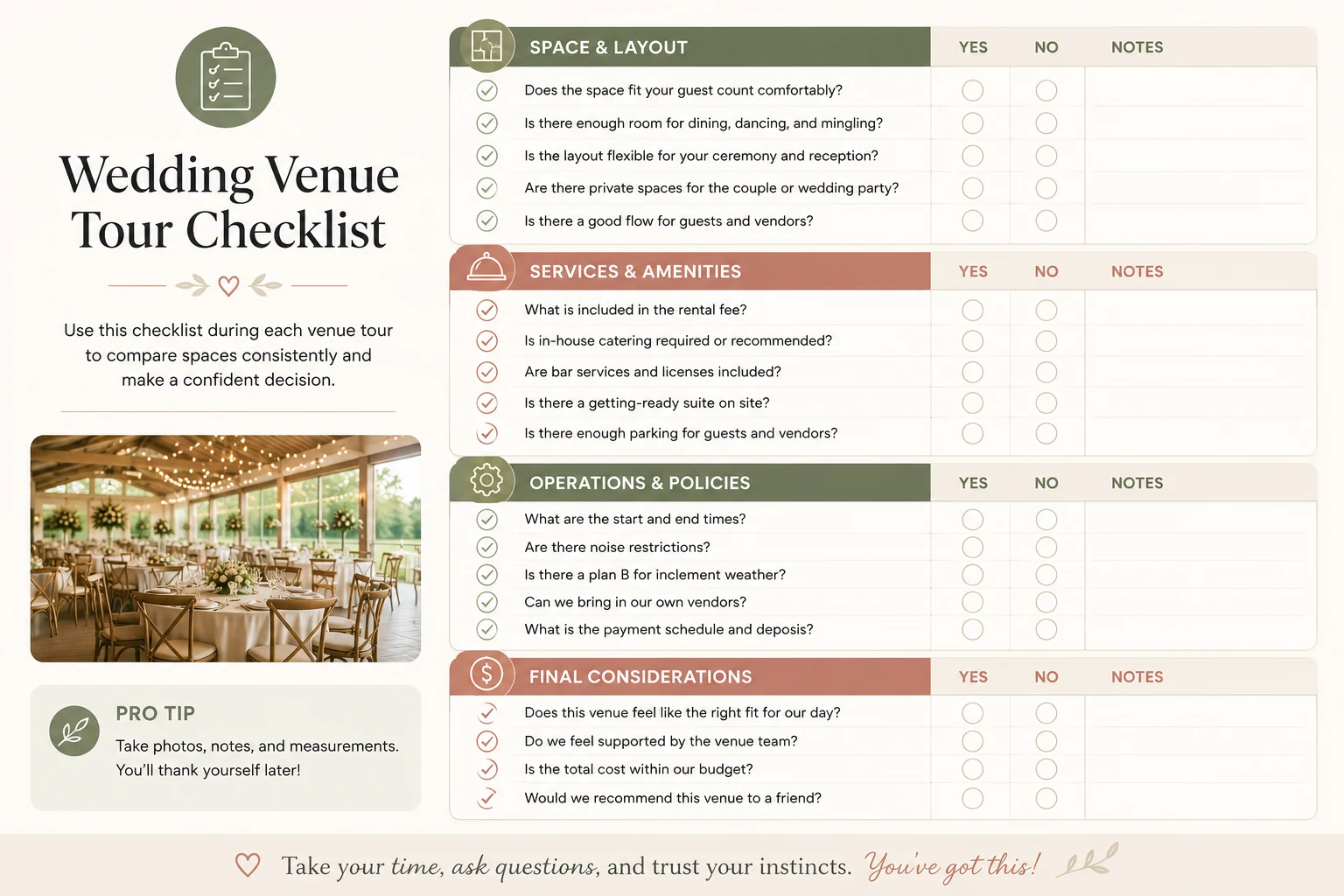
Step 6: Tour and Evaluate Each Venue
Tour every serious contender using the same process. Take notes immediately rather than relying on memory.
Bring:
- Your question list
- Guest-count estimate
- Budget range
- Phone or camera
- Measuring tape if needed
- Notes about accessibility requirements
- A list of planned entertainment or installations
- Your comparison scorecard
Follow the complete guest journey
Begin where guests will arrive and move through the day in order:
- Parking, shuttle stop or drop-off
- Main entrance
- Ceremony space
- Cocktail-hour area
- Reception space
- Bar and restrooms
- Outdoor areas
- Departure and late-night collection point
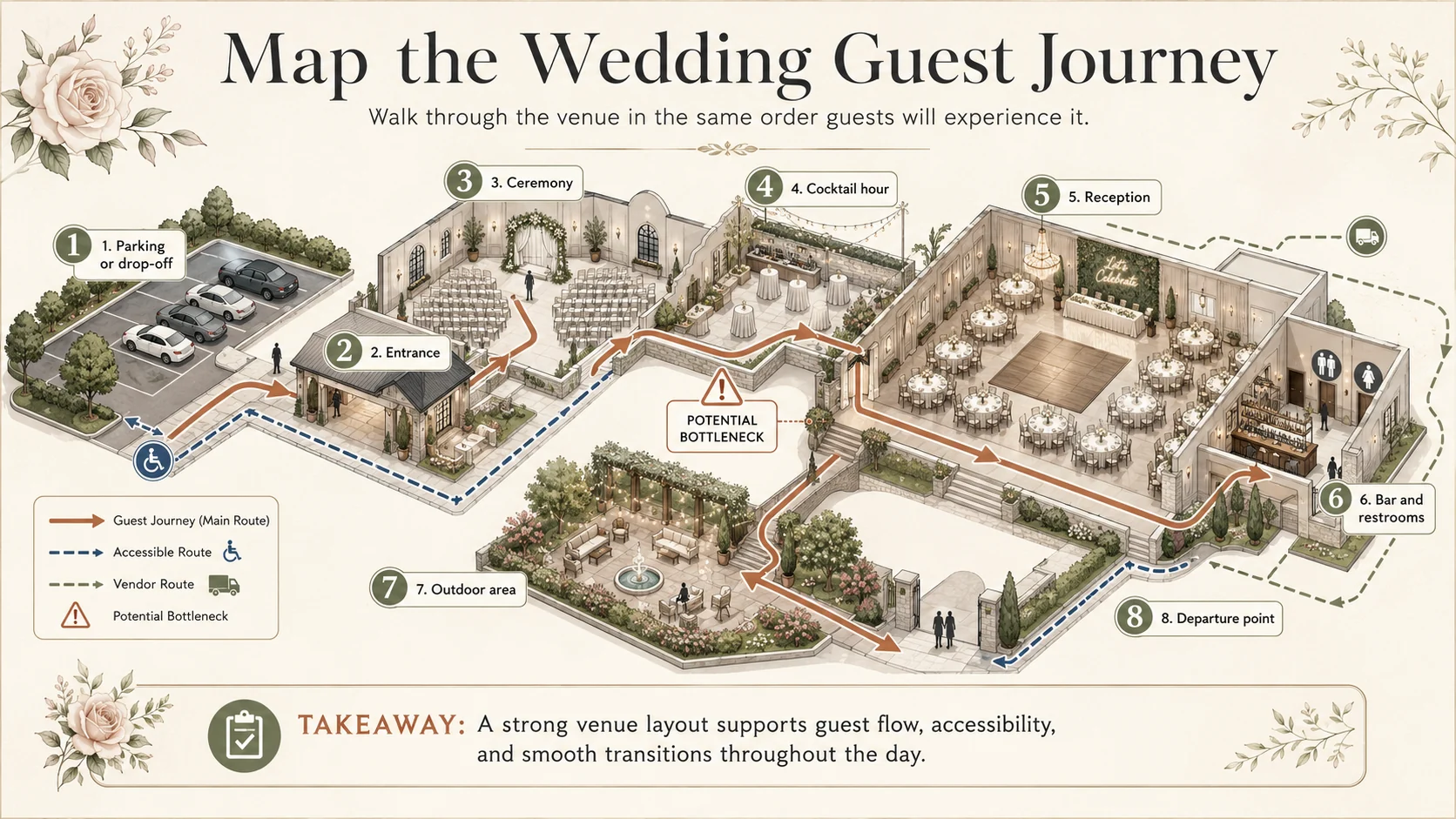
This walkthrough can reveal bottlenecks that are easy to miss when viewing each room separately.
What to photograph and record
With the venue's permission, document:
- Entrances
- Parking and drop-off points
- Ceremony views
- Reception layout
- Weather-backup spaces
- Restrooms
- Getting-ready rooms
- Lighting conditions
- Power outlets
- Vendor entrances
- Storage areas
- Signage locations
- Stairs and accessible routes
- Outdoor surfaces
- Noise sources
- Areas where guests may gather
Capture practical details, not only attractive features.
Check lighting, sound and connectivity
Visit at roughly the same time of day as your planned wedding where possible.
Review:
- Natural and artificial lighting
- Sunset direction
- Temperature and ventilation
- Heating or cooling
- Echo and sound spill
- Nearby roads or public spaces
- Electrical capacity
- Wi-Fi
- Mobile reception
Connectivity matters if vendors need online access or guests will use digital tools during the event.
Test the weather-backup plan
Do not accept "we can move indoors" as a complete plan.
Ask:
- Which indoor space will be used?
- How many guests fit comfortably?
- When is the weather decision made?
- Who makes the decision?
- Who moves the furniture and décor?
- Is additional staffing required?
- Will the room change affect the timeline?
- Are there extra charges?
- Does the backup space remain available throughout the event?
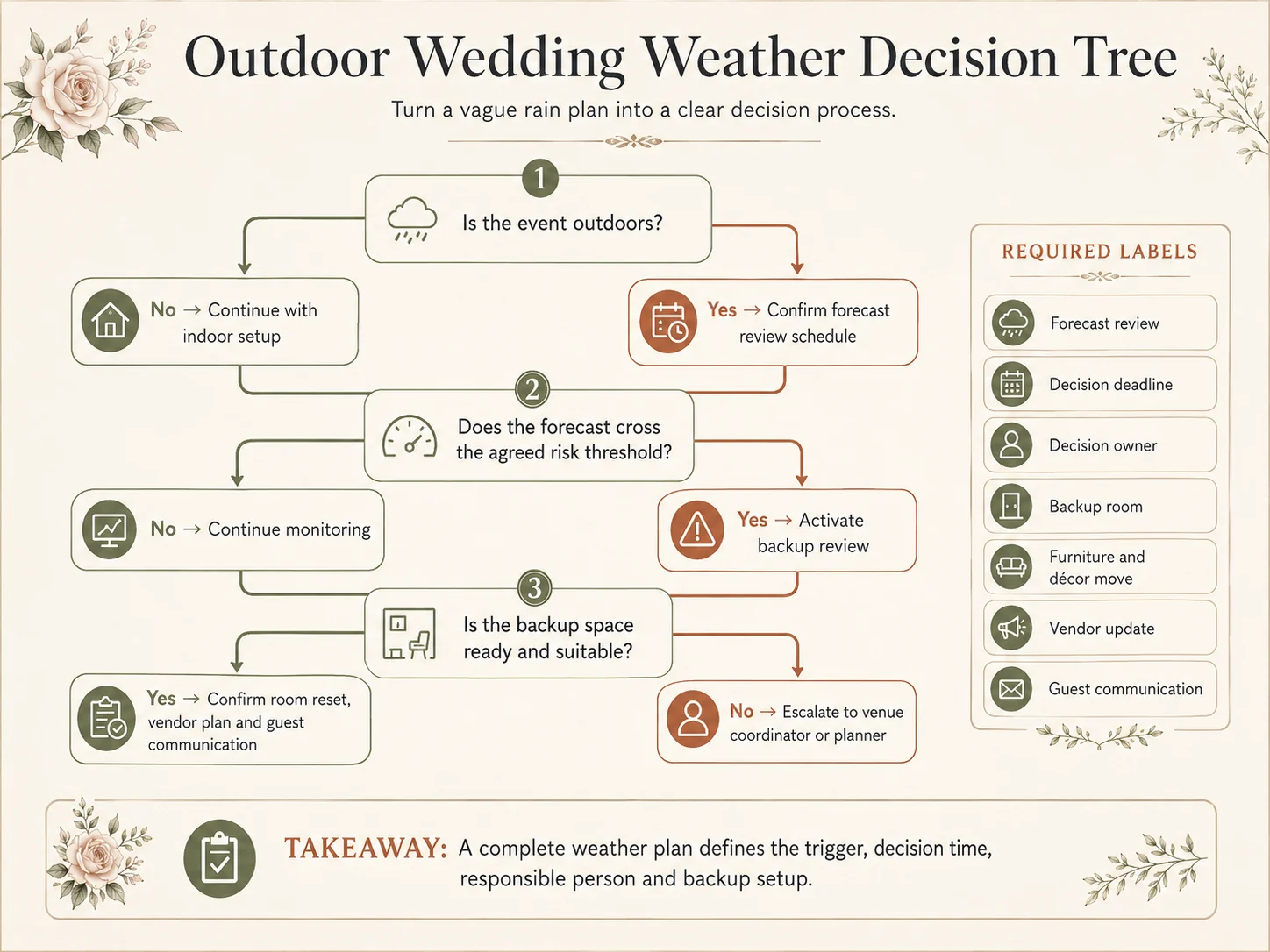
Evaluate the backup plan as though it will definitely be used. If you would be disappointed with the wedding in that configuration, the venue carries a meaningful risk.
Essential questions to ask a wedding venue
Availability and use
- Is our preferred date available?
- Will another event take place on the same day?
- Which spaces are included?
- Are any areas shared?
- What are the access, setup and finishing times?
- Is there a noise limit or curfew?
Costs and payments
- What is included in the quote?
- Which charges are mandatory?
- What is the payment schedule?
- Is the deposit refundable?
- When can prices change?
- What happens if our guest count changes?
- What are the overtime rates?
Catering and drinks
- Is catering in-house or external?
- Is there a minimum spend?
- Can dietary requirements be accommodated?
- Is a tasting included?
- Can we bring our own alcohol?
- Are corkage or cake-cutting fees charged?
- Are vendor meals required?
Vendors and production
- Must we use preferred vendors?
- Are outside-vendor fees charged?
- When can suppliers access the venue?
- Is there a loading area?
- What power is available?
- Are candles, confetti or suspended decorations allowed?
- Who removes equipment after the event?
Staffing and coordination
- Who will manage the venue on the wedding day?
- When will we meet that person?
- What does the venue coordinator handle?
- Which responsibilities remain with us or our planner?
- Who responds to problems during the event?
Comprehensive venue-question checklists from major wedding-planning publishers also emphasise availability, cost, vendor policies, logistics, catering and staffing.
How to Compare Wedding Venues Objectively
Score venues only after receiving enough information to compare them fairly.
A weighted scorecard prevents one striking feature from outweighing serious problems elsewhere.
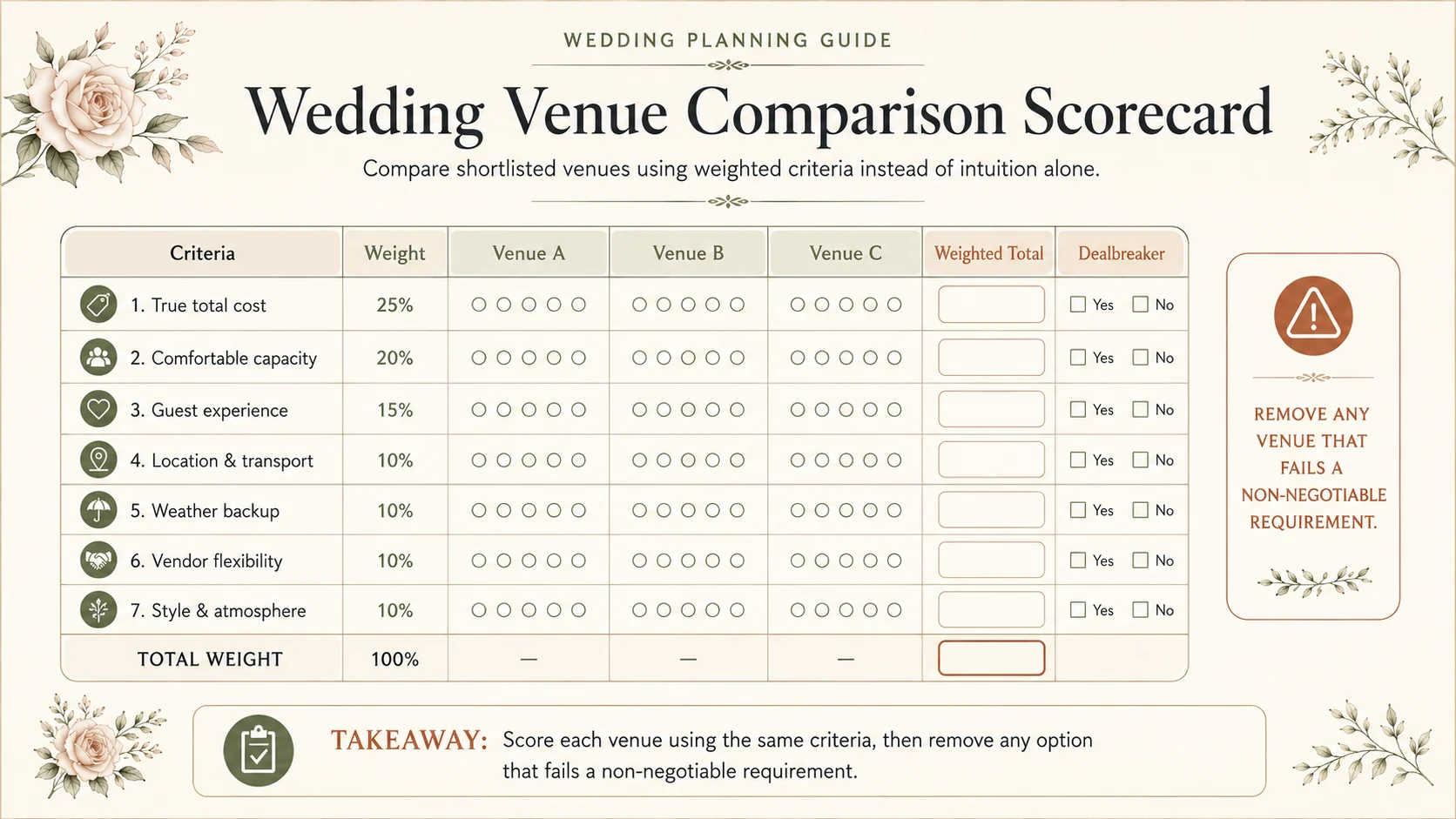
| Criterion | Suggested weight | Score from 1–5 |
|---|---|---|
| True total cost | 25% | |
| Comfortable capacity | 20% | |
| Guest experience | 15% | |
| Location and transport | 10% | |
| Weather backup | 10% | |
| Vendor flexibility | 10% | |
| Style and atmosphere | 10% |
Multiply each score by its weight, then compare the totals.
Adjust the percentages to reflect your priorities. For example, accessibility may need to be a non-negotiable requirement rather than a weighted preference.
Separate dealbreakers from preferences
A score should never cancel out a dealbreaker.
Examples of dealbreakers may include:
- Insufficient accessible access
- No workable weather backup
- Capacity below the invitation count
- Prohibited cultural or religious requirements
- Costs above the maximum budget
- A contract term you cannot accept
Once unsuitable venues are removed, use the scorecard to compare the remaining options.
Revisit the leading venue
A second tour can feel different once the initial excitement has passed. Use it to confirm:
- The proposed floor plan
- Final inclusions
- Guest flow
- Weather arrangements
- Accessibility
- Vendor access
- Contract questions
Do not assume verbal assurances will become contractual obligations. Request important commitments in writing.
Step 7: Review the Wedding Venue Contract
The venue contract should clearly describe what you are purchasing, what each party must provide and what happens if plans change.
What the contract should include
Confirm that the written agreement covers:
- Couple and venue details
- Event date
- Access and event times
- Included rooms and outdoor areas
- Guest capacity
- Services and equipment
- Catering and bar arrangements
- Staffing
- Setup and breakdown
- Total price
- Taxes and additional charges
- Payment schedule
- Deposit terms
- Cancellation and rescheduling
- Insurance requirements
- Damage responsibility
- Vendor restrictions
- Noise limits and curfew
- Overtime
- Weather arrangements
- Refund conditions
- Venue cancellation or closure
- Contract amendment process
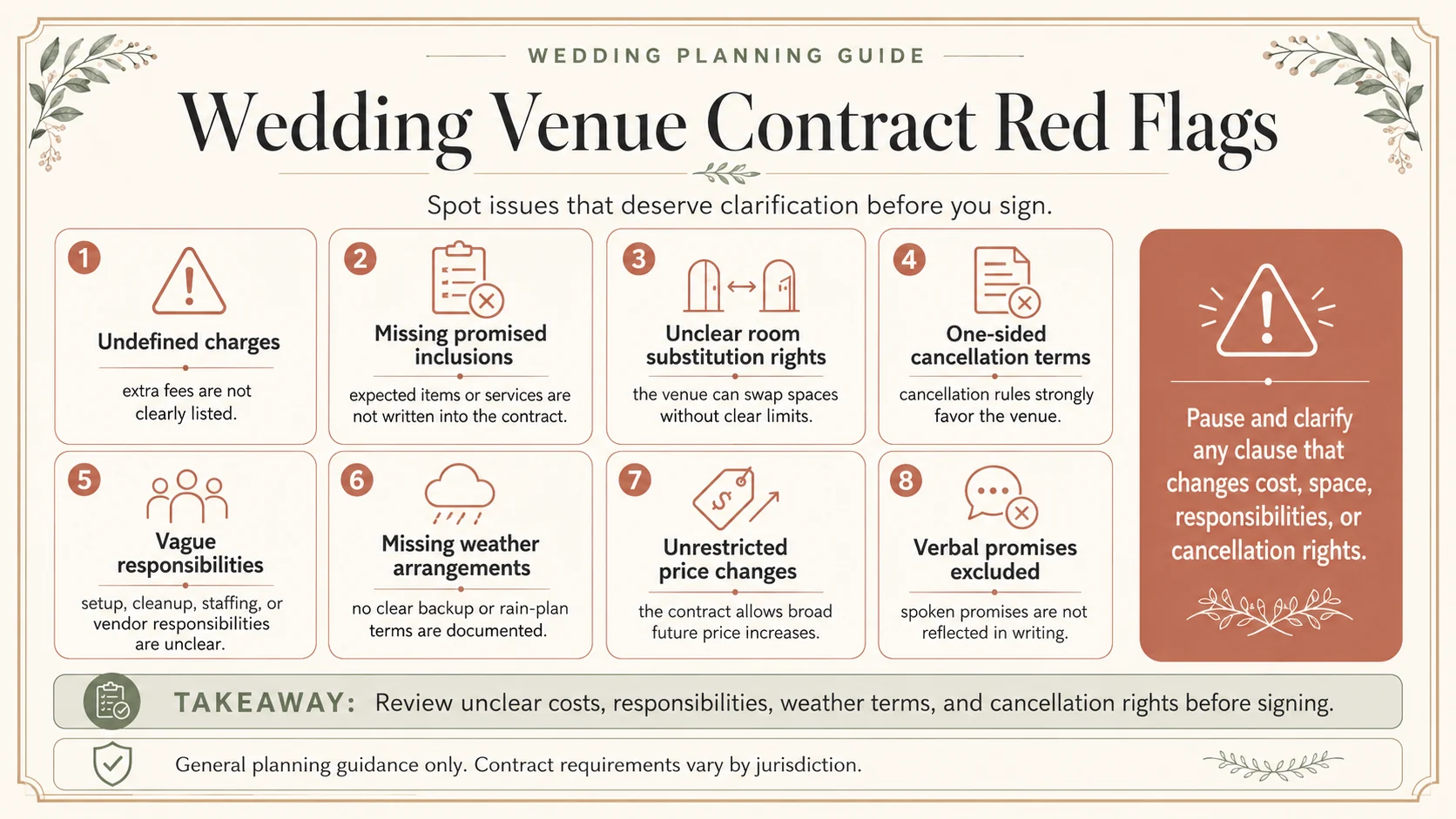
Contract red flags
Pause before signing if:
- Important charges are undefined.
- Promised inclusions are absent.
- The venue can change the booked space without clear conditions.
- Cancellation terms apply differently to the venue and the couple.
- Responsibilities are described vaguely.
- Weather arrangements are not documented.
- The contract conflicts with the written proposal.
- Verbal promises cannot be added.
- Price changes are permitted without a clear basis.
- The venue will not explain unclear wording.
A venue contract can involve substantial financial commitments. Seek advice from a qualified professional where terms are complex, unclear or unusually restrictive. General wedding-planning guidance cannot replace jurisdiction-specific legal advice.
Step 8: Coordinate the Venue After Booking
Booking the venue begins the operational stage of wedding planning.
Immediately after booking
- Save the signed contract and proposal.
- Record all payment dates.
- Update the wedding budget.
- Confirm the date with key participants.
- Begin booking priority vendors.
- Share venue restrictions with relevant suppliers.
- Add location and travel information to the wedding website.
During the main planning period
- Confirm catering and bar arrangements.
- Develop the floor plan.
- Coordinate transport and accommodation.
- Plan accessibility requirements.
- Confirm supplier access.
- Review power and production needs.
- Plan décor installation and removal.
- Create the event timeline.
- Decide where signs and guest instructions will be placed.
During the final month
- Confirm the final guest count.
- Complete the venue walkthrough.
- Approve the floor plan.
- Share the final timeline.
- Confirm the weather decision process.
- Provide vendor contact details.
- Confirm deliveries and collections.
- Review outstanding payments.
- Assign responsibility for gifts, personal items and décor.
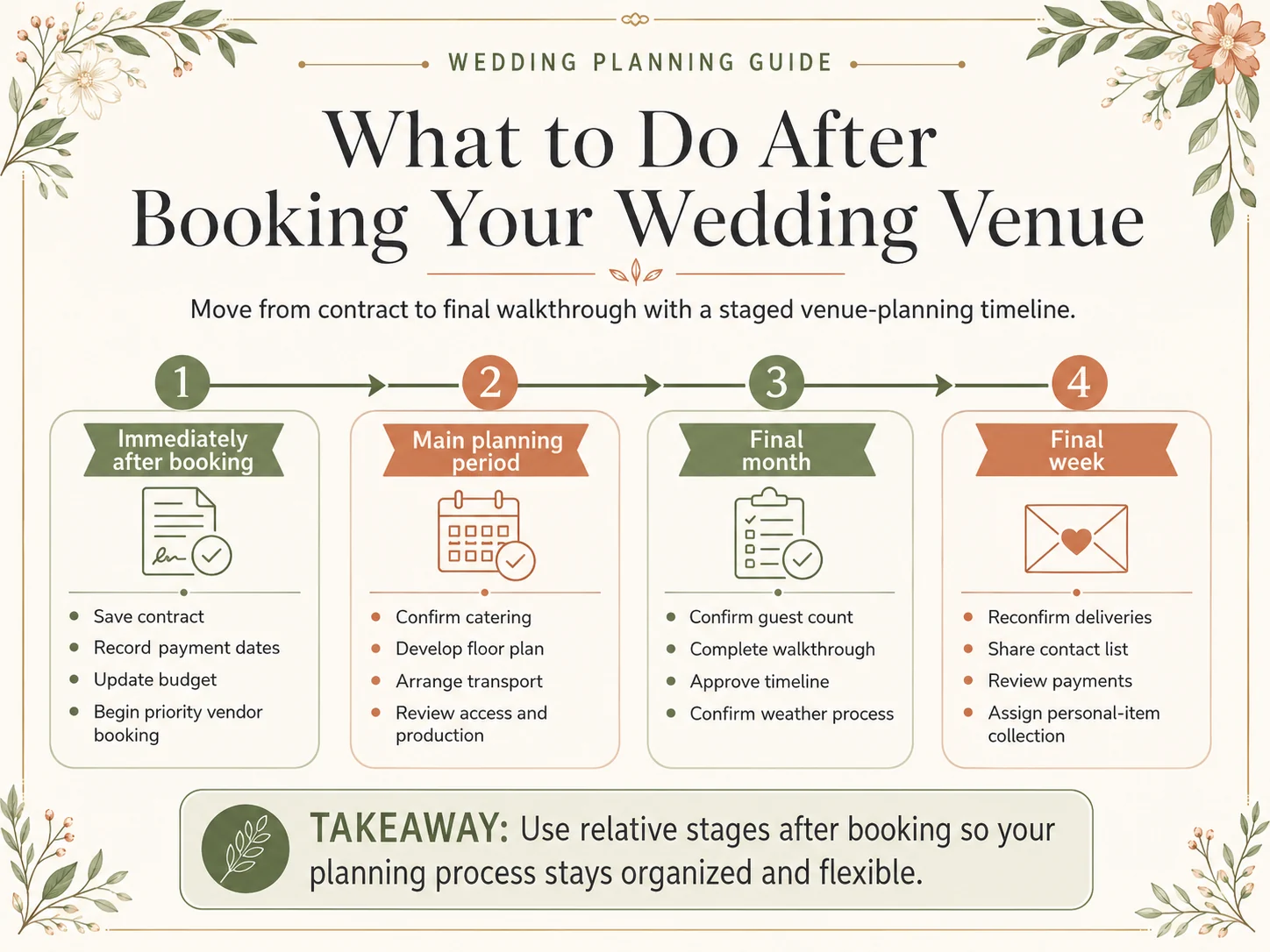
Venue-planning timelines vary according to location, season and demand. Current guidance from Zola suggests booking around nine to 14 months before the wedding as a general starting point, while highly sought-after venues or dates may require an earlier search. Treat that range as planning guidance rather than a universal deadline.
Book and Compare Your Wedding Vendors
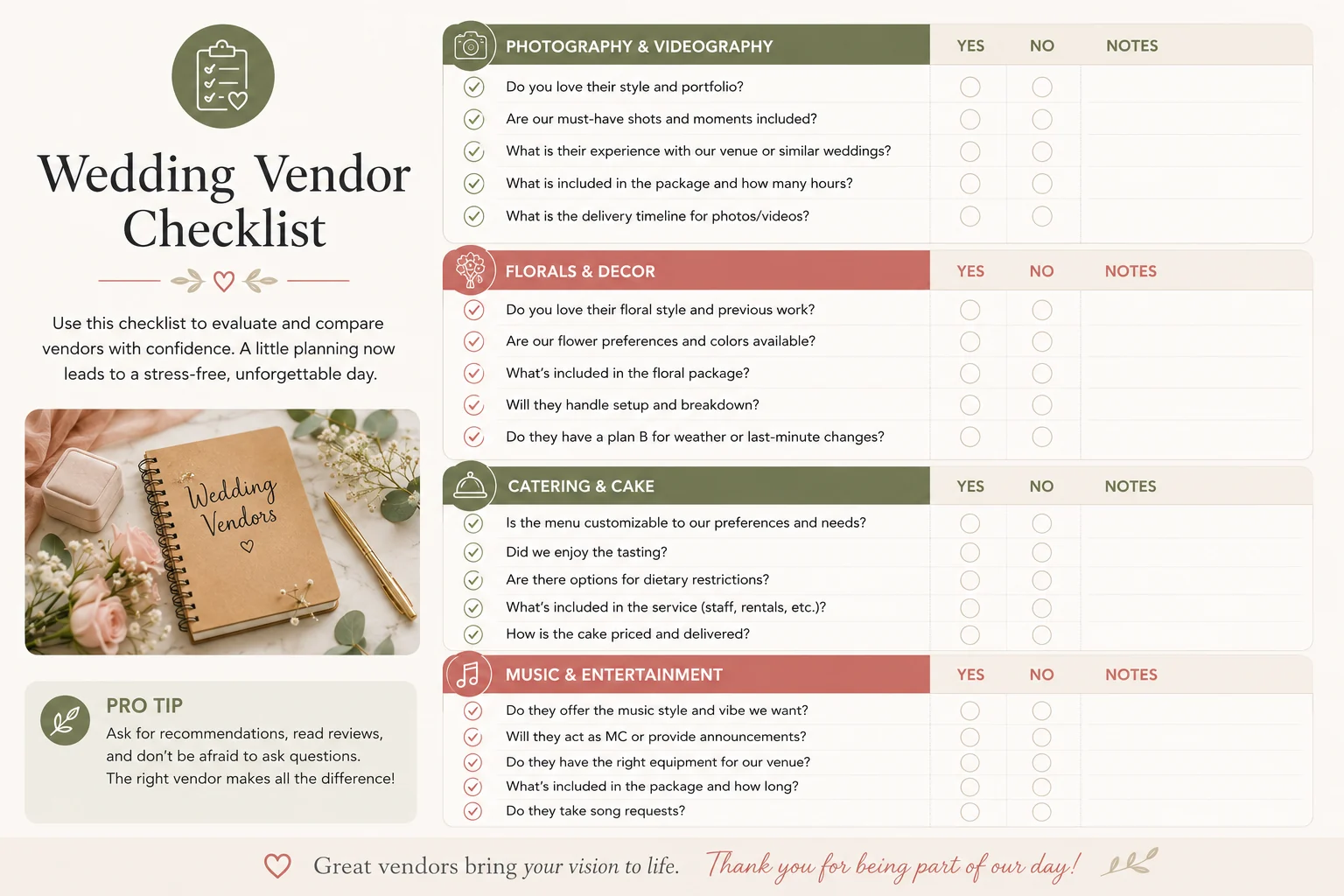
With the venue secured, your next priority is assembling the vendor team it depends on: photographer, videographer, caterer, florist, entertainment, cake and more. Book according to your priorities and each supplier's availability rather than a fixed order.
Use a consistent checklist so you ask every vendor the same questions about style, inclusions, timings and cost. Asking the same things each time makes it far easier to compare suppliers fairly later.
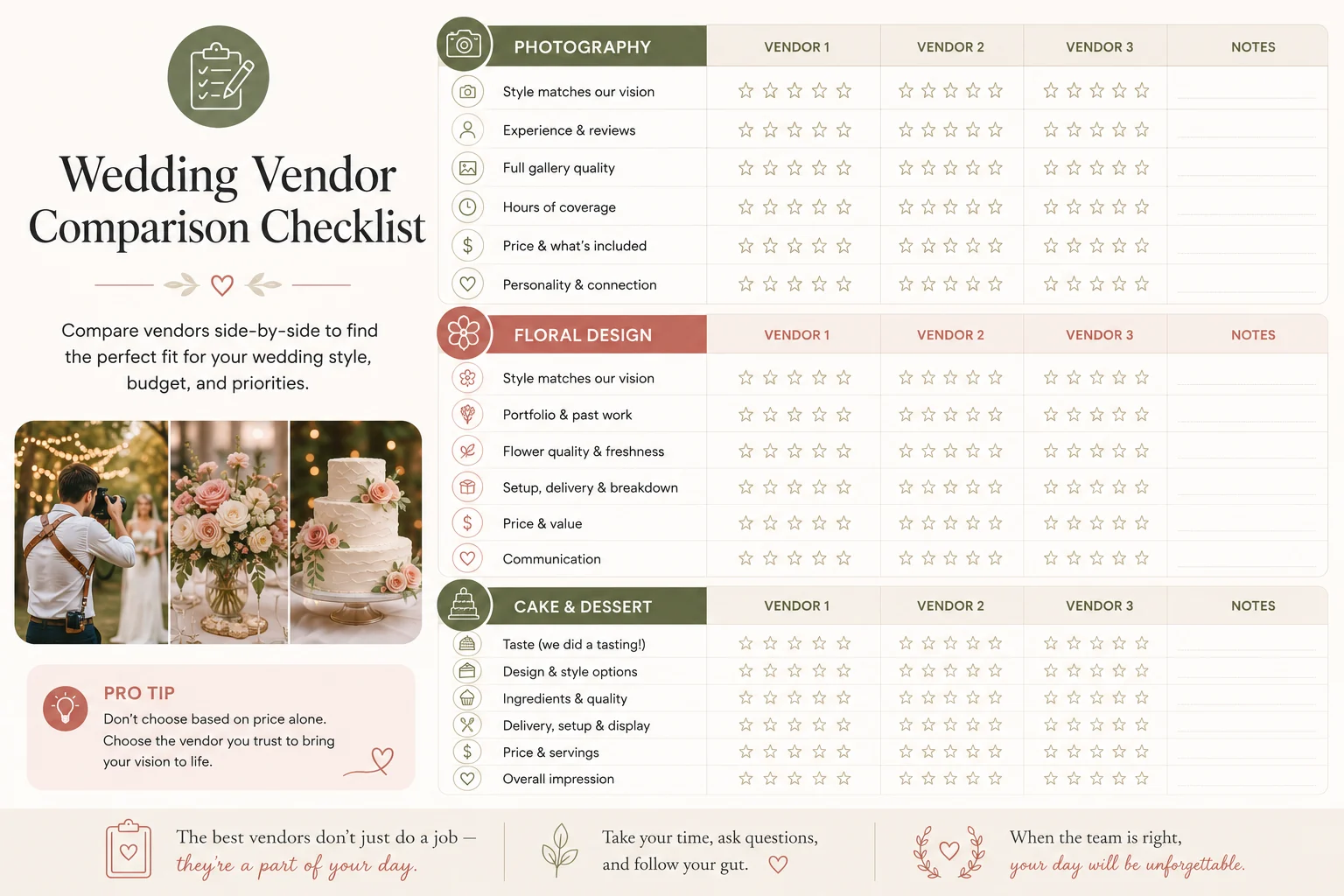
Then score your shortlisted vendors side by side. A simple comparison sheet keeps the decision grounded in fit, experience and value rather than a single striking photo or the lowest quote.
Plan the Guest Experience Around the Venue
A successful venue plan considers what guests will need from arrival to departure.
Arrival, transport and accommodation
Give guests clear information about:
- The full address
- Parking
- Drop-off points
- Shuttle service
- Public transport
- Walking routes
- Accommodation
- Ceremony start time
- Outdoor terrain
- Accessibility
- Expected weather
- Appropriate footwear or clothing
Add the information to the wedding website and repeat the most important details close to the event.
Signage and guest instructions
Plan signs around natural decision points rather than placing everything at the entrance.
Useful locations include:
- Parking areas
- Venue entrance
- Ceremony entrance
- Bar
- Seating-plan area
- Guest book table
- Restrooms
- Transport pickup point
Keep instructions brief and readable from an appropriate distance.
Collecting guest photos at the venue
Professional photographers focus on the couple, key moments and the formal story of the day. Guests often capture different conversations, reactions and behind-the-scenes moments — our guide on wedding photos from guests explains why they matter.
A QR-code photo-sharing system can give guests one place to contribute those photos and videos during or after the wedding. If you want to weigh the options, we compare the best photo sharing apps for events.
Guestreel provides couples with a personalized QR code and event link. Guests can upload through their browser without creating an account or downloading an app, and the media is collected in one private gallery in its original quality.
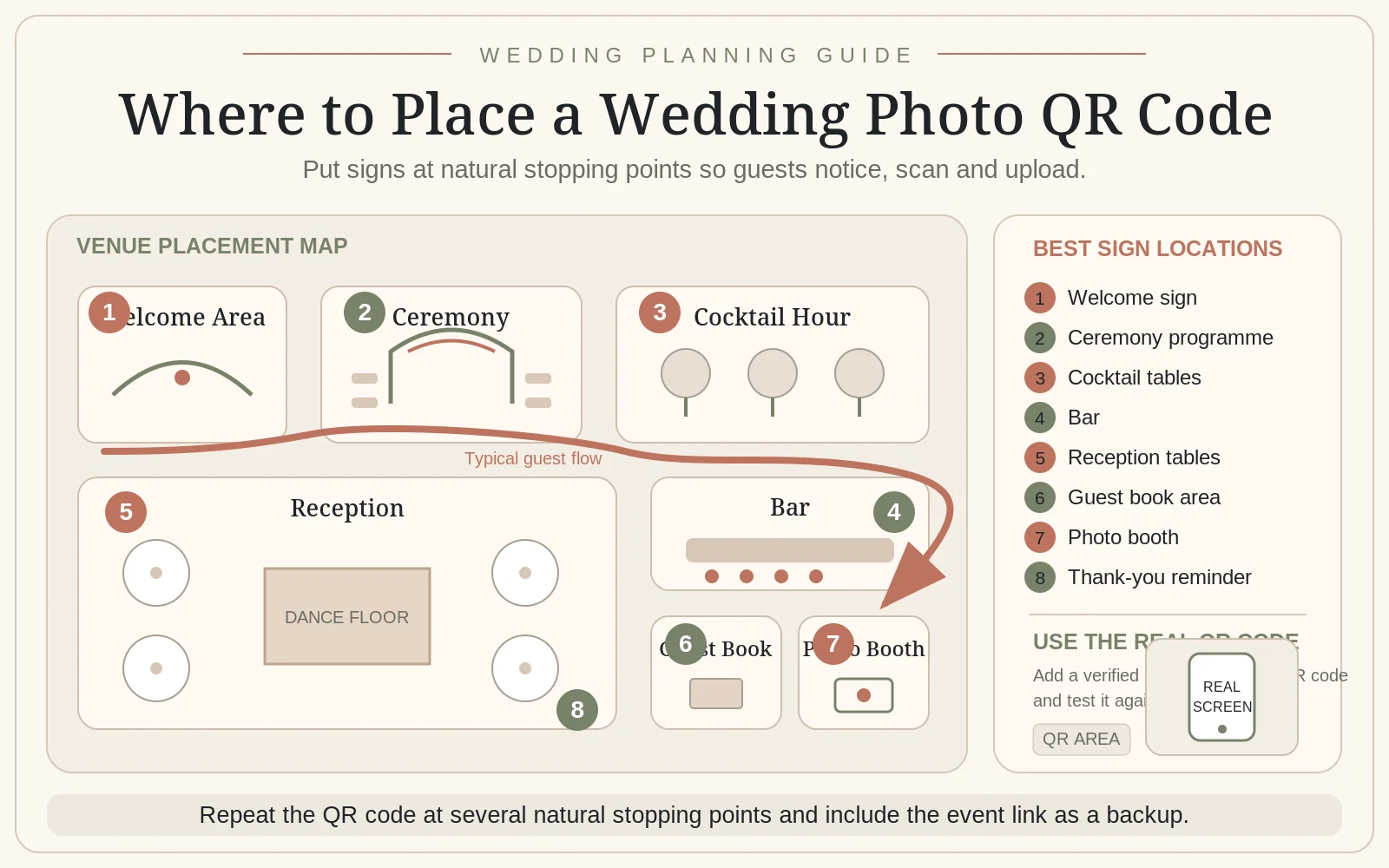
Potential QR-code placements include:
- The welcome sign
- Ceremony programmes
- Cocktail tables
- The bar
- Reception tables
- The guest book area
- The photo booth
- The wedding website
- Thank-you cards
Use several relevant placements rather than relying on one sign that guests may miss.
For venues with unreliable mobile reception or Wi-Fi, include the event link on the wedding website and printed materials so guests can upload later. Test the guest upload process at the venue before the wedding.
Common Wedding Venue Planning Mistakes
- Touring before setting a guest-count ceiling: A venue cannot be assessed properly without knowing how many people it must hold.
- Comparing hire fees instead of total costs: A low base price may require expensive rentals, staffing and transport.
- Trusting the stated maximum capacity: Ask for the comfortable seated capacity using your intended layout.
- Treating the weather backup as an emergency detail: Evaluate it as a genuine alternative version of the wedding.
- Choosing entirely for appearance: Attractive décor cannot compensate for poor access, flow or service.
- Ignoring the guest journey: Walk through arrival, transitions, restrooms, transport and departure.
- Assuming the venue coordinator is your wedding planner: Confirm exactly which tasks each person handles.
- Failing to document promises: Add important commitments to the contract or a signed amendment.
- Overlooking mobile reception and Wi-Fi: Test connectivity if guests or suppliers will depend on it.
- Booking without reading cancellation terms: Understand the financial consequences of cancelling or rescheduling.
- Forgetting setup and breakdown: Confirm who installs, moves and removes every item.
- Planning signage too late: Reserve practical locations for directions, schedules and guest participation.
Final Wedding Venue Decision Checklist
Before signing, confirm that:
- The venue fits your full invitation count comfortably.
- The true total cost fits your budget.
- The date, access times and included spaces are documented.
- The guest journey is practical.
- Accessibility requirements are met.
- The weather backup is acceptable.
- Catering and vendor restrictions are understood.
- Setup, breakdown and overtime responsibilities are clear.
- All important promises appear in writing.
- The payment and cancellation terms are manageable.
- The venue still feels right once the practical checks are complete.
The strongest venue choice balances atmosphere with evidence. Compare the total cost, test the guest experience, review the backup plan and put every important commitment in writing. Once those foundations are secure, the venue can support the rest of the wedding rather than complicating it.
FAQ
What should you decide before looking at wedding venues?
Decide your maximum invitation count, overall venue budget, preferred location, acceptable dates and non-negotiable requirements. These five decisions provide enough information to filter out unsuitable venues before arranging tours.
How far in advance should you book a wedding venue?
Many couples begin their search about a year before the wedding, but the appropriate timeline depends on the venue, season, location and flexibility of the date. Popular weekend dates and destination venues may require earlier booking.
How many wedding venues should you tour?
Tour enough venues to compare realistic options, but avoid visiting spaces that already fail your budget, capacity or location requirements. A focused shortlist of suitable venues is more useful than a large collection of inconsistent options.
Should you choose the wedding date or venue first?
Choose a fixed date first only when that date is non-negotiable. Otherwise, select a preferred period and ask suitable venues about availability. Date flexibility can provide more venue options.
What percentage of the wedding budget should go to the venue?
There is no universal percentage because venues package their services differently. One quote may include catering, furniture and staff while another covers only the space. Set a total venue-related limit and compare complete costs rather than relying on a broad percentage.
What hidden venue fees should you ask about?
Ask about taxes, service charges, staffing, security, cleaning, corkage, cake cutting, rentals, overtime, insurance, outside-vendor fees, parking, heating, power, setup and breakdown. Request an itemised written proposal.
What is the difference between maximum and comfortable capacity?
Maximum capacity is the highest permitted occupancy under a particular configuration. Comfortable capacity considers the actual wedding layout, including tables, the dance floor, entertainment, accessibility routes, bars and service space.
What is the difference between a venue coordinator and a wedding planner?
A venue coordinator generally manages matters related to the venue. A wedding planner may oversee the wider event, including suppliers, design, timeline and coordination. Responsibilities differ, so request a written explanation of what each person will handle.
What should an outdoor venue's weather plan include?
The plan should identify the backup space, comfortable capacity, decision deadline, responsible person, setup process, staffing, timeline changes and any additional charges. Review the backup layout before booking.
What should you do after booking a wedding venue?
Save the contract, record payment dates, update the budget, confirm the date and begin booking vendors. Then develop the floor plan, guest transport, supplier access, accessibility arrangements, signage and final timeline.