The best DIY wedding ideas are not necessarily the most ambitious. They are the ones that save money, make the wedding feel more personal, or create something you could not easily buy ready-made, without turning the final weeks before your wedding into a production line.
For most couples, good projects include signs, table numbers, place cards, simple centerpieces, photo displays and guest-book details. Large installations, complicated fresh flowers and anything that needs hours of work on the wedding morning deserve more caution.
Start with the projects that give you the biggest result for the least stress.
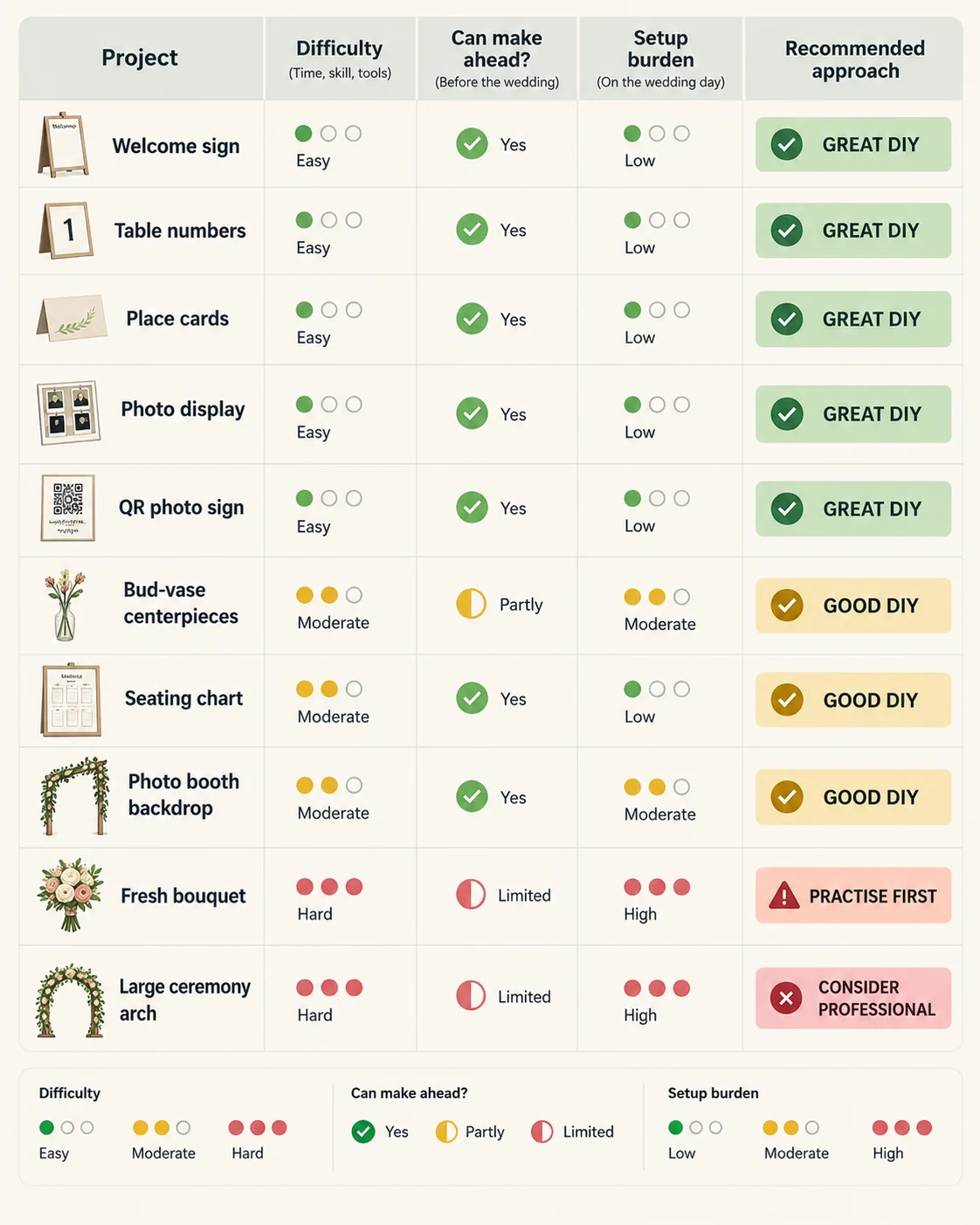
The Best DIY Wedding Ideas at a Glance
| Project | Difficulty | Make ahead? | Setup burden | Verdict |
|---|---|---|---|---|
| Welcome sign | Easy | Yes | Low | Great DIY |
| Table numbers | Easy | Yes | Low | Great DIY |
| Place cards | Easy | Yes | Low | Great DIY |
| Printed menus | Easy | Yes | Low | Great DIY |
| Photo display | Easy | Yes | Low | Great DIY |
| Wedding card box | Easy | Yes | Low | Great DIY |
| QR photo-sharing sign | Easy | Yes | Low | Great DIY |
| Bud-vase centerpieces | Easy to moderate | Partly | Moderate | Usually worth it |
| Seating chart | Moderate | Mostly | Low | Good DIY |
| Wedding favours | Easy to moderate | Yes | Low | Keep them simple |
| Photo booth backdrop | Moderate | Yes | Moderate | Good with help |
| Fresh wedding bouquet | Moderate to hard | Limited | High | Practise first |
| Large ceremony arch | Hard | Partly | High | Often better rented or professionally installed |
A project becomes less attractive to DIY when it needs specialist skills, cannot be prepared early, is difficult to transport or has serious consequences if something goes wrong.
What Counts as a DIY Wedding?
A DIY wedding is simply a wedding where you make or assemble some elements yourself rather than buying everything finished or hiring a professional for every detail.
It does not mean making your invitations, flowers, signs, favours, centerpieces, cake and ceremony arch from scratch.
Selective DIY usually works better. You might create your own stationery and table décor, for example, while leaving catering, complex florals and structural installations to experienced suppliers.
If the visual direction is still undecided, establish that first. These wedding theme and décor ideas can help you choose a style before buying materials that may not work together.
What Should You DIY, Buy, Rent or Hire?
Before opening Canva or heading to a craft shop, decide whether DIY is actually the best way to get the result you want.
| Option | Best when | Watch out for |
|---|---|---|
| DIY | The project is simple, personal and can be finished early | Hidden tool costs and time |
| Buy | You want something inexpensive and reusable | Buying more than you need |
| Buy second-hand | The item is decorative and widely available | Storage and collection |
| Rent | You need larger items for one day only | Delivery, deposits and return times |
| Hire a professional | Skill, safety or wedding-day setup matters | Higher upfront cost |
A handmade table number has very little downside if it is not perfect. A heavy ceremony installation is different. The bigger the consequences of failure, the stronger the argument for professional help.
The DIYability Test: Is a Project Really Worth Making?
Before committing to a project, judge it against five things.
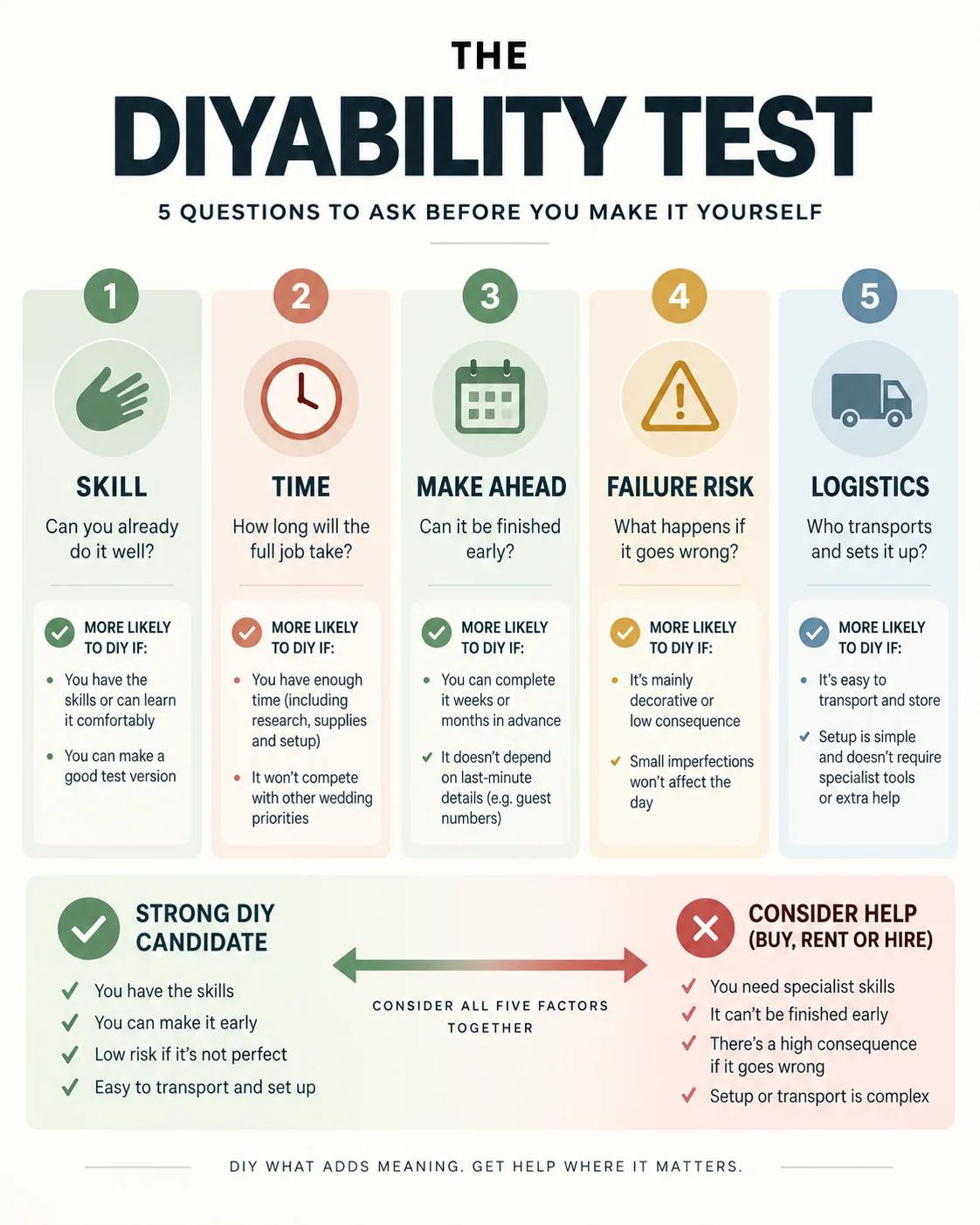
Skill
Could you make a good version of this today?
Printing menus or arranging photos in frames requires very little specialist knowledge. Producing elaborate fresh flowers or constructing a freestanding arch does.
If the technique is completely new, make one prototype before committing to dozens.
Time
Count the whole job, not just the crafting.
There is research, buying supplies, testing, producing every copy, fixing mistakes, packing, transporting and eventually setting everything up.
One handmade place card may take only a few minutes. Multiply that by 120 guests and the decision looks different.
Make-ahead flexibility
Projects you can finish a month early are easier to live with than projects that come alive only during wedding week.
Signs, card boxes, table numbers, dried-flower pieces and photo displays all score well here.
Failure risk
Ask what happens if the project does not turn out exactly as planned.
Slightly imperfect place cards are harmless. An unstable structure or badly timed fresh-flower installation can create a genuine problem.
Wedding-day logistics
Every finished project still needs to reach the venue and end up in the right place.
Know:
- how it will be transported;
- where it will be stored;
- who will set it up;
- whether tools are required;
- who will remove it afterwards.
A project that looks easy at home can become surprisingly inconvenient once transport and setup enter the equation.
Easy DIY Wedding Ideas for Beginners
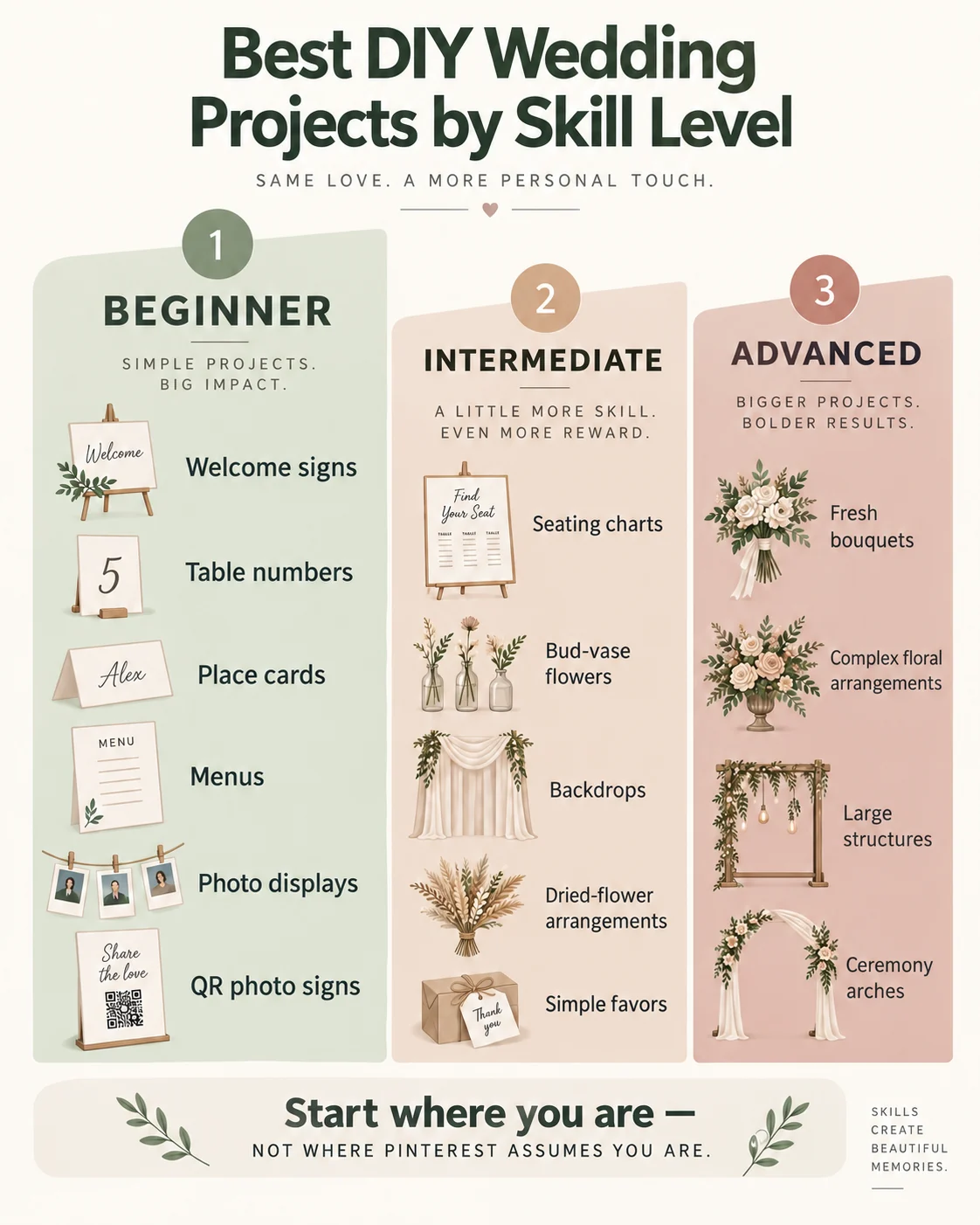
You do not need a Cricut, elaborate craft equipment or years of experience for most of these projects.
Wedding welcome sign
A welcome sign can be made from a printed poster, framed card, mirror, acrylic sheet or painted board.
Keep the wording simple. Names, the wedding date and a short welcome are usually enough.
Check where it will stand before deciding on size, and confirm whether the venue provides an easel.
Table numbers
Table numbers are inexpensive to personalise and easy to prepare well in advance.
Try:
- numbers in small frames;
- folded printed cards;
- painted wooden pieces;
- acrylic numbers;
- bottles or vases with number tags.
Guests need to spot them quickly, so readability matters more than elaborate lettering.
Place cards
Folded card is perfectly sufficient, but small details can make place settings more personal.
Options include luggage tags, ribbon tags, pressed-flower cards or mini envelopes.
Wait until the guest list is reasonably settled before printing every name.
Printed menus
Design your own menus and print them at home or through a professional printer.
Depending on the meal and table style, you might provide one per guest, one per couple or several per table.
Do not print the final batch until the caterer has confirmed the menu.
Photo display
A photo display adds personality without requiring much craft skill.
You could use:
- photographs from your relationship;
- childhood pictures;
- family wedding photos;
- travel memories;
- images clipped to string;
- a timeline of your relationship.
If original photographs are valuable, display copies instead.
Wedding card box
A wooden box, vintage-style case, glass display box or simple lockable container can all work.
Decorate it to match the wedding, but keep the purpose obvious and think about security if guests are likely to leave cards containing money.
DIY Wedding Ceremony Ideas
Ceremony projects can have a big visual effect because every guest sees the same space.
Ceremony welcome sign
A ceremony sign can do more than welcome guests. It might also explain seating or communicate an unplugged-ceremony request.
Keep instructions short enough to read while people are arriving.
Aisle markers and chair details
Ribbon, greenery, small flower jars, dried flowers and fabric bows can all define the aisle without decorating every chair.
Concentrating details at the aisle ends often gives a cleaner result and means far less setup.
Ask the venue what may be attached to chairs or pews before choosing fixings.
DIY wedding arch
A straightforward arch may be achievable if you already have suitable building skills and the venue allows it.
The important part is not the flowers or fabric. It is whether the structure is stable, transportable and appropriate for the location.
Explore different wedding arch ideas before deciding whether making one yourself is realistic.
Large, heavy or suspended installations are usually better rented or handled by someone experienced.
Ceremony backdrop
If you want a focal point without constructing a full arch, a backdrop may be easier.
Fabric panels, ribbon, paper details, decorative screens or lightweight frames can all work.
Build the complete version once before the wedding. Venue setup should be assembly, not experimentation.
DIY Wedding Table and Reception Décor
Reception décor is especially DIY-friendly because many items can be produced in batches and completed early.
Bud-vase centerpieces
Instead of one large floral arrangement, group several small bottles or vases.
Because the vessels create much of the visual interest, each one needs only a few stems. Mixed second-hand glassware can work particularly well for garden, vintage and relaxed wedding styles.
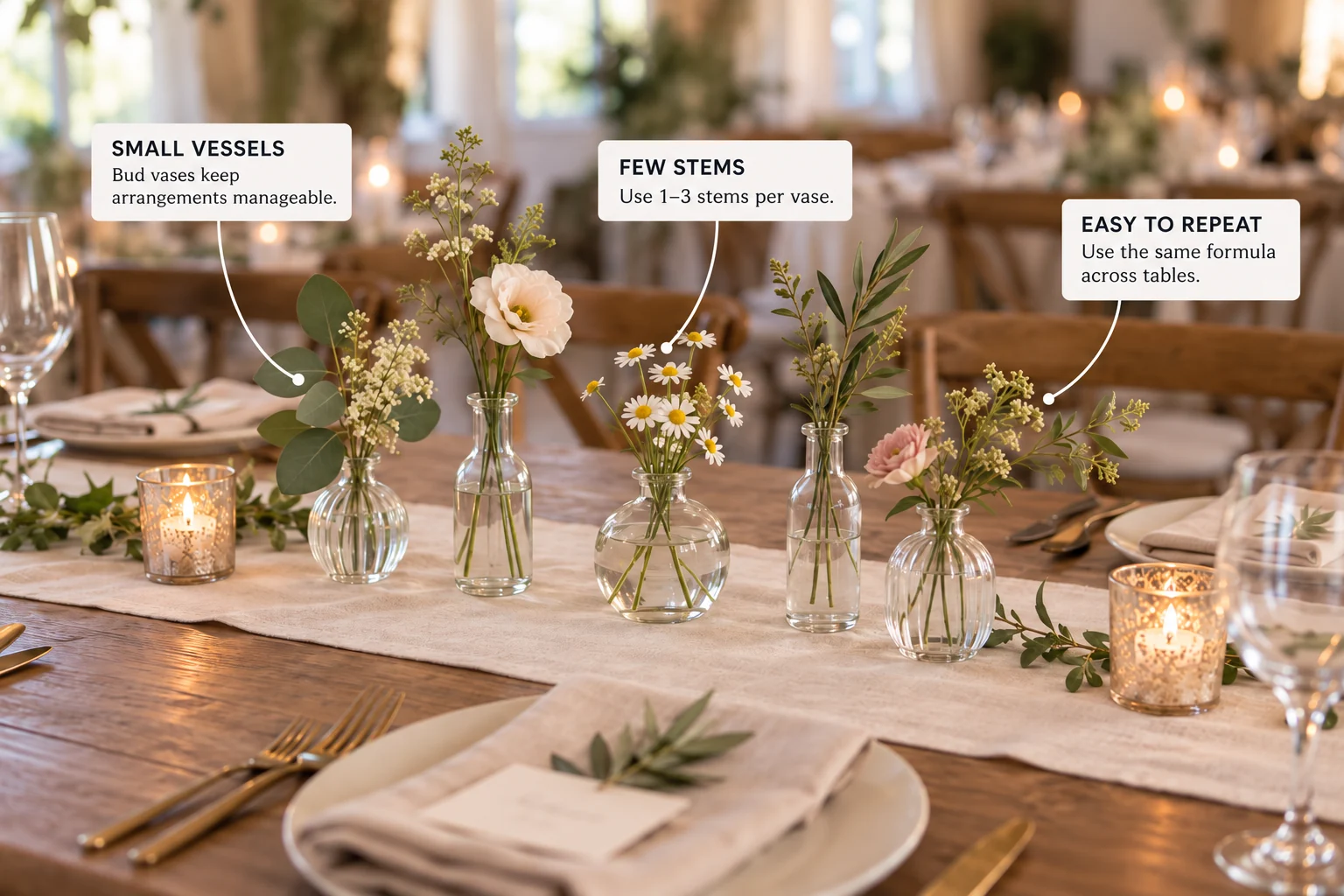
Fresh flowers still need suitable preparation and storage, so check requirements with your flower supplier.
Candle clusters
Candles at different heights can make a table feel finished without requiring complicated florals.
Before buying anything, check the venue's rules on open flames. If candles are restricted, battery-operated alternatives may work better.
Fruit and flower arrangements
Seasonal fruit can bring colour and shape to a tablescape.
Lemons with greenery, pears with neutral flowers or grapes arranged around candle holders can create a strong visual effect with relatively little construction.
Table runners
Fabric, gauze, paper or greenery can connect the length of a table.
Measure the actual tables before ordering. Photos can make proportions surprisingly difficult to judge.
Personalised table names
Tables do not have to be numbered.
You might name them after:
- places you have travelled together;
- songs;
- films;
- cities;
- shared interests;
- important dates.
A sentence explaining the significance of each name can turn a functional detail into something guests enjoy discovering.
DIY Wedding Sign Ideas
Signage is one of the easiest areas to personalise because most pieces can be designed and tested long before the wedding.
Seating chart
A seating chart should solve one problem quickly: helping guests find where they are sitting.
Possible formats include:
- a printed board;
- individual name cards;
- framed lists;
- hanging tags;
- acrylic or mirror displays.
For a large guest list, arranging names alphabetically can make the chart easier to scan.
Directional signs
Use directional signs where guests genuinely have a choice to make: a path dividing toward the ceremony, separate reception rooms, parking or facilities.
If every few metres has another arrow, the signs become decoration rather than navigation.
Bar menu
A simple drinks menu can help guests decide what they want before reaching the bar.
Use the same typography and styling as the rest of the wedding stationery so the collection feels intentional.
Memorial sign
If you are displaying photographs of loved ones who cannot be there, a short framed message may be all that is needed.
This is one area where restraint often feels more meaningful than elaborate decoration.
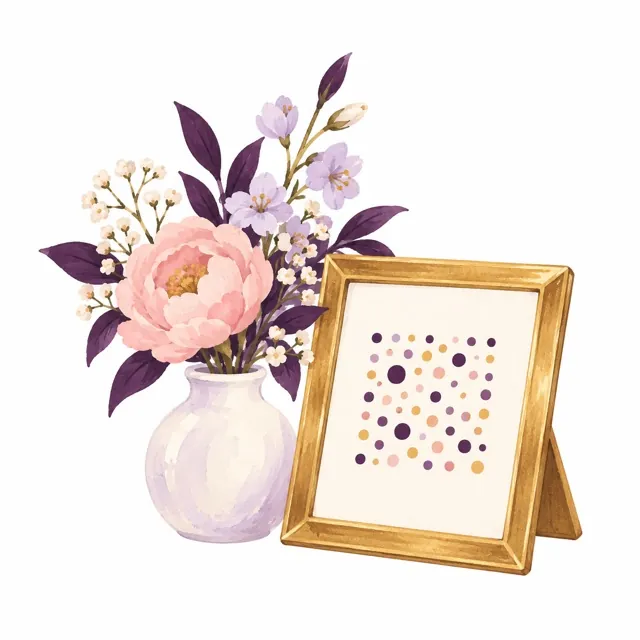
QR wedding photo sign
Your guests will probably take hundreds of photos and videos between them. A QR sign gives those pictures somewhere to go instead of leaving them scattered across camera rolls and messages.
With Guestreel's wedding photo sharing, couples can create an event with a personalised QR code. Guests scan it and upload photos and videos through their browser, with no app required, into one private event gallery.
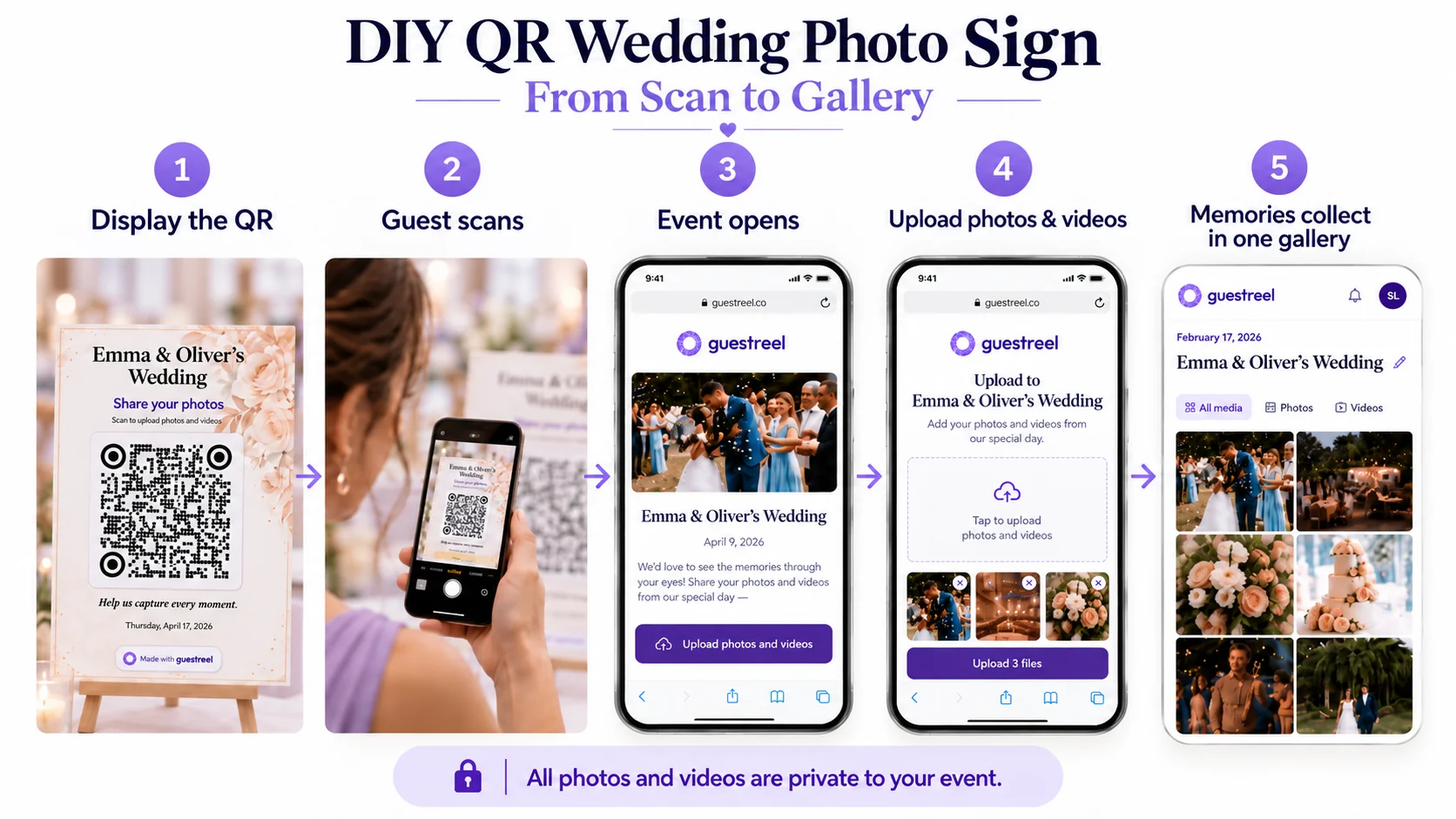
Create the event first, then incorporate the QR code into a sign that matches your stationery. Good locations include the bar, guest-book table, reception entrance or photo-booth area.
If collecting candid guest photos is important to you, this guide explains more ways to collect wedding photos from guests.
DIY Wedding Flower Ideas
Flowers are possible to DIY, but they deserve more respect than paper-based projects because the timing is less forgiving.
Bud-vase flowers
For beginners, small arrangements are much easier to manage than traditional centerpieces.
Choose a restrained palette and let each vase contain only a few stems.
Dried flowers
Dried flowers remove much of the last-minute pressure associated with fresh materials.
They can work for table arrangements, signs, place settings, bouquets and backdrops, although fragile stems need careful packing.
A simple bouquet
If you want to make your own bouquet, practise before committing.
The test version does not need to use your final flowers. Its job is to show whether you enjoy the process and can produce the shape you want.
Greenery
Greenery can be used along tables, stairs and signs with relatively little floral styling.
Fresh foliage still has storage requirements. Artificial or dried alternatives are easier to prepare in advance.
When to leave the flowers to a florist
Professional help becomes more sensible when the design depends on:
- complex bouquets;
- delicate flowers;
- large arrangements;
- on-site installations;
- significant refrigeration or storage;
- extensive wedding-week preparation.
DIY should remove pressure or add enjoyment. If it does neither, it is probably the wrong project.
DIY Wedding Guest Experience Ideas
Not every worthwhile DIY idea has to sit on a table. Some of the most memorable projects give guests something to interact with.
DIY photo booth
A simple photo area needs three things: a clear location, decent lighting and enough space for groups.
Add a backdrop and a few props if they fit the wedding. You do not need a suitcase full of novelty accessories.
These wedding photo booth ideas cover more DIY and low-cost setups.
Guest-book station
A guest book can take many forms:
- advice cards;
- postcards;
- instant photos;
- signed artwork;
- individual notes;
- messages stored in a keepsake box.
If a traditional blank book does not appeal to you, any of these can become the keepsake instead.
Memory wall
Collect meaningful photographs from your relationship and families, then plan the arrangement at home.
Photograph the finished layout before packing it. Whoever sets it up at the venue can then recreate it without guessing.
Advice cards
Specific prompts make blank cards easier to fill in.
For example:
- "Our best marriage advice is…"
- "Open this on your first anniversary…"
- "Never forget to…"
- "Our favourite memory with you is…"
Games
Personalise bought or rented games with your own scorecards, signs or question cards rather than building every component yourself.
It is a useful DIY principle in general: make the part that adds personality, not necessarily the whole thing.
Simple DIY Wedding Favour Ideas
Favours are easiest to justify when they are straightforward, useful and can be finished well before the wedding.
Ideas include:
- seed packets;
- tea or coffee packets;
- mini candles;
- small plants;
- printed recipe cards;
- purchased treats with personalised tags;
- small keepsakes you already know how to make.
For homemade food, cosmetics or anything applied to the body, consider ingredients, allergens, hygiene, storage and any requirements that apply where you live.
Often the lowest-stress option is to buy the favour and DIY only the packaging.
How to Make DIY Wedding Décor Look Cohesive
You do not need to create completely different projects for a rustic, modern, garden or boho wedding.
Instead, repeat a small design system across everything you make:
- two or three main colours;
- one or two typefaces;
- a consistent paper or material;
- similar frames or vessels;
- one recurring decorative detail.
A rustic wedding might repeat natural wood, linen and wildflower-style arrangements. A modern wedding could use clean typography, simple forms and restrained colours. A garden wedding may need little more than botanical stationery and arrangements that complement the surroundings.
Consistency makes DIY work look intentional. More decoration does not necessarily make it look more professional.
What You Should Not DIY for Your Wedding
Some jobs are poor DIY candidates even when the inspiration photos look achievable.
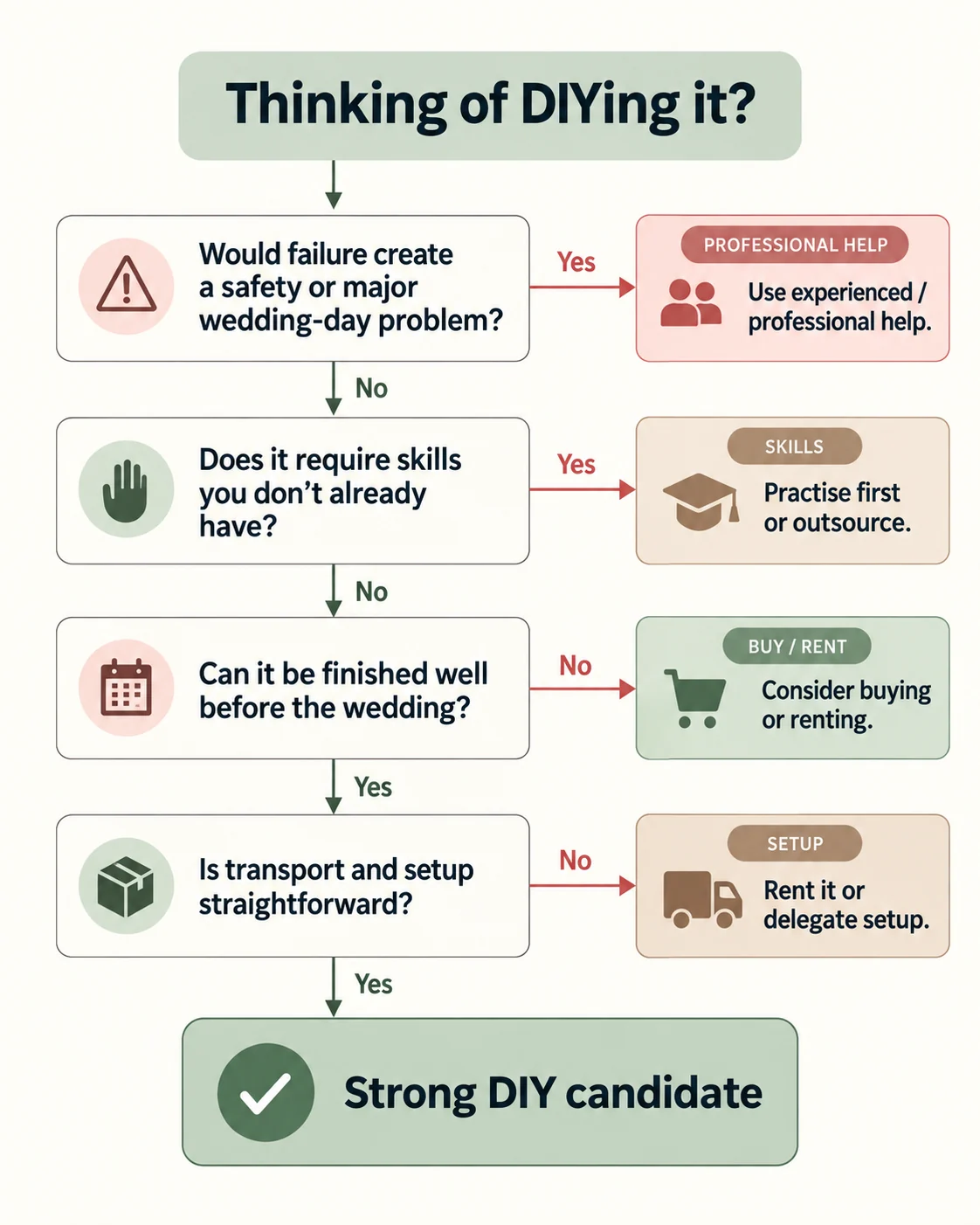
Anything where failure creates a serious problem
Decorative mistakes are one thing. Structural stability, food service, electrical work or other safety-critical tasks are different.
Use appropriately experienced people where mistakes could affect guests or the running of the event.
Complicated fresh flowers without practice
A few vases are realistic for many beginners. Large bouquets and floral installations are another level of work.
Test first rather than finding out during wedding week.
Projects that depend on the wedding morning
Try to keep the morning itself free from unfinished production.
Anything requiring hours of painting, printing, construction or complicated assembly has been scheduled too late.
Projects that barely save money
DIY is not automatically the budget option.
Compare it with:
- buying ready-made;
- buying second-hand;
- renting;
- hiring a supplier;
- reselling bought items afterwards.
Sometimes the financially sensible DIY decision is not to DIY.
Anything the venue prohibits
Check venue policies before committing to:
- open flames;
- wall fixings;
- hanging installations;
- confetti;
- outdoor structures;
- stakes;
- setup times;
- cleanup;
- collection deadlines.
Rules differ from one venue to another, so confirm them directly.
How to Calculate the Real Cost of DIY Wedding Décor
Do not compare a finished rented item with only the raw-material cost of making your own.
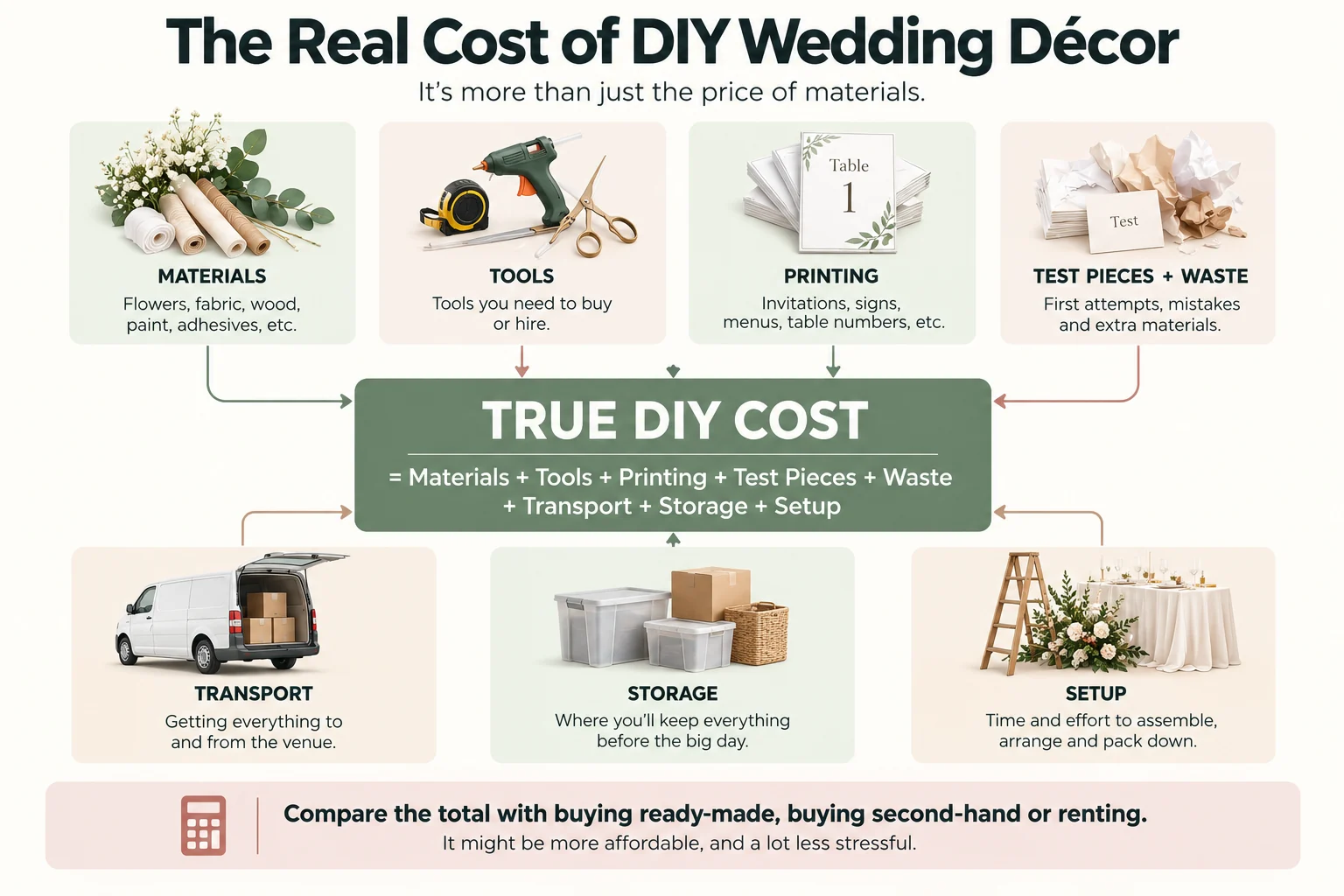
A more realistic calculation is:
True DIY cost = materials + tools + printing + test pieces and waste + transport + storage + setup requirements
A handmade sign, for example, may require the board, paint, brushes, lettering supplies, a stand and protective packaging.
That does not mean every enjoyable hour spent crafting needs a monetary value. If making the project is part of the fun for you, that matters too.
The point is simply to understand the trade-off before assuming DIY equals cheaper.
A Practical DIY Wedding Timeline
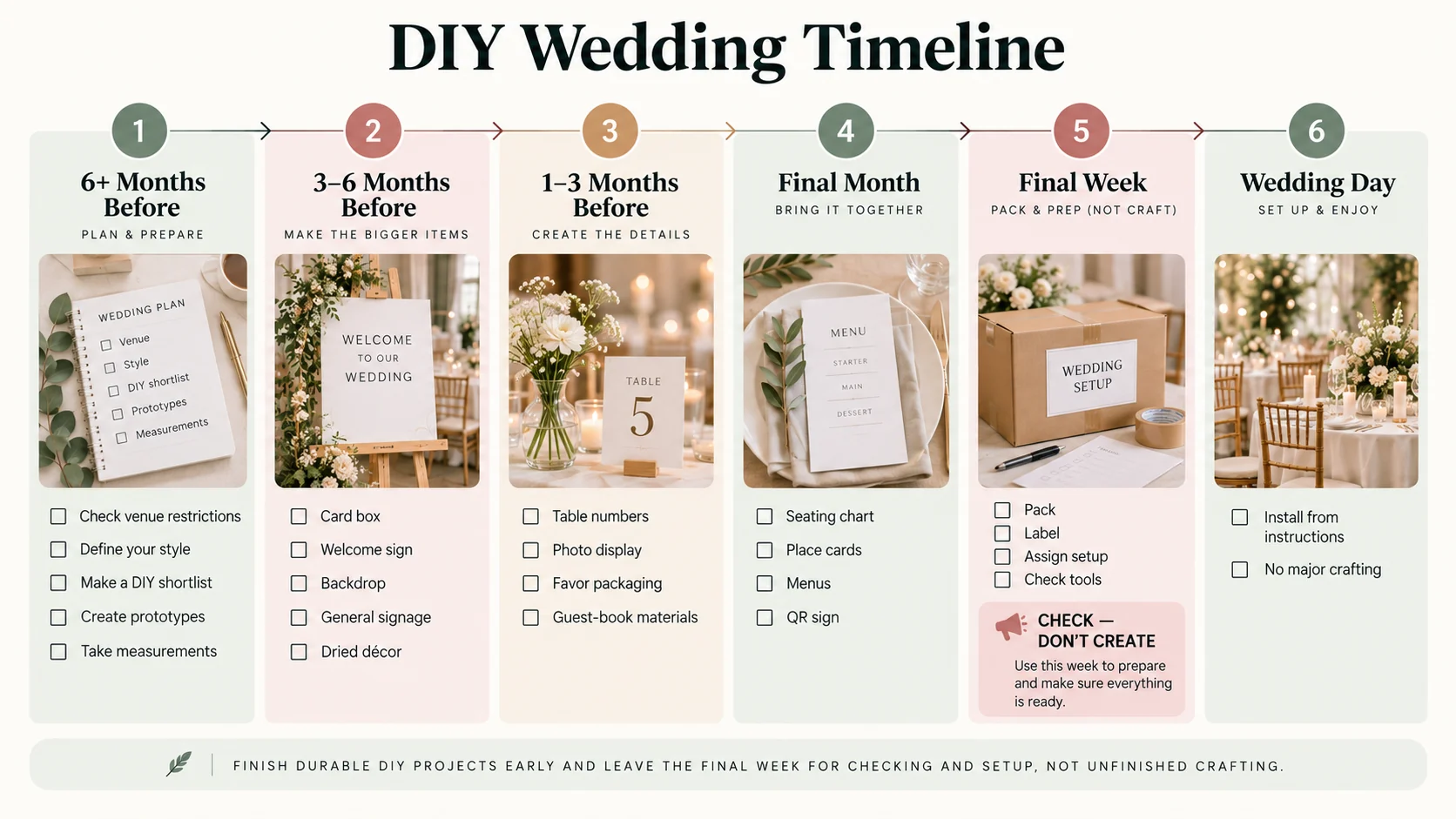
The safest approach is to work backwards from the wedding and keep the final weeks as light as possible.
Six months or more before
Decide what is genuinely worth making.
This is the time to:
- confirm venue restrictions;
- choose the overall style;
- list potential DIY projects;
- compare DIY with buying or renting;
- make prototypes;
- start collecting second-hand materials.
Add the important deadlines to your overall wedding planning checklist.
Three to six months before
Finish projects that do not depend on guest numbers:
- card box;
- welcome sign;
- photo-booth backdrop;
- frames;
- general signage;
- dried-flower decorations.
One to three months before
Move on to details that depend on a more settled plan:
- table numbers;
- favour packaging;
- photo displays;
- guest-book materials;
- bar signage.
Final month
Complete guest-specific pieces:
- place cards;
- seating chart;
- menus;
- personalised favours;
- QR photo-sharing signs.
Pack items by location (ceremony, entrance, reception tables, bar and guest-book area) instead of putting every sign in one box and every vase in another.
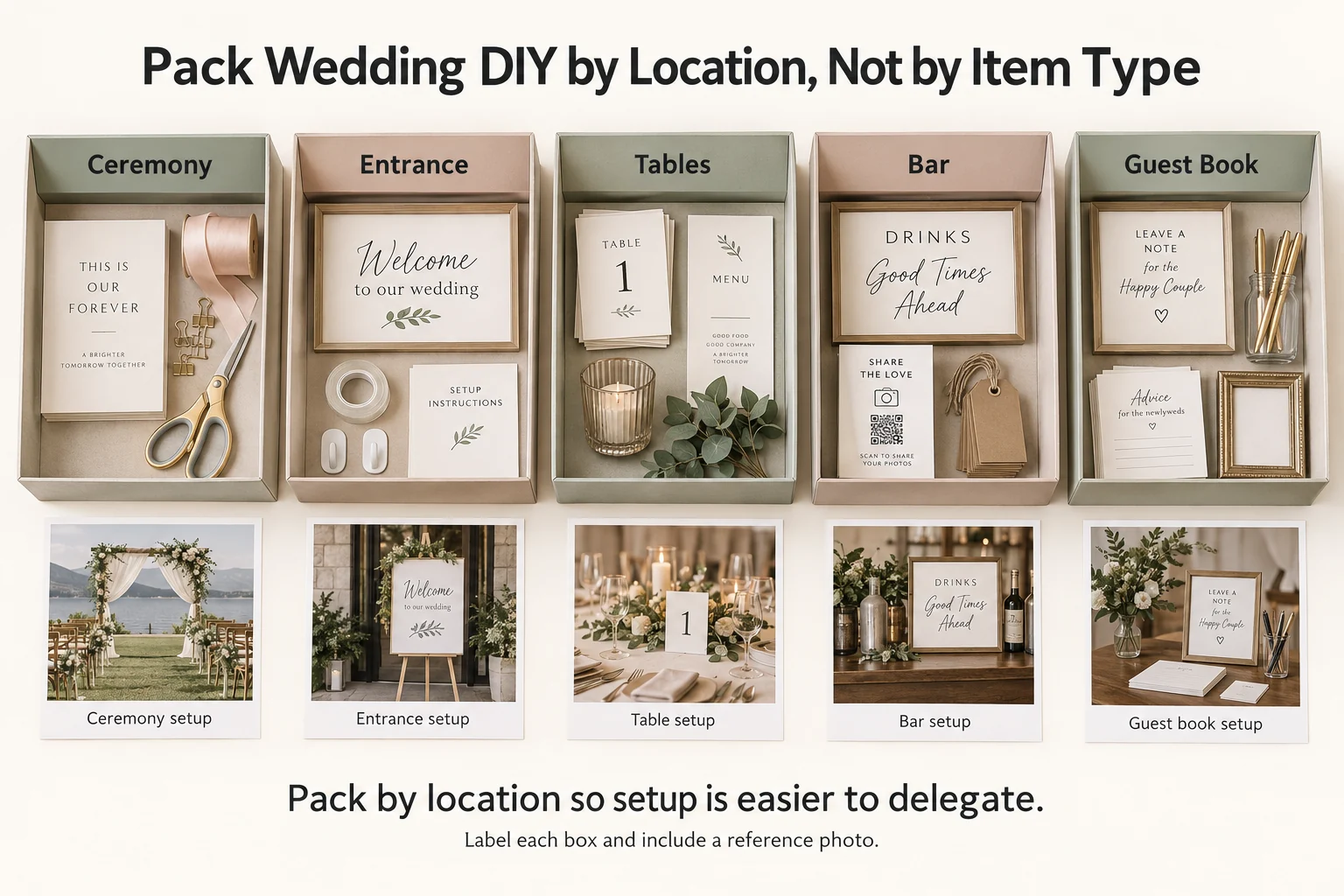
Final week
Ideally, you should now be checking rather than creating.
Confirm that boxes are labelled, setup instructions are clear and every task has an owner.
Fresh flowers and other time-sensitive items will naturally follow a shorter schedule.
The 8-Point DIY Check Before You Start
Before buying materials, answer these eight questions:
- Does the venue allow it?
- Do I have accurate measurements?
- What will it really cost once tools and extras are included?
- Can I make one good prototype first?
- Where will the finished pieces be stored?
- How will they get to the venue?
- Who will set them up?
- What is the fallback if I run out of time?
If several answers are unclear, solve those problems before adding another project to your list.
Make the Parts That Matter to You
DIY works best when it gives you something personal without taking over the wedding itself.
Choose a few projects with low setup risk, make one test version before producing dozens, and finish as much as possible early. Buy, rent or delegate the jobs that demand skills, equipment or time you do not realistically have.
The goal is not to prove how much of your wedding you can make yourself. It is to spend your effort on the details you will actually be glad you made.
Frequently asked questions
What are the easiest wedding decorations to make yourself?
Welcome signs, table numbers, place cards, printed menus, photo displays, card boxes and simple bud-vase arrangements are among the easiest DIY wedding decorations. They require relatively little specialist equipment and most can be finished before the final week.
Is it actually cheaper to DIY a wedding?
It can be, but DIY does not automatically save money. Compare materials, tools, printing, failed test pieces, transport and setup with the cost of buying, renting or purchasing second-hand. DIY tends to work best when the project is simple or you already own the equipment.
How many DIY wedding projects should I take on?
There is no ideal number. Base the decision on available time, skills and help. A handful of finished, coordinated projects will usually serve the wedding better than a long list that creates stress in the final weeks.
Can I DIY wedding flowers as a beginner?
Simple arrangements such as bud vases are more realistic for beginners than bouquets or large installations. Practise before deciding, and make sure you understand how your chosen fresh flowers need to be prepared and stored.
How do I make DIY wedding décor look professional?
Limit the number of colours, fonts and materials you use. Make one finished sample first, measure carefully and repeat the same design rules across signs, stationery and table details. Consistency usually creates a more polished result than adding more decoration.
What DIY wedding projects can be finished months in advance?
Welcome signs, card boxes, photo displays, frames, table-number holders, dried-flower pieces and many backdrops can be prepared months ahead. Seating charts, place cards and menus generally need to wait until guest and catering details are more settled.
Written by Linda DoWrites Guestreel’s planning guides.