The biggest wedding trends for 2026 are less about one dominant look and more about making the day feel personal. Couples are mixing vintage details with modern technology, choosing more atmospheric décor, embracing candid photography, reworking traditions and giving guests more ways to take part.
That doesn't mean every idea filling your Pinterest feed is suddenly everywhere. Some 2026 wedding trends are already widely adopted; others are simply gaining attention fast.
Here are the main themes shaping weddings this year.
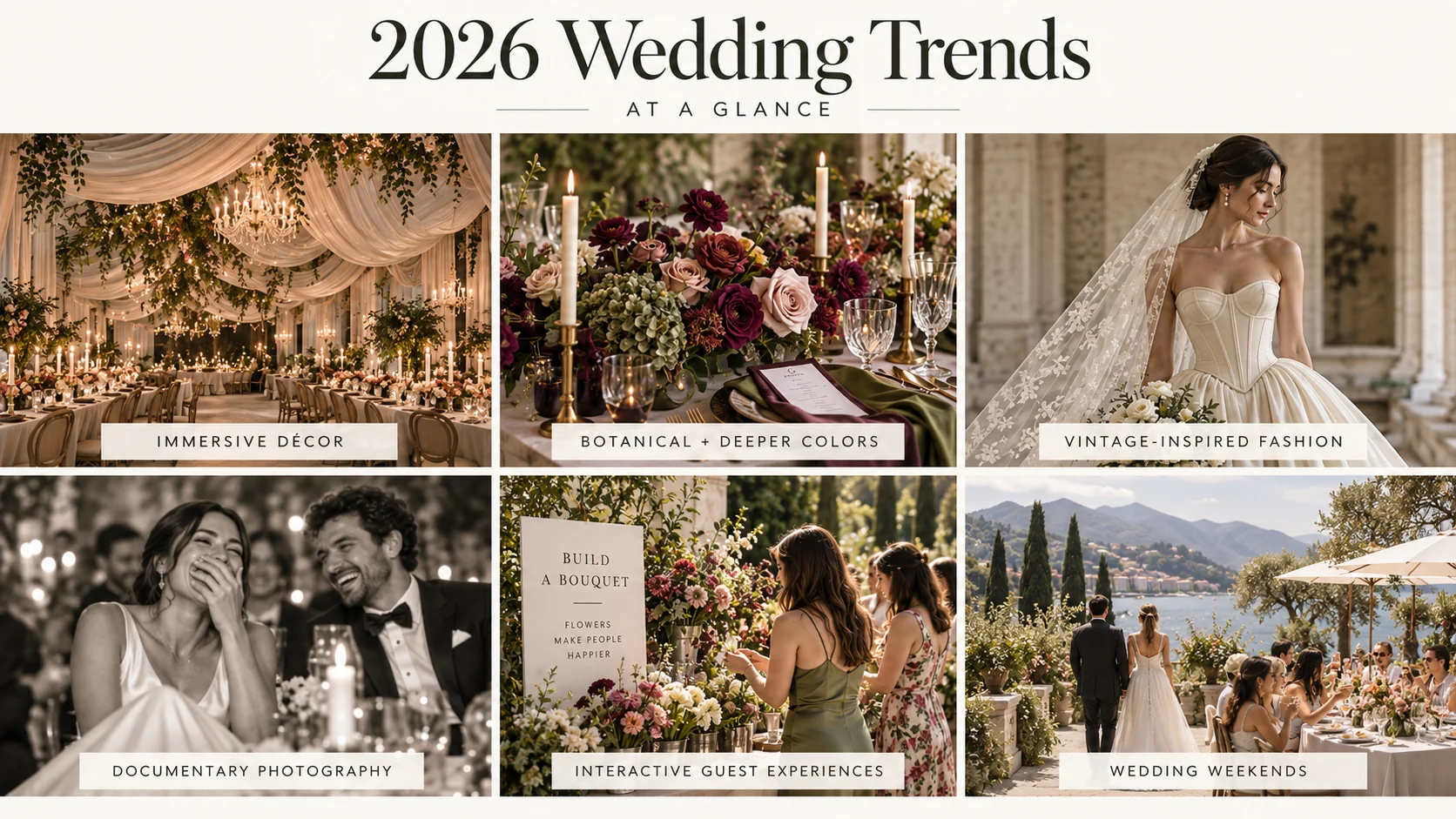
2026 Wedding Trends at a Glance
| 2026 wedding trend | What it looks like |
|---|---|
| Personalisation | Traditions, menus, décor and entertainment adapted to the couple rather than copied from a template |
| Vintage and nostalgic style | Heirlooms, pre-loved pieces, historical silhouettes, film and camcorder-inspired imagery |
| Immersive décor | Draping, layered fabrics, atmospheric lighting and statement installations |
| Nature-led color | Sage, green, olive, plum, merlot and other grounded tones |
| Expressive wedding fashion | Vintage influences, multiple looks and statement accessories |
| Documentary photography | Candid moments, movement, direct flash and less rigid posing |
| Social-first and guest content | Vertical clips, behind-the-scenes footage and photos captured by guests |
| Interactive guest experiences | Flower bars, live artists, games, audio or video guestbooks and participatory keepsakes |
| Food with personality | Personal menus, thoughtful mocktails and playful desserts |
| Experience-led venues | Gardens, historic settings and unconventional spaces with built-in atmosphere |
| Wedding weekends | Welcome drinks, after-parties, brunches and other events around the main wedding |
| Practical use of AI | Help with timelines, etiquette, budgets and planning admin |
How We Researched These 2026 Wedding Trends
We looked at three types of evidence: surveys showing what couples are actually choosing, search and save data showing which ideas are gaining interest, and current wedding-industry research.
They are not the same thing.
A search term growing rapidly on Pinterest tells us that an idea is attracting attention. It does not mean most couples are using it. Survey data is better at showing adoption, while search data can reveal ideas much earlier.
The main sources include Zola's 2026 First Look Report, based on more than 11,500 couples getting married in 2026; Pinterest's 2026 Wedding Trends Report, based on search and save behaviour; and Zola's separate 2026 wedding style research.
A note on the data: wedding trends vary by country, culture, budget and age. Some surveys cited here primarily reflect US couples, while Pinterest's search and save data covers a broader global audience.
What's Already Popular, and What's Only Beginning to Emerge?
Calling everything a "trend" can make a fast-growing Pinterest idea sound just as widespread as something couples are already choosing in large numbers.
They are different signals.
| Trend | Evidence | What the evidence tells us |
|---|---|---|
| Green and sage palettes | Zola couple survey | Already widely used among surveyed 2026 couples |
| Vintage and nostalgic style | Zola/Poshmark couple survey | A significant influence on wedding style, not just a niche aesthetic |
| Documentary photography | Zola research | An established preference for more candid coverage |
| Social-first wedding content | Zola couple survey | A meaningful behaviour alongside traditional photo and video |
| Dramatic draping | Pinterest search growth | Strong emerging interest rather than majority adoption |
| Plum and olive palettes | Pinterest search growth | Rapidly growing inspiration interest |
| Jazz-club and speakeasy venues | Pinterest search growth | A rising venue idea, not proof that traditional venues are disappearing |
| Video guestbooks and camcorders | Pinterest search growth | Growing interest in nostalgic, participatory media |
| AI wedding planning | Zola couple survey | Already used by a substantial share of surveyed couples |
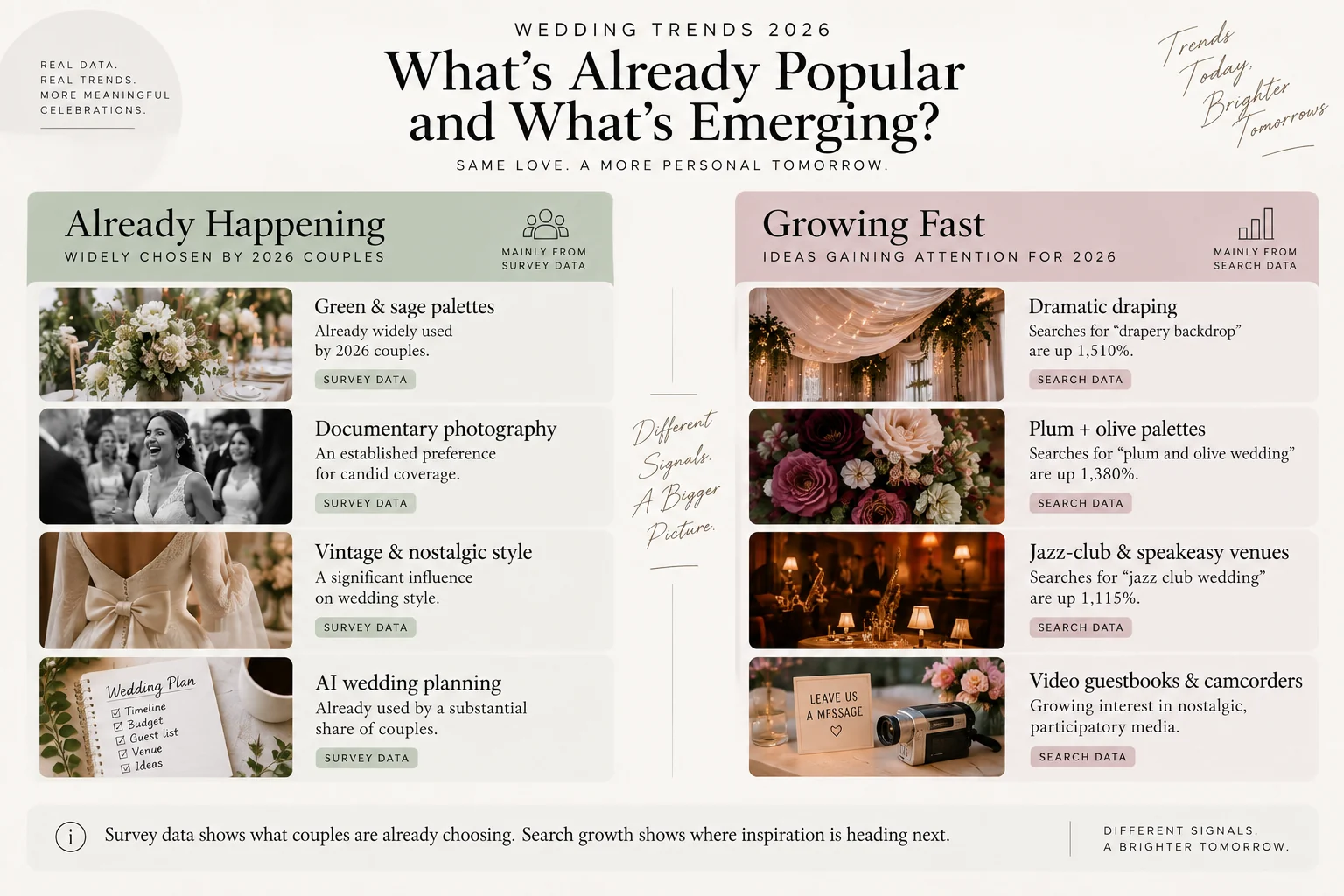
This distinction is useful throughout the rest of the guide: adoption data tells us what couples are already doing; search data shows where curiosity is moving next.
The Biggest Shift: Weddings Are Getting More Personal
Couples have never had more wedding inspiration. That's also part of the problem.
Zola found that 87% of surveyed couples had made at least one wedding-planning decision because of something they saw on social media. At the same time, 60% said managing their real budget against online inspiration was their biggest planning stressor.
The result is an interesting push and pull. Pinterest, TikTok and Instagram influence wedding choices heavily, but couples increasingly want the finished celebration to look less like everybody else's feed.
That helps explain the interest in heirlooms, vintage pieces, unusual venues, personal food choices, private vows and activities tied to the couple's real life.
The useful way to approach a trend in 2026 is not, "How do we copy this?"
It is, "What part of this actually feels like us?"
Wedding Décor and Design Trends for 2026
Wedding décor is getting more tactile and atmospheric. Instead of adding decorations simply to fill a room, couples are using fewer but more noticeable design choices to change how the space feels.
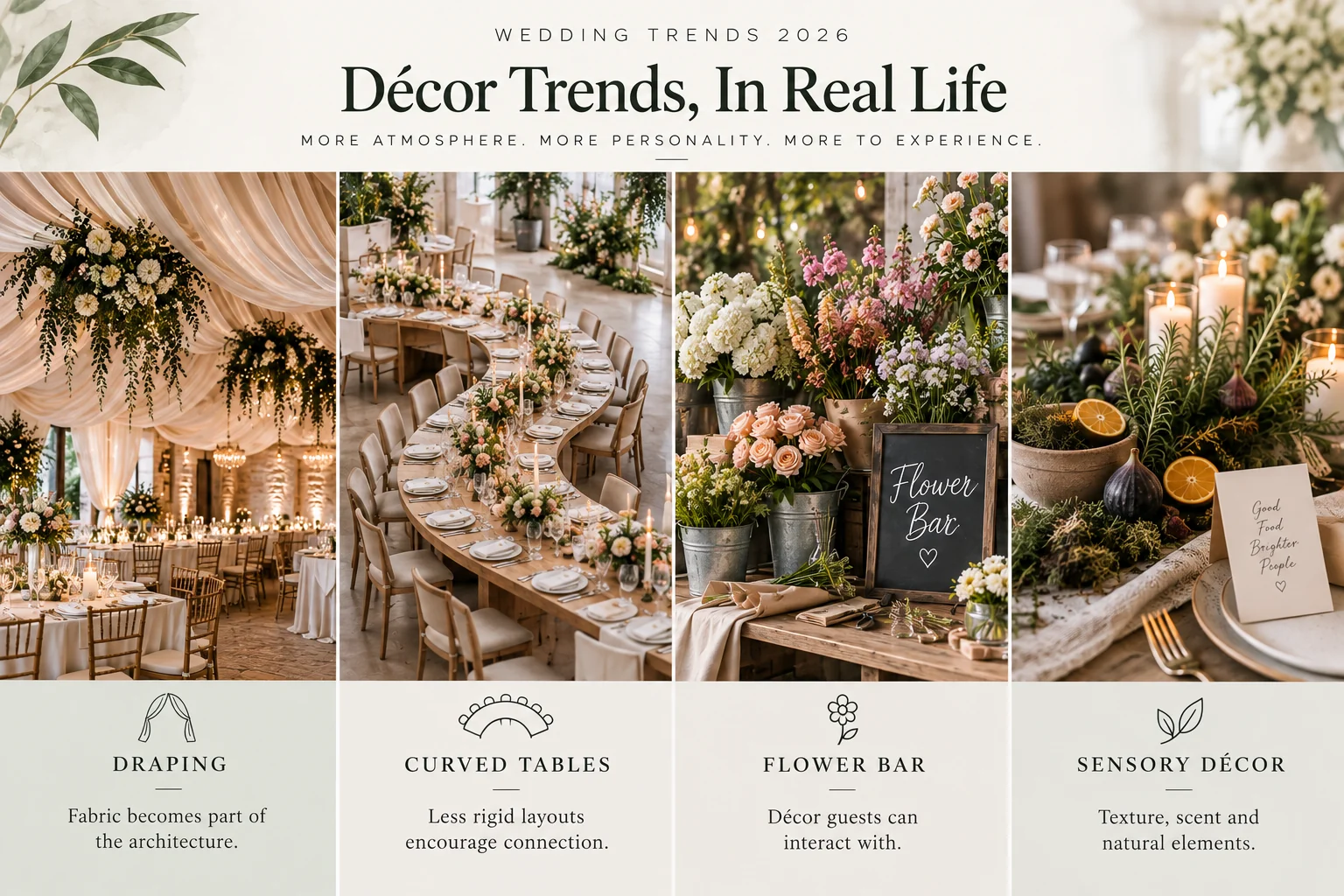
Draping is doing much more than covering ceilings
Fabric is becoming part of the architecture.
Pinterest reported a 1,510% increase in searches for "drapery backdrop", alongside increased interest in stained-glass arches, lace, large floral installations and other layered design ideas.
Expect fabric around entrances, bars and stages as well as ceilings. Sheer materials can soften a large room; heavier fabrics can make a plain venue feel warmer and more intimate.
You don't need to drape the entire reception. One strong installation often has more impact than fabric everywhere.
Table layouts are loosening up
Curved and serpentine tables are becoming an alternative to identical rows of rounds or long banquet tables.
The point isn't that one table shape has become the official look of 2026. It's that couples are paying more attention to how guests move through the room, who they can talk to and what the reception looks like from different angles.
This is one trend to test against the venue before falling in love with the moodboard. Curved layouts can require more floor space and may affect service routes, capacity and sight lines.
Décor is becoming something guests can interact with
A centerpiece doesn't have to sit untouched until the florist collects it.
Pinterest reports growing searches for flower bars, perfume stations, vegetable centerpieces, herbs, moss tablescapes and other sensory ideas. Searches for "flower bar set up" increased 870% in its 2026 dataset.
That could mean a station where guests choose flowers to take home, fragrant herbs across the tables or food and produce incorporated into the styling.
The stronger idea behind the trend is simple: let at least some of the décor do something.
Wedding Color Trends for 2026
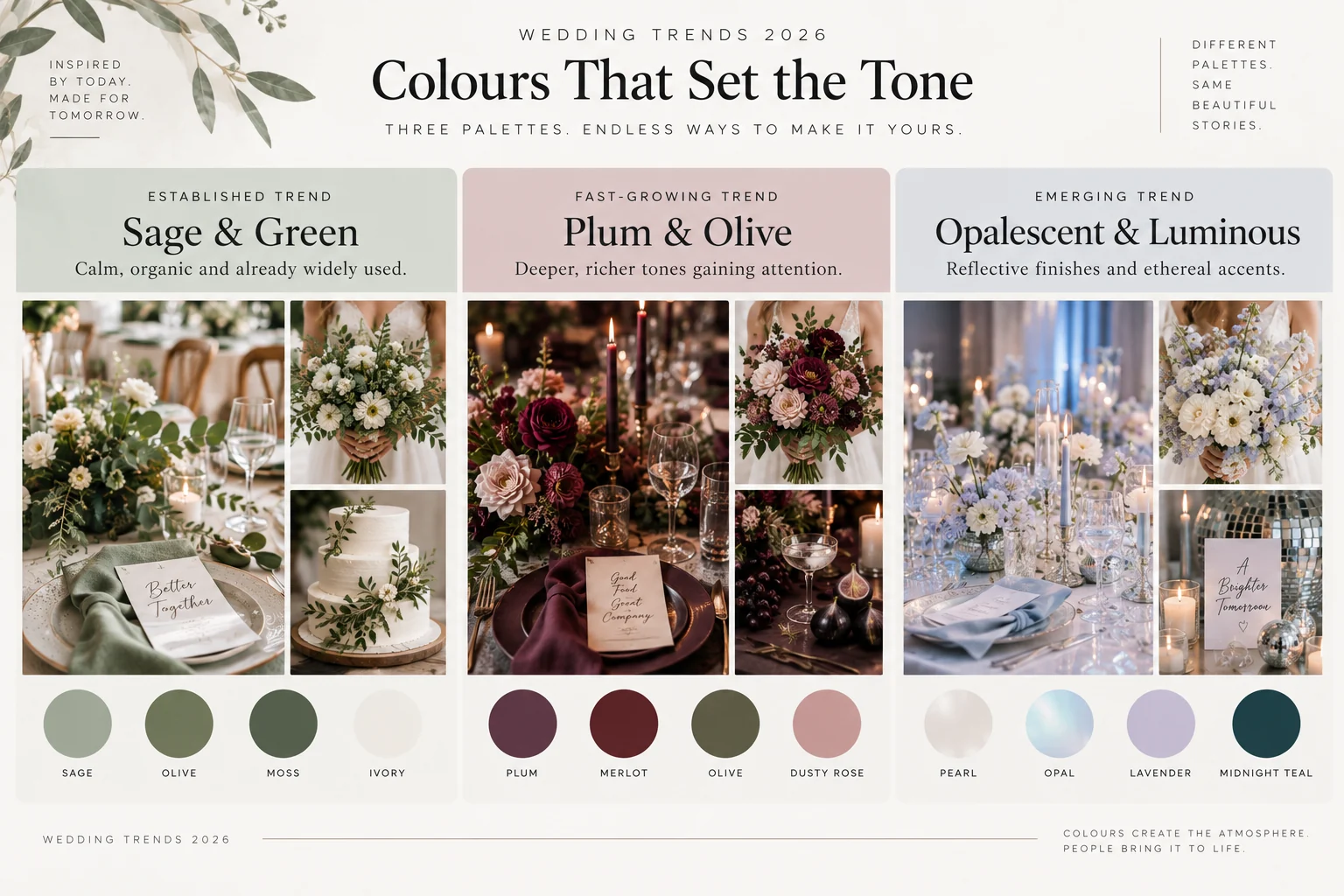
There isn't one official wedding color for 2026. Two directions are showing up at the same time: grounded botanical shades and brighter, more luminous finishes.
Sage is still everywhere, but it isn't the whole story
According to Zola, 53% of surveyed 2026 couples plan to use some form of green, while 30% specifically selected sage.
Sage isn't exactly new. What makes it useful is its flexibility.
It can sit quietly beside ivory and natural wood, move warmer with terracotta and blush, or become moodier alongside olive, burgundy and darker botanical greens.
Plum, olive and merlot are moving into the conversation
Pinterest is seeing particularly rapid growth around deeper combinations. Searches for "plum and olive wedding" increased 1,380%, while plum, fig, merlot, muted rose and dusty olive all rose in the platform's 2026 trend data.
That doesn't mean plum and olive have overtaken sage.
It means couples looking for something richer than pale neutrals are increasingly exploring those shades.
Opalescent details offer the opposite mood
Not everything is earthy.
Pinterest also reports growing searches for opalite, opalescent styling, midnight teal, chrome and soft iridescent palettes.
You don't need to turn the wedding into a holographic theme to use the idea. Reflective glassware, stationery, lighting or a few accessories can give a classic palette a more unexpected edge.
Wedding Fashion Trends for 2026
Wedding fashion is looking backwards as often as it looks forwards.
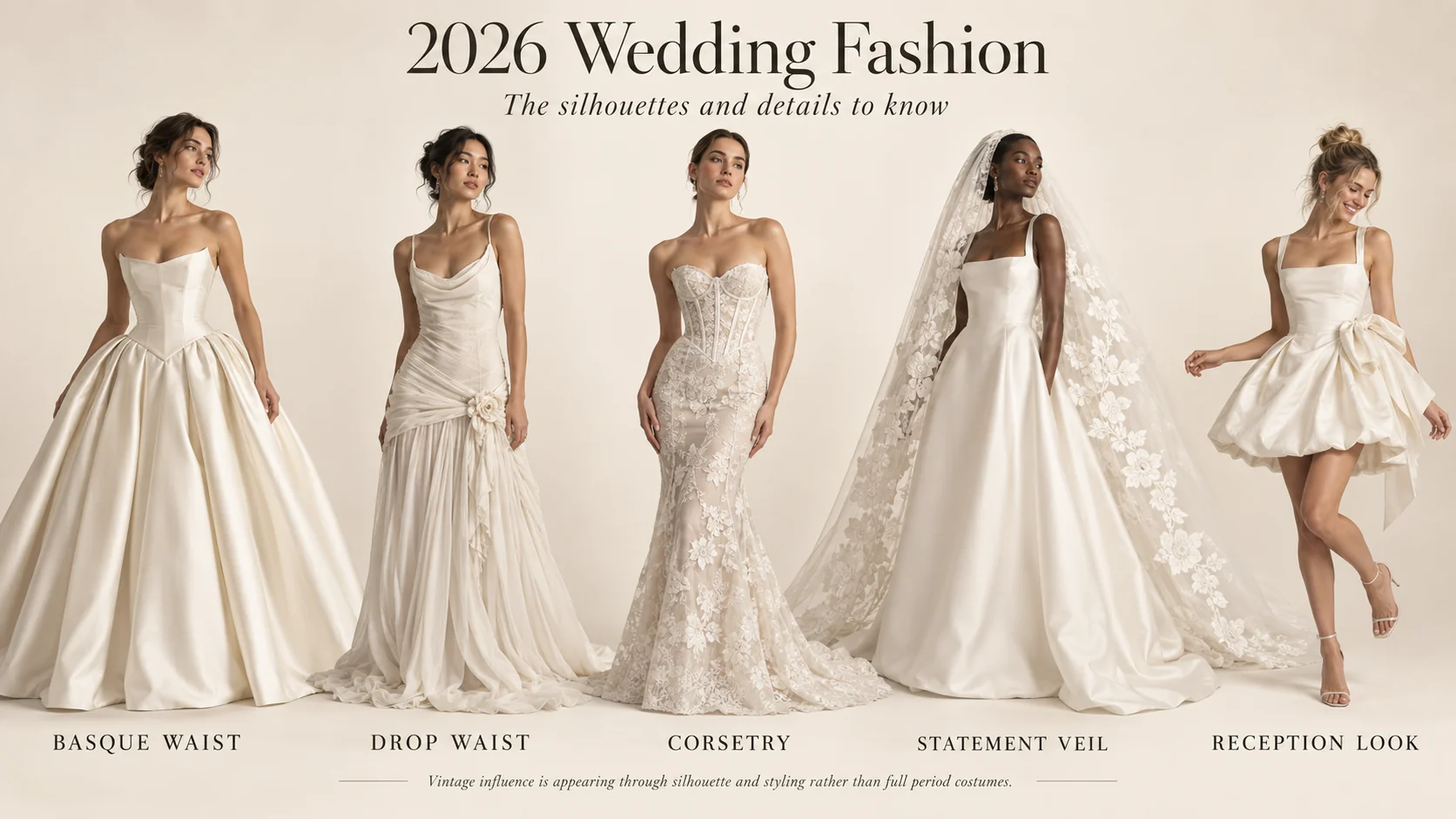
In research conducted by Zola and Poshmark with more than 800 engaged couples, 78% said vintage or nostalgic style was influencing their wedding aesthetic. Another 58% said they were taking inspiration from historical fashion eras, with the 1990s the most referenced decade.
Vintage doesn't necessarily mean wearing an old wedding dress
The influence can show up in:
- basque and drop waists;
- corseted bodices;
- longer sleeves;
- vintage jewellery;
- heirloom fabrics;
- archival-inspired veils;
- classic tailoring;
- pre-loved accessories.
Rather than recreating one decade from head to toe, couples are mixing references with contemporary pieces.
That tends to feel more personal and is less likely to turn the wedding into a costume.
One wedding, more than one look
The same Zola research found 62% of surveyed couples were considering more than one outfit across their wedding celebration.
A second look makes the most sense when the day itself changes.
A structured ceremony dress may be swapped for something easier to dance in. Formal tailoring can become more relaxed for an after-party. A veil, gloves, jacket or other accessory can also create a noticeable change without requiring a completely new outfit.
Multiple looks aren't a rule. If you love the outfit you chose, there's no reason to spend half the reception changing out of it because TikTok said you need a second dress.
Wedding Photography and Content Trends for 2026
Wedding photography is continuing to move away from the idea that every memorable photograph needs to be perfectly posed.
Documentary photography keeps the imperfect moments
Documentary wedding photography focuses on observing what is happening rather than continuously directing it.
That might be a friend laughing halfway through a speech, somebody fixing a veil, a conversation at the edge of the dance floor or a reaction the couple never saw.
Formal portraits aren't disappearing. They are simply sharing the gallery with more movement, emotion and imperfection.
Zola describes candid, documentary-style photography as firmly part of the 2026 direction and reports that 40% of surveyed couples are asking professional photographers or videographers to capture some form of social-first content as well.
Film, direct flash, motion blur and less polished framing all fit within that wider appetite for wedding images that feel lived-in rather than staged.
Do you need a wedding content creator as well?
A wedding content creator isn't the same thing as a photographer or videographer.
| Who captures it? | What they're typically there for |
|---|---|
| Photographer | Professionally photographed images and a finished gallery |
| Videographer | Professionally produced moving footage and wedding films |
| Content creator | Fast-turnaround, phone-first photos and vertical social video |
| Guests | Informal moments happening throughout the wedding from many viewpoints |
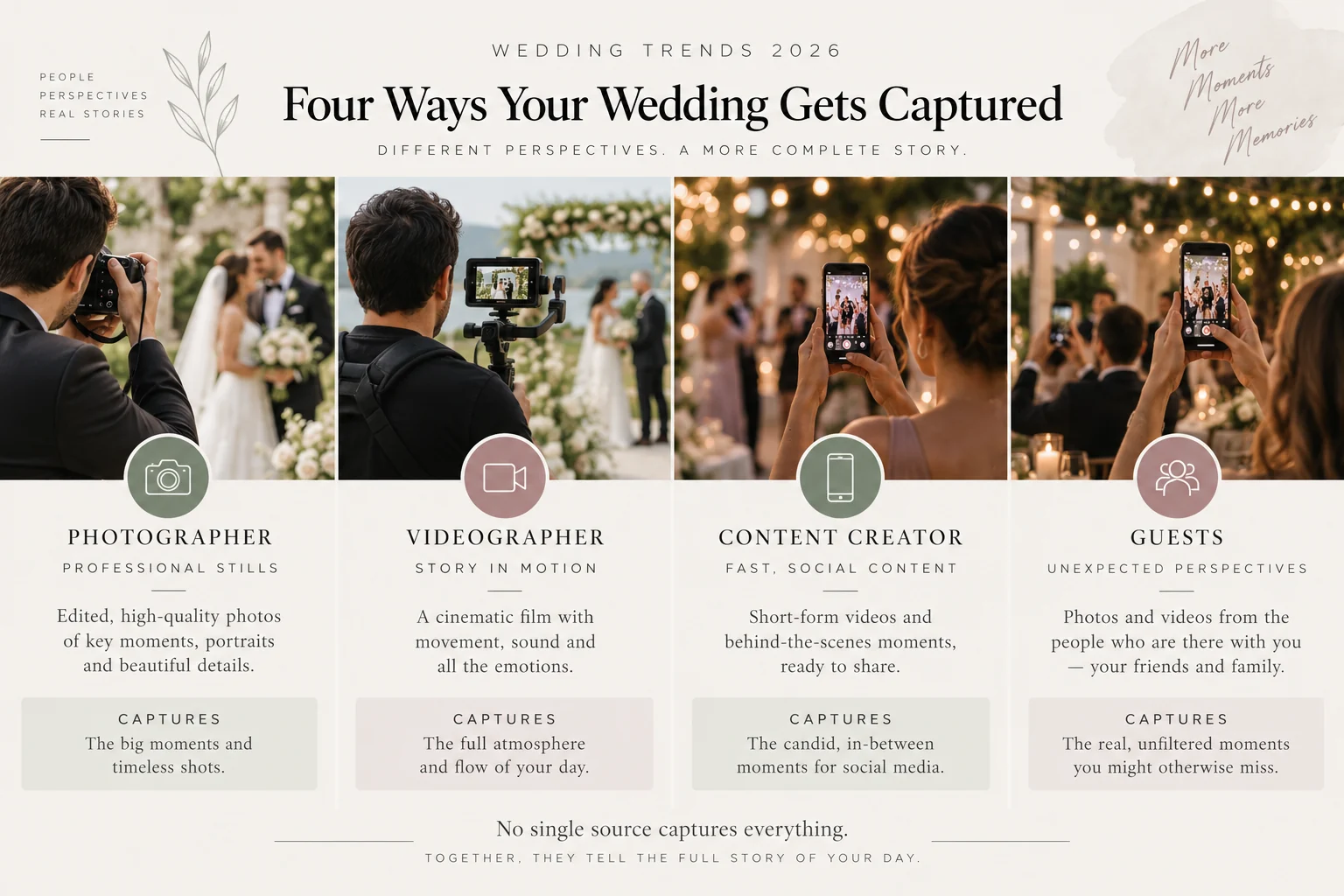
There can be overlap, so check exactly what your photographer and videographer already provide before hiring someone else.
A content creator makes the most sense when getting informal phone footage quickly matters to you. It is not automatically a fourth essential wedding vendor.
Your guests will photograph a completely different wedding
While your photographer is capturing the ceremony, someone at the back may be recording your parents' reaction. While you're talking to one table, another group is taking photographs you won't see until later.
Those guest perspectives are one reason candid wedding memories are becoming more valuable.
The practical problem is getting them off everyone's phones afterwards.
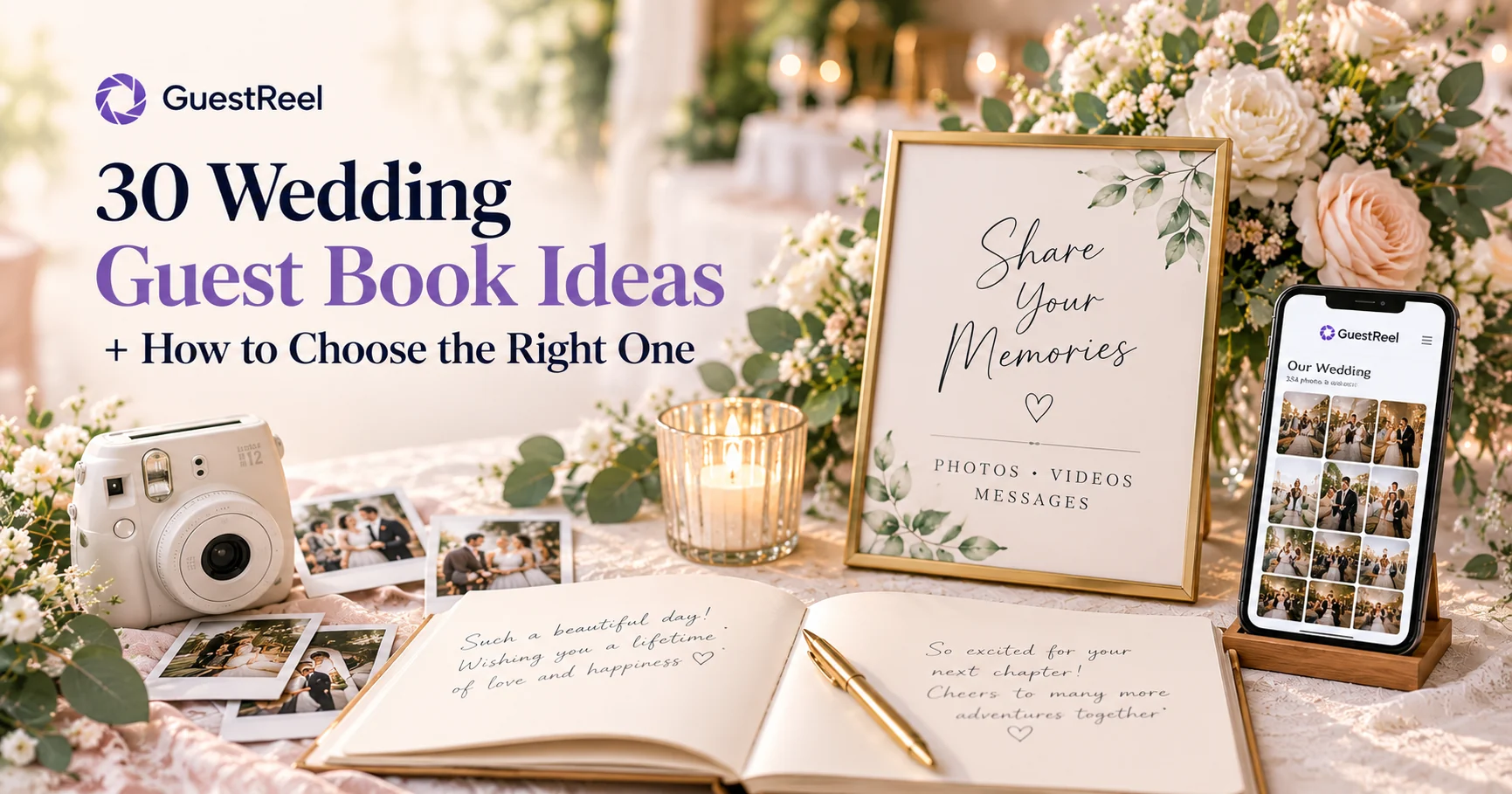
If you want to collect them, plan that part before the wedding. Guestreel, for example, lets guests scan a personalised QR code or open an event link and upload photos and videos through their browser into one organised event gallery, without requiring an app.
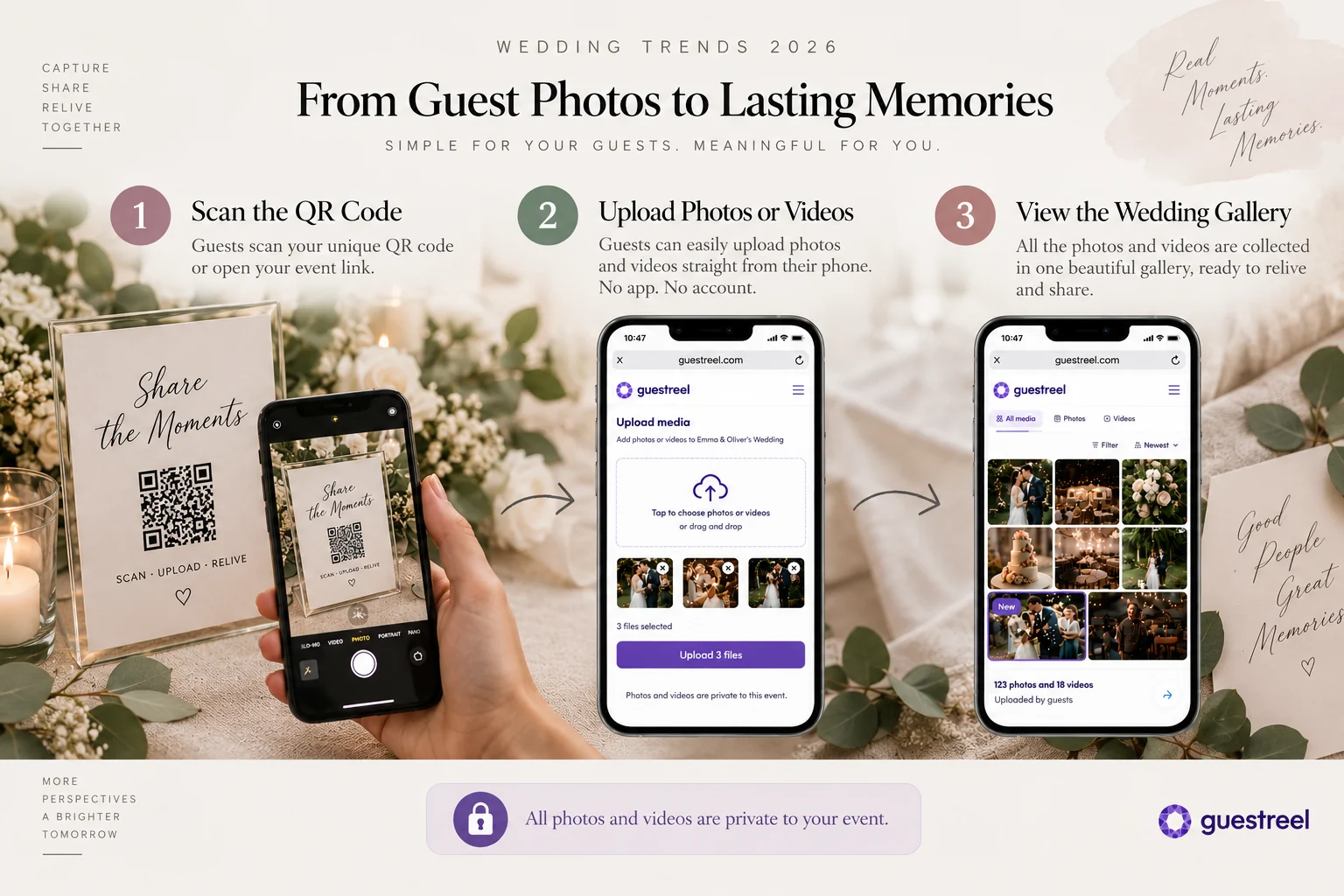
If you're deciding how to handle that, this guide to collecting wedding photos and videos from guests compares the main options.
Wedding Guest Experience Trends for 2026
A good guest experience doesn't require another activity every 20 minutes.
The better trend is toward giving people one or two things they will genuinely remember or participate in.
Guests are being invited to do more than watch
Pinterest reports growing interest in flower bars, analog games, photo-booth stickers and other hands-on experiences.
Depending on the wedding, that might mean:
- a live illustrator;
- flower or perfume stations;
- lawn games;
- custom engraving;
- a collaborative guestbook;
- a photo or video station;
- a food experience guests can customise.
The wedding itself should decide the activity, not the trend list. If a photo station appeals, these wedding photo booth ideas cover everything from classic booths to simple DIY setups.
A small dinner where everyone knows one another may need nothing extra. A long reception with several different social groups may benefit from something that gets people talking.
Guestbooks are becoming more than a book
Audio and video guestbooks fit neatly into another 2026 pattern: using modern technology to preserve something personal.
Pinterest reports growing search interest around video guestbooks, camcorders, projectors and analog-style photo booths.
A written guestbook records words. Audio and video can preserve voices, expressions and stories as well.
There's room for both.
Not every moment needs an audience
Private vows, quiet first looks and private final dances continue the move toward weddings that aren't designed entirely for spectators.
A wedding day can be intensely social. Building one or two moments where the couple can actually talk to each other is less about creating another trend and more about protecting some space inside a busy schedule.
Food, Drink and Cake Trends for 2026
Wedding food is getting more personal too.
Instead of automatically working through a standard wedding menu, couples are increasingly using food to reference places, cultures, memories and dishes they genuinely enjoy.
That might mean food from where each partner grew up, a late-night version of a favourite takeaway, a family dish or a dessert connected to an important trip.
Zola's 2026 research points to personalised catering, curated cocktail and mocktail menus and alternative desserts among the year's notable directions.
Mocktails are also receiving more attention as a real part of the drinks menu rather than the fallback option for anyone not drinking alcohol.
And cakes are becoming noticeably less serious.
Pinterest reports increased searches for tiramisu wedding cakes, flower-pot cakes, kitsch cakes, pink-and-red vintage designs and other playful desserts. "Flower pot cake ideas" rose 715% in its dataset, while "wedding cake tiramisu" increased 635%.
You don't need a flower-pot cake just because Pinterest says people are searching for one.
The useful takeaway is that dessert is another place where couples feel more comfortable being playful.
Wedding Venues and Weekends Are Becoming More Experience-Led
Couples are thinking less about how much décor can be added to a venue and more about what the venue already contributes.
Venues with personality are attracting interest
Pinterest recorded rapid search growth for ideas including jazz-club weddings, speakeasy lounges, cabins, greenhouses and movie-theatre weddings. Searches for "jazz club wedding" rose 1,115% in its 2026 dataset.
These aren't replacing hotels, barns or traditional wedding venues.
They show growing interest in spaces with atmosphere already built in.
If an unconventional venue catches your eye, check the boring details before booking it: accessibility, capacity, bathrooms, catering restrictions, transport, power, weather backup and setup time matter more than how good the room looks on Pinterest.
Experiential weddings aren't necessarily small weddings
One easy assumption is that more personal weddings must mean smaller guest lists.
Zola's data doesn't support that as a universal shift. Its surveyed 2026 couples reported an average guest count of 145. At the same time, 37% were planning at least one additional event, such as welcome drinks or brunch, and 18% were planning a two- or three-day wedding weekend.
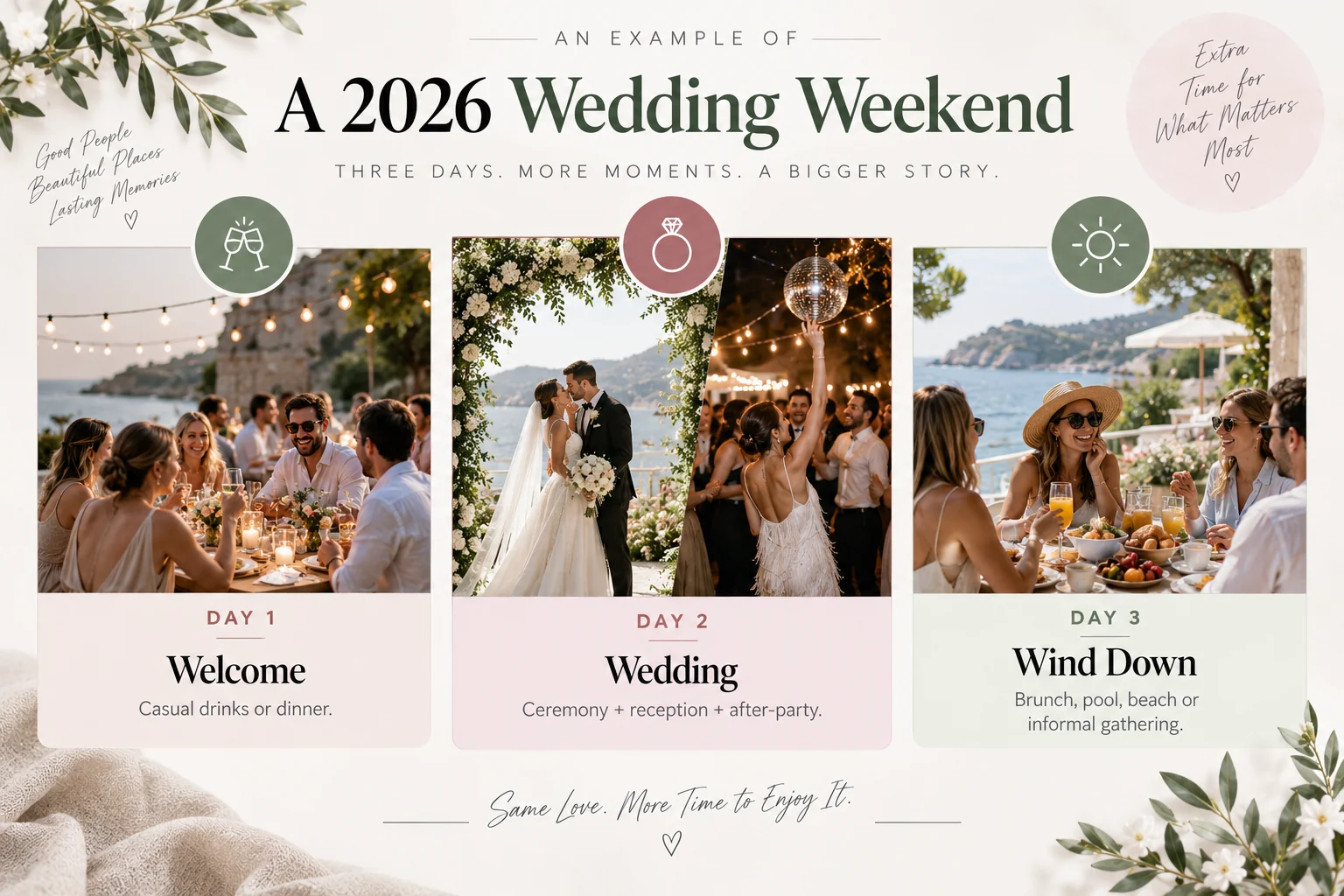
The change is less "everyone is having a micro wedding" and more "the wedding can take different forms."
For some couples, that means an intimate dinner. For others, it means 150 guests and three days of events.
Wedding Technology Trends in 2026
Wedding planning is becoming more digital even as the wedding itself leans into vintage cameras, physical keepsakes and other analog details.
AI has moved into everyday wedding planning
Zola reports that 54% of its surveyed 2026 couples use AI somewhere in the planning process. The most common uses centre on practical jobs such as etiquette questions, timelines, emails and budgeting rather than deeply personal decisions.
That distinction matters.
AI can help organise a first-pass timeline or turn scattered planning notes into a checklist. Venue rules, supplier contracts, final timings and costs still need to be checked with the people actually responsible for them.
And couples themselves are drawing a line around the personal stuff: Zola found 63% said AI had no place in writing vows.
Technology is most useful when guests barely notice it
QR codes, digital galleries and other wedding tools work best when they remove a step rather than create one.
Meanwhile, Pinterest's growing searches for camcorders, projectors, analog-style photo booths and video guestbooks show that couples still want physical or nostalgic experiences in the room.
It isn't really a contradiction. Digital tools can handle friction in the background while analog details give people something tangible to remember.
Which Wedding Trends Are Becoming Less Dominant?
Very few wedding ideas suddenly become "out." They usually lose momentum while something else becomes more interesting.
A few shifts in the current data are worth noting.
Ultra-unusual venues may be cooling slightly
Pinterest shows fast-growing interest in some unconventional venues, but Zola's survey paints a more measured picture.
Outdoor garden venues remain the leading preference in Zola's data, while rustic venues remain popular. Zola says interest in museums, galleries and restaurant buyouts has cooled slightly.
That is a useful reminder that eye-catching search growth does not automatically equal widespread adoption.
Perfectly polished photography has more competition
Traditional wedding portraits aren't going away, but documentary photography, film-inspired imagery and social-first content mean heavily staged photographs no longer have the field to themselves.
Couples increasingly want both: the family portraits worth framing and the unplanned moments they didn't realise were happening.
One-size-fits-all wedding aesthetics are harder to sustain
Pinterest describes the broader 2026 movement as couples moving away from one-size-fits-all rituals in favour of more personal celebrations. Zola's vintage research points in a similar direction: couples are using old, pre-loved and inherited pieces partly because they want their wedding to feel less interchangeable.
That does not mean neutral weddings, classic ballrooms or traditional ceremonies are unfashionable.
It means copying an entire aesthetic without adapting it is increasingly at odds with the direction of the year.
How to Choose Wedding Trends You'll Still Like Later
Wedding trends are most useful as a filter for discovering ideas you hadn't considered.
They become less useful when they turn into a second planning checklist.
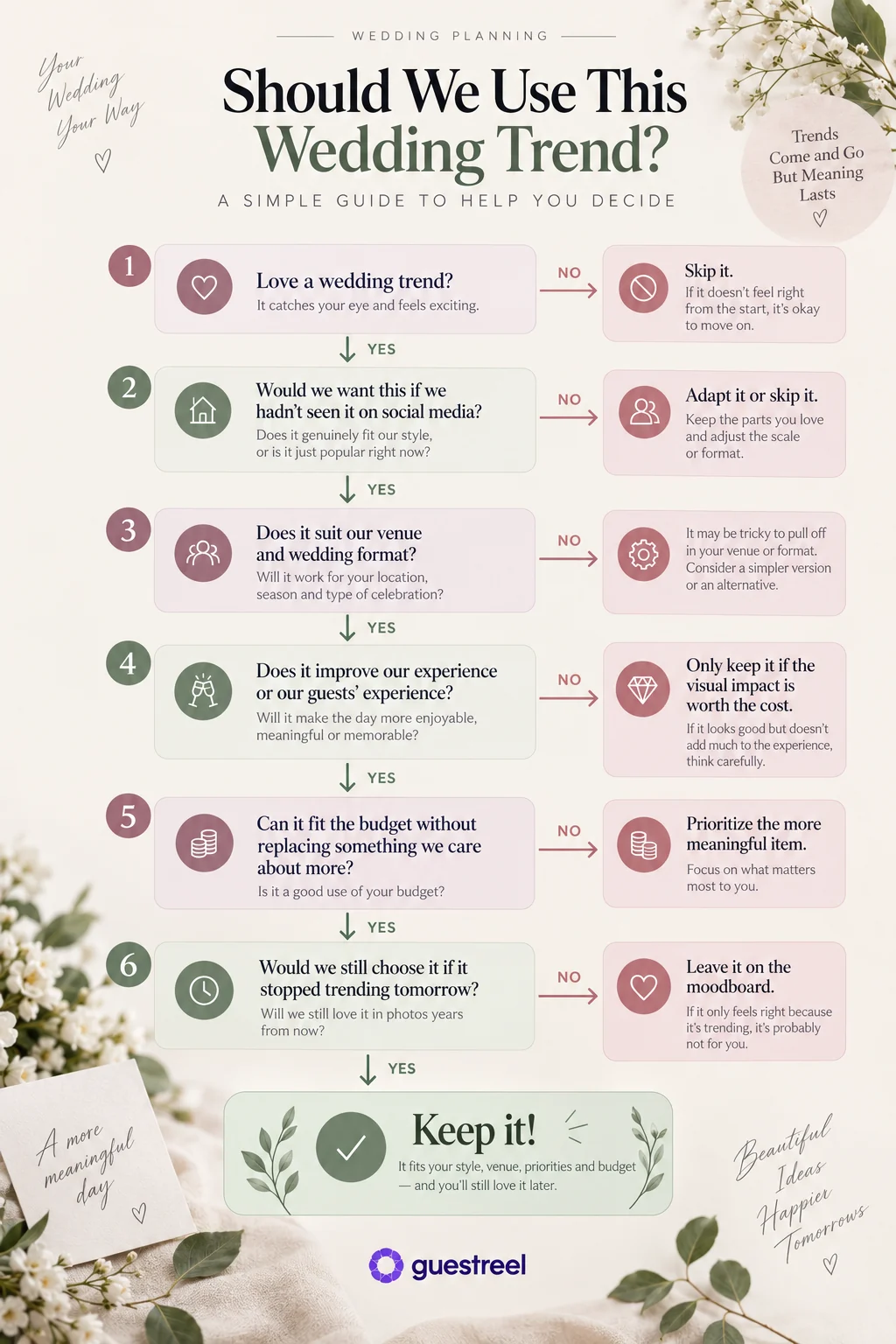
Before committing money or time to one, ask:
- Would we still like this if we hadn't seen it on social media?
- Does it fit the venue rather than fighting it?
- Does it improve the day, or only the photograph?
- Will we or our guests actually notice it?
- What are we giving up elsewhere in the budget to afford it?
- Does it connect to anything personal about us?
- Would we still choose it if nobody called it a trend?
If an idea survives those questions, it's probably worth considering.
If it doesn't, leave it on the moodboard.
For the bigger planning picture, a wedding planning checklist can help turn the ideas you keep into actual tasks and deadlines. It is also worth checking the most common wedding planning mistakes to avoid before adding more décor, activities or vendors.
The Takeaway
The defining wedding trend of 2026 is not a specific color, dress or centerpiece. It is the freedom to be more selective.
A vintage veil can sit beside a QR code. Documentary photographs can exist alongside formal portraits. A traditional ceremony can include private vows. A classic venue can feel completely different because of one thoughtful design choice.
Look at the trends, save what genuinely interests you, and ignore the rest.
The wedding does not need to look like 2026.
It needs to look like yours.
Frequently asked questions
What is the biggest wedding trend for 2026?
Personalisation is the clearest overall shift. Couples are still influenced heavily by social media, but current research points toward more selective use of trends, vintage and meaningful details, personalised food, candid photography and traditions adapted to the couple rather than followed automatically.
Are small weddings still trending in 2026?
Intimate weddings remain popular, but there is no evidence that large weddings have disappeared. Zola reports an average of 145 guests among its surveyed 2026 couples. The more useful trend is flexibility: some couples are choosing smaller celebrations, while others are expanding the wedding into several events across a weekend.
What wedding trends are going out of style in 2026?
There isn't a reliable list of trends that are simply "dead." Current evidence suggests some ultra-unusual venue formats have cooled slightly, while highly staged photography and one-size-fits-all aesthetics now compete with candid coverage and more personalised styling. Classic choices themselves are not disappearing.
Are wedding content creators still popular in 2026?
Yes, but they are not essential for every wedding. Zola reports increased demand for social-first wedding content, including couples asking existing photographers and videographers to provide vertical photos or video. A separate content creator is most useful when fast-turnaround phone content is important and your existing suppliers do not provide it.
How can you follow wedding trends without making the wedding look dated?
Use a trend as inspiration rather than a complete template. Start with what you already like, then borrow the color, material, layout or experience that fits. Personal references, venue-appropriate design and choices connected to your own story usually have more staying power than reproducing a viral idea exactly.
Written by Linda DoWrites Guestreel’s planning guides.