You'll probably remember your first kiss. You might not remember the look on a parent's face just before the ceremony, or your friends laughing together at the back of the room. Those are the photographs that can surprise you later.
The best wedding photo ideas mix the obvious moments with the ones only you would think to request: a portrait with your grandparents, a detail with a family story behind it, a photo of the people who helped you get ready.
Start with the 40 ideas below, keep the ones that feel like you, and use the shot-list guide to share your priorities with your photographer. You don't need to recreate every image you save.
Essential Wedding Photos: The Quick Checklist
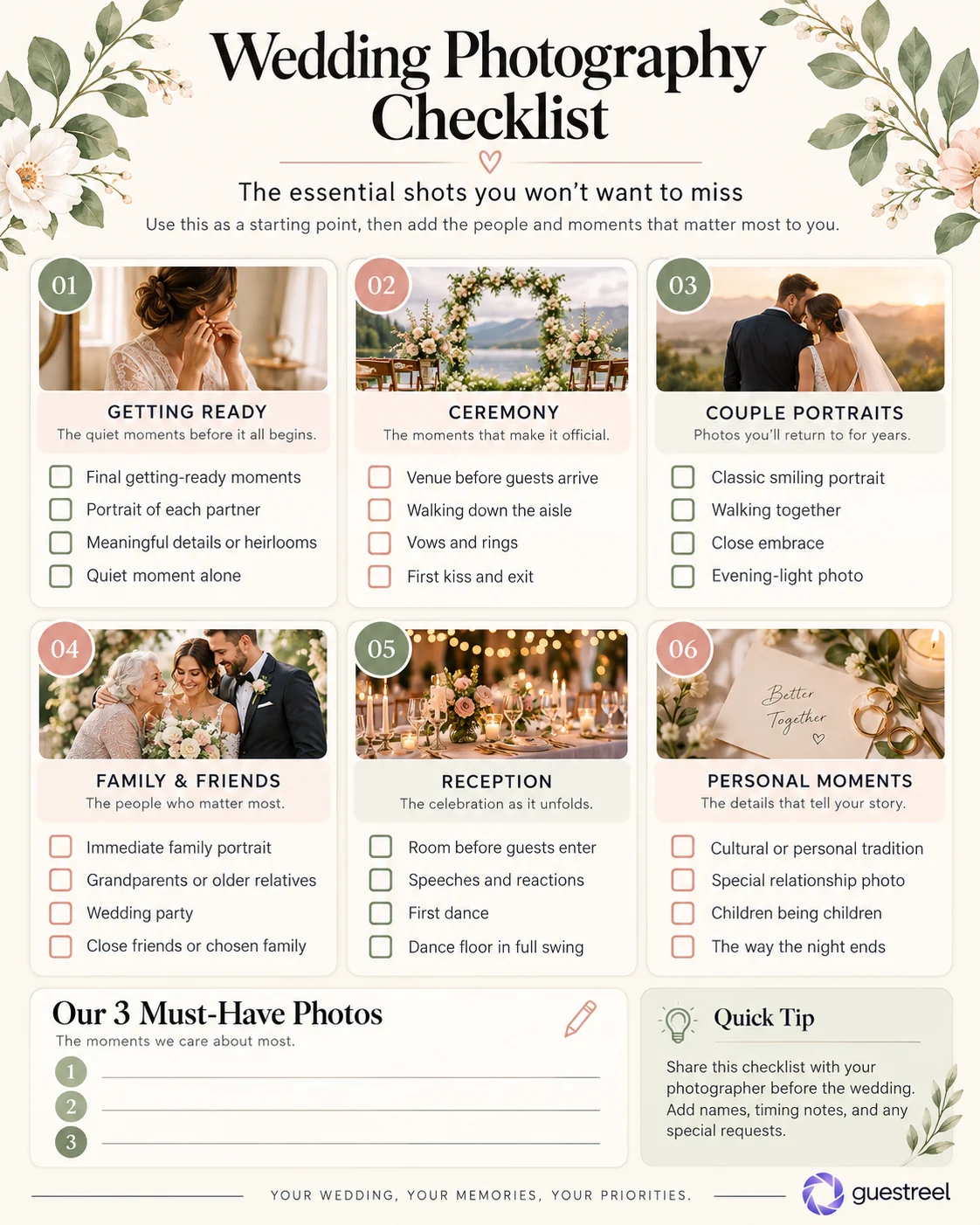
If you only have a few minutes, make sure your photography plan accounts for these moments:
- Before the ceremony: getting ready, individual portraits, meaningful details and any first look;
- During the ceremony: the entrance, vows, rings, first kiss and the walk back down the aisle;
- People: a portrait of the two of you, immediate family, older relatives, chosen family and close friends;
- Reception: the room before guests enter, speeches, the first dance or equivalent traditions, and guests celebrating;
- Personal priorities: anything unusual your photographer couldn't know about without being told.
Think of this as a checklist of moments, not 20 poses your photographer must reproduce. If your wedding doesn't include a first dance, a wedding party or a traditional aisle entrance, leave those off without a second thought.
Wedding Photo Ideas for Every Part of the Day
Getting-Ready Photos
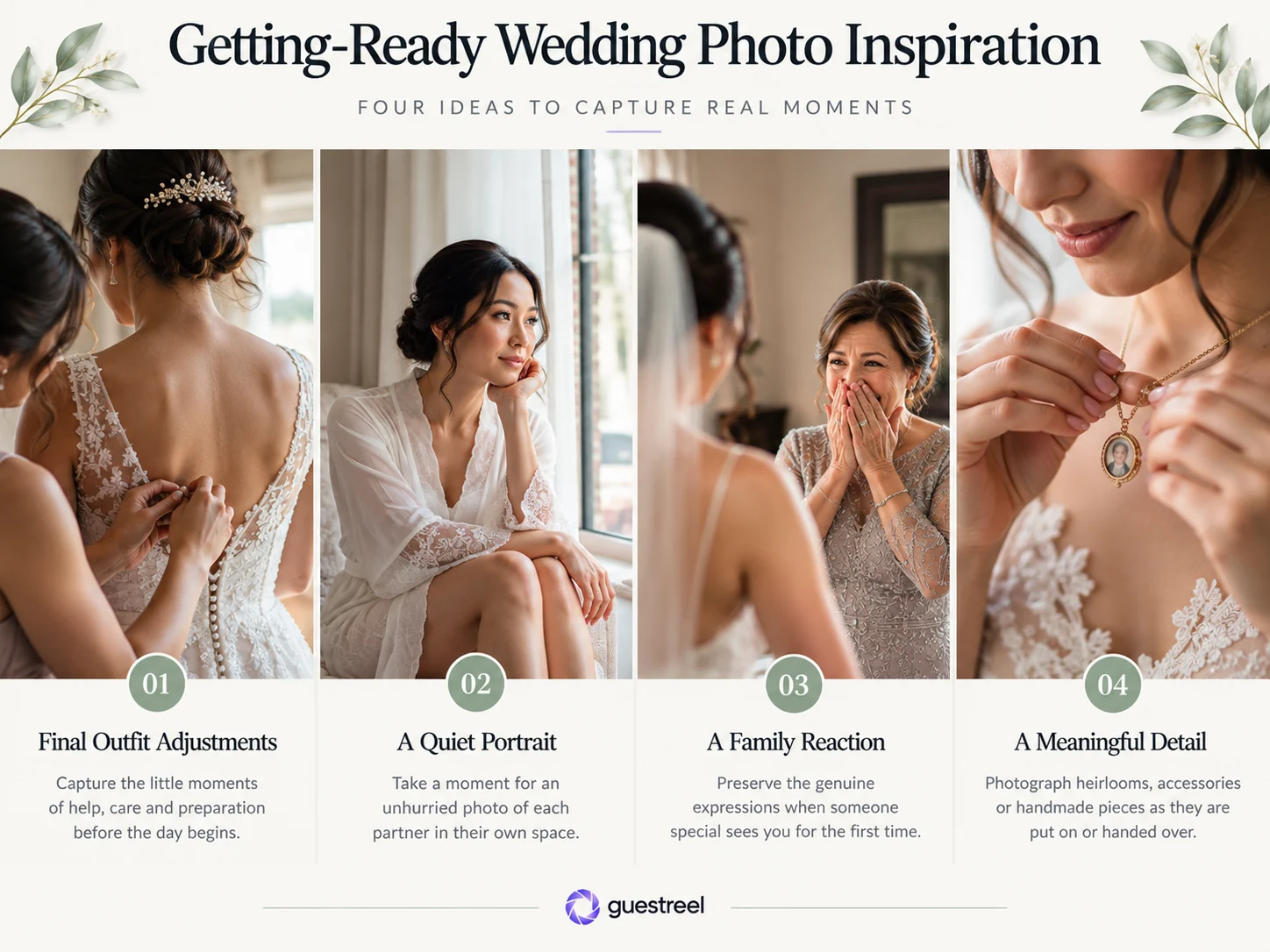
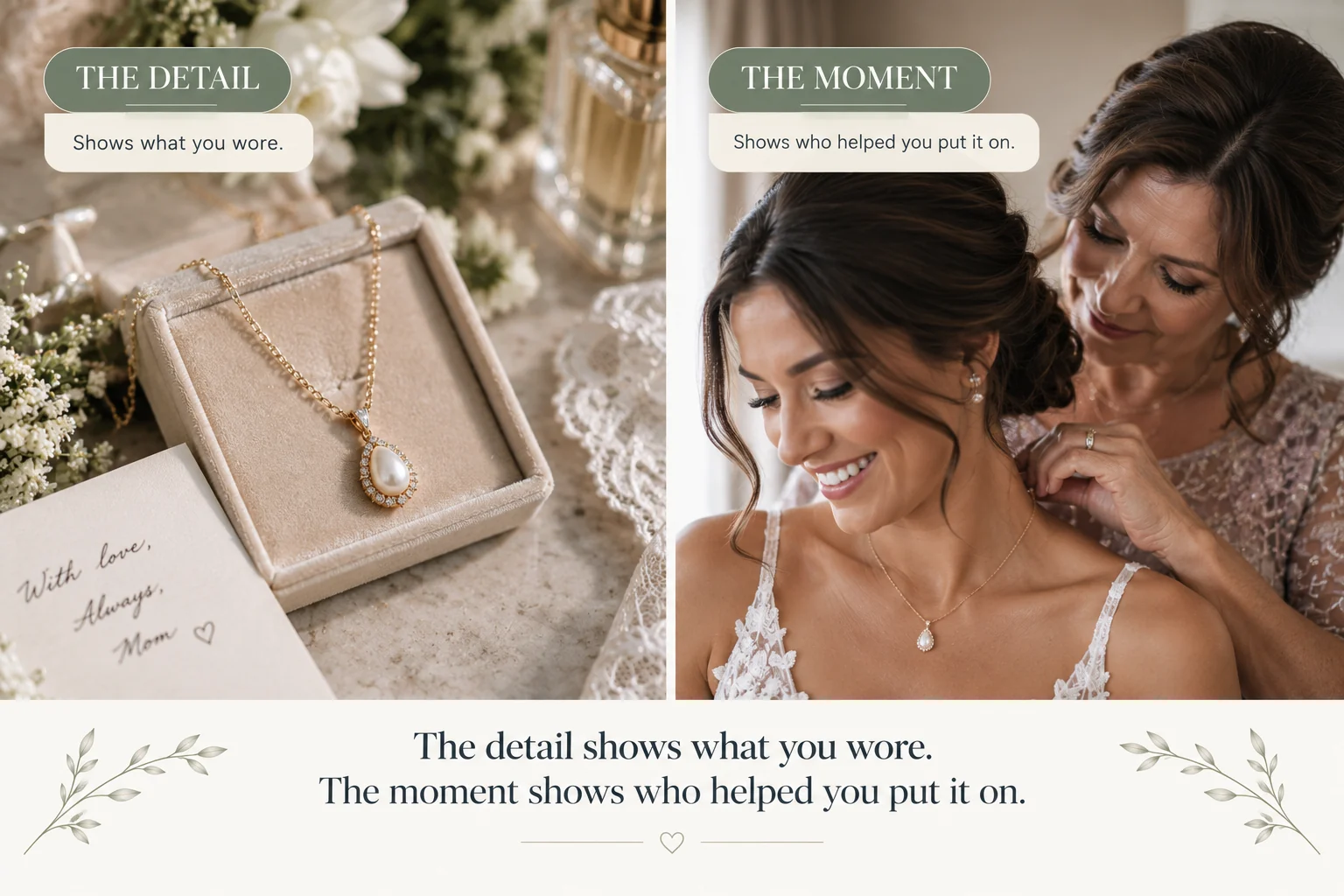
- The final touches. A jacket being buttoned, jewellery fastened or a veil adjusted makes a more personal photograph when the hands doing the helping belong to someone you love.
- An unhurried portrait of each partner. Before the day gets busy, set aside a moment for a full-length photo and a closer portrait of each of you, in whatever outfits you've chosen.
- The room before everyone leaves. A wide shot of friends, half-finished cups of tea and the bustle of preparation can say more about the morning than another picture of shoes.
- A parent's or friend's reaction. If someone special is seeing you dressed for the first time, let your photographer know. Don't rehearse the expression; the moment is enough.
- A quiet pause. Sitting by a window, reading a note or taking a few minutes alone can give your album a change of pace.
- Something borrowed, inherited or handmade. Photograph the object, but also the moment it is put on or handed over. The story often lives in the interaction.
Before you plan the morning shots: if you're preparing in different buildings, check whether one photographer can cover both locations without rushing.
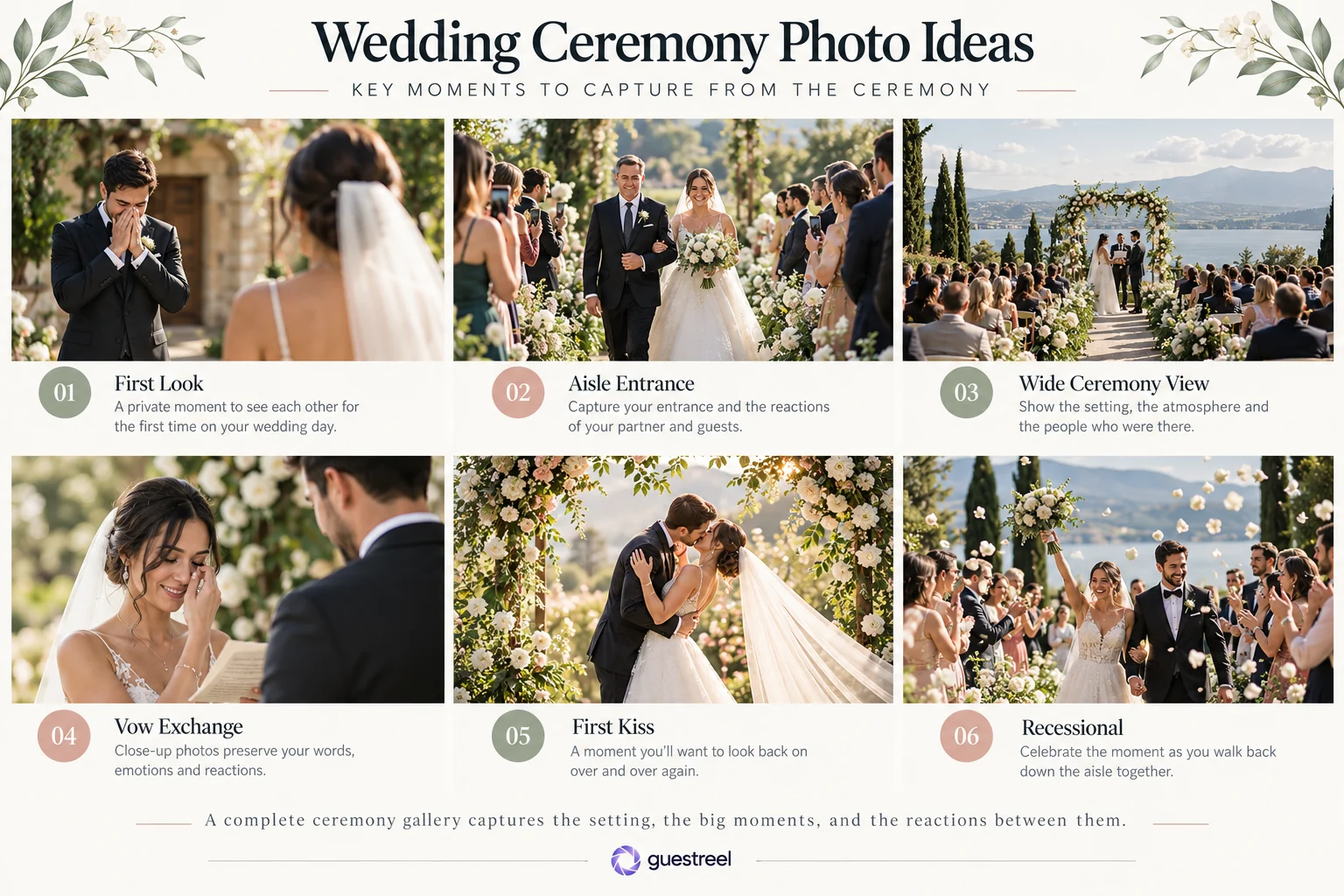
First Look and Ceremony Photos
- A first look, if you want one. Seeing each other before the ceremony can make space for a private moment and earlier portraits. It isn't a requirement, and neither of you needs to perform a dramatic reaction.
- A first touch. Hold hands around a doorway or corner without seeing each other. Some couples prefer this if they're saving the reveal for the ceremony.
- The empty ceremony space. Photograph the setting before guests arrive: the chairs, light, flowers and view that you spent time choosing.
- The entrance and the person waiting. Both sides of the aisle matter. Ask whether the photographer can capture the walk and the reaction without disrupting the ceremony.
- A wide ceremony photograph. Include the space and guests as well as the two of you. It gives the close-up images a sense of place.
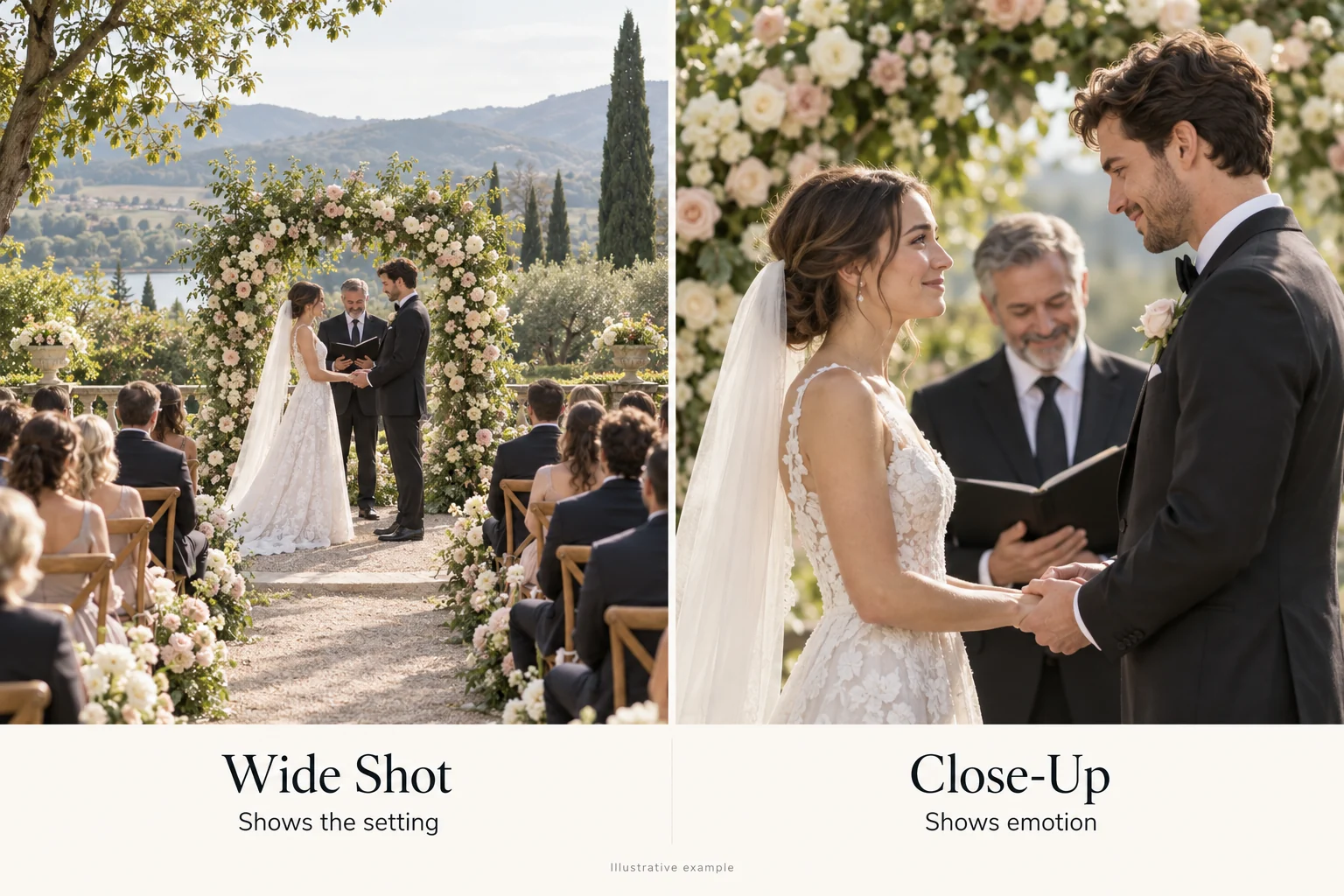
- Your vows and the small gestures between them. The words may be in a booklet; the photograph catches a hand squeeze, a smile or a deep breath.
- The exchange of rings. A close view of the hands works well, but the faces are worth remembering too.
- The first kiss or another meaningful closing ritual. Share the ceremony order so the photographer is ready. Any rules about movement or where people can stand take priority.
- The walk back down the aisle. There's often a completely different energy after the ceremony. Look for the laughter, waving and people leaning into the aisle to congratulate you.
- The first hugs afterwards. Rather than rushing straight into portraits, consider leaving a little room for greetings with the people closest to you.
Some religious and civil ceremony venues restrict photography positions, flash or guest cameras. Ask about those rules in advance, then make a plan that respects them.
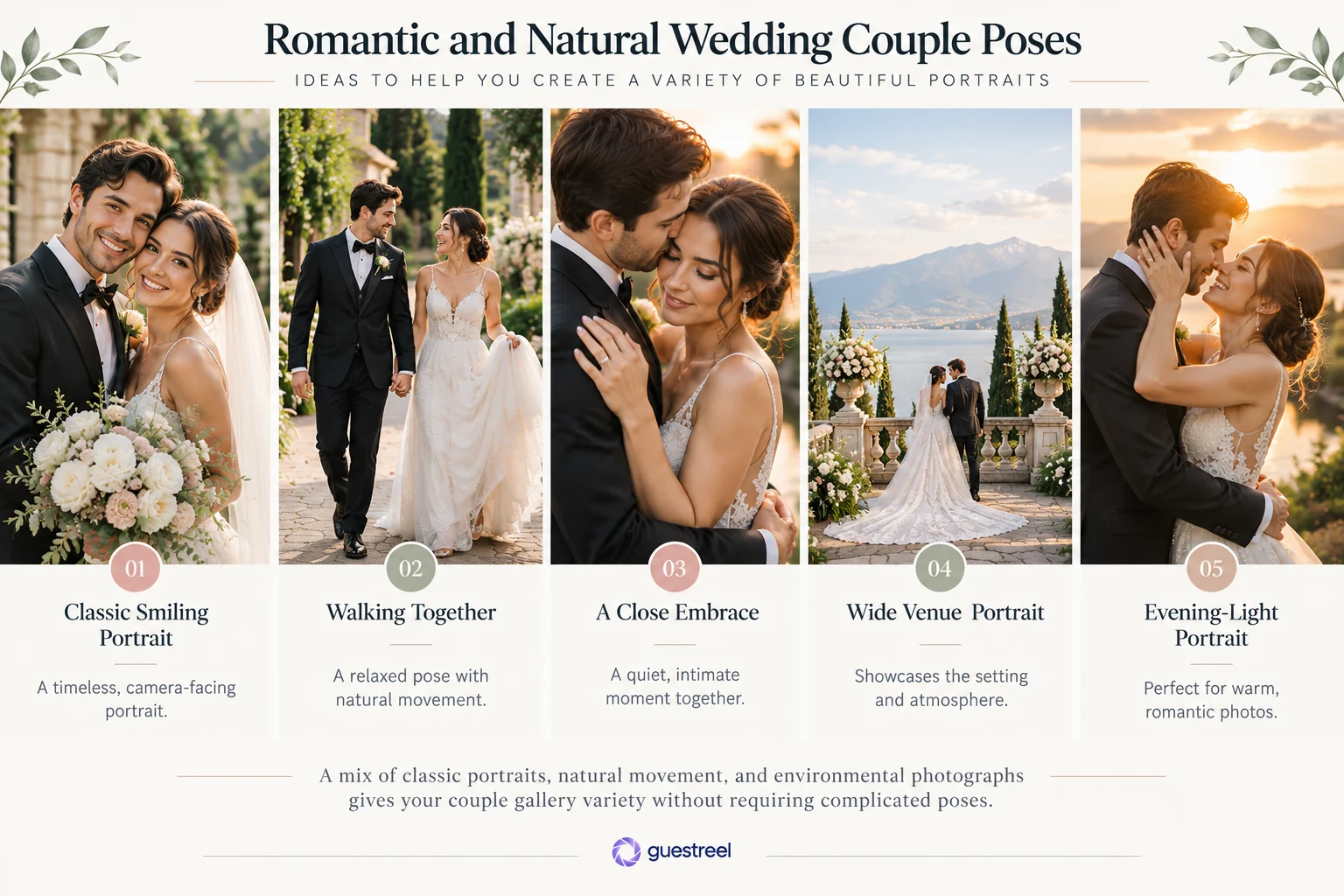
Couple Portrait Ideas
- The straightforward smiling portrait. One clear photo of you both looking at the camera is worth having, even if you love artistic photography. It also makes an excellent picture to print for family.
- Walking together. Walk towards the camera, through a garden or across the venue grounds. Talk to each other instead of watching your feet.
- A close embrace. You don't need elaborate posing instructions. Ask for a frame that feels like how you naturally stand together.
- The full-outfit photograph. Give the clothes room in the frame, especially if your outfit includes unusual tailoring, embroidery, a train or cultural details.
- A portrait that shows the location. Stand small within a grand staircase, coastline or city street. The setting becomes part of the wedding story.
- A little movement. A turn, slow dance or walk with a long veil can work beautifully, provided the ground and clothing allow it.
- The evening-light portrait. If soft late-day light appeals to you, ask about a short break for photos. The timing depends on sunset, weather and where the light reaches your venue.
- The photo where you both lose composure. Laughing, fixing each other's outfit or reacting to a joke can be more recognisable than a perfectly arranged pose.
Couples who feel awkward being photographed can tell their photographer that upfront. A little direction is useful; being asked to act like someone else isn't.
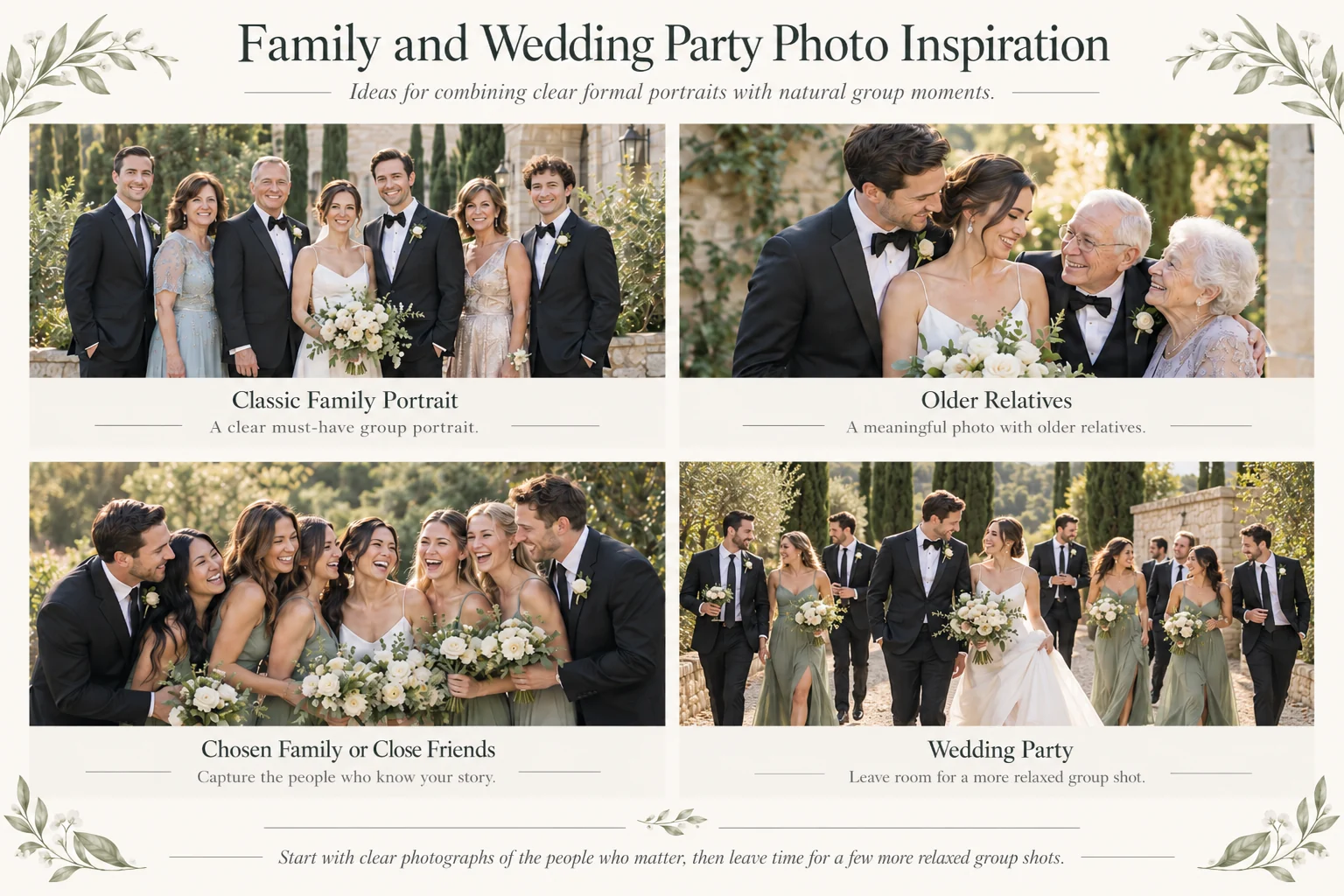
Family and Wedding Party Photos
- A classic family portrait. Get the clear, everyone-facing-the-camera version before attempting creative variations. Name the people you want included ahead of time.
- You with each grandparent or older relative. If these photographs matter, schedule them near the start of group portraits so nobody has to wait unnecessarily.
- Siblings or chosen family together. Make time for relationships that wouldn't be obvious from a standard family list.
- A whole wedding-party photo. Include everyone in one clean frame. It is often more useful later than a dozen variations of the same line-up.
- A wedding-party walk or conversation. Ask everyone to move or talk naturally. It's an easy way to get a less formal picture without props.
- The friends who know your stories. Take a smaller photograph with your university friends, childhood friends or another close-knit group that matters to you.
If you want playful portraits of guests throughout the day, a self-serve station may help. See these wedding photo booth ideas for different ways to set one up.
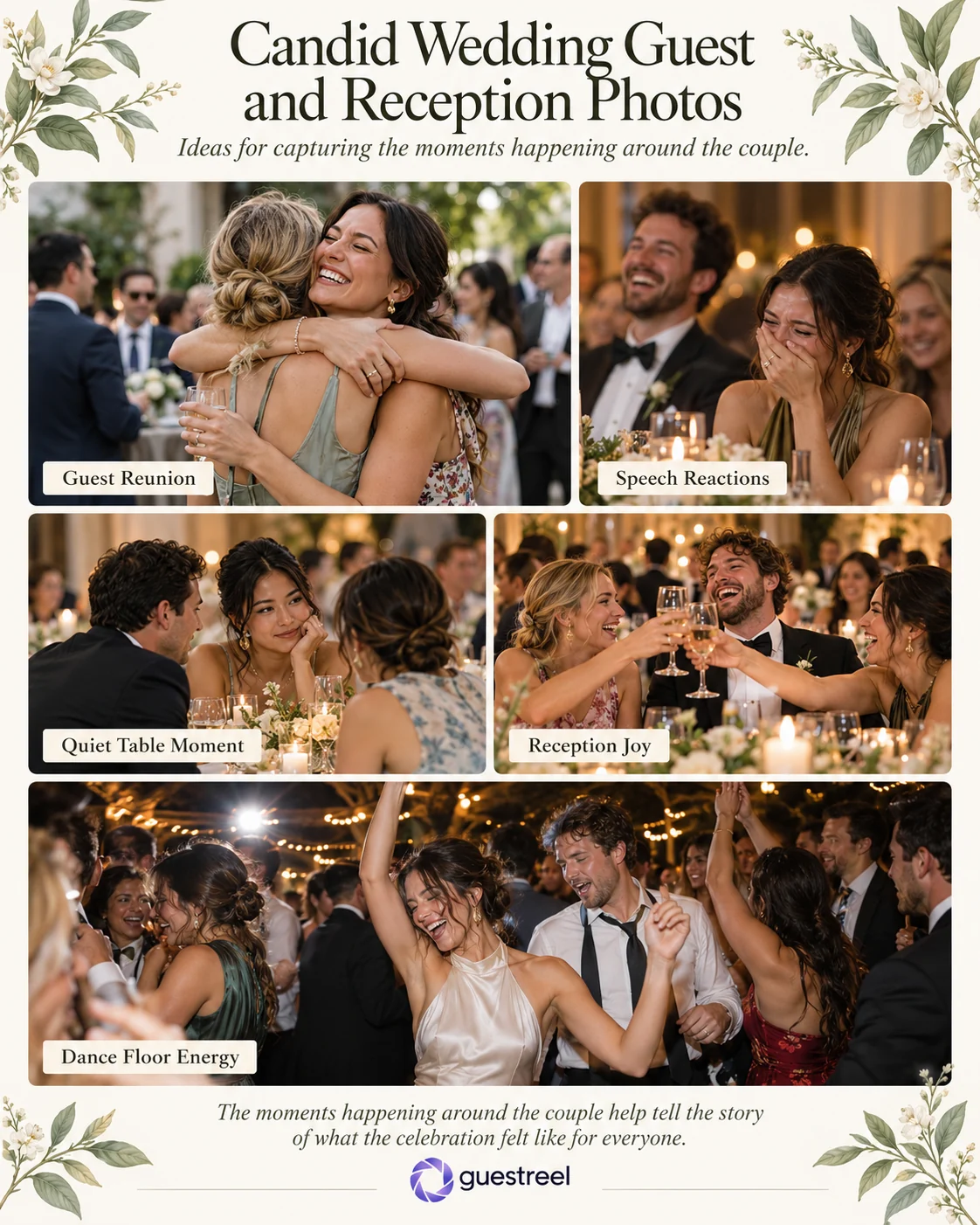
Candid Guest and Reception Photos
- A reunion. Two relatives greeting each other after years apart can be easy to miss when attention is on the couple.
- The people listening to speeches. Photograph both the speaker and the people reacting. The same story is happening on both sides of the room.
- Guests around their tables. A few relaxed photographs of each table can preserve people who don't spend much time on the dance floor.
- Children being children. A spontaneous game or dance can add life to the gallery, as long as parents' wishes about photographs are respected.
- The reception room before dinner. Ask for one wide view before coats, bags and glasses fill the tables, plus a few favourite details.
- The first dance, or your version of it. A wide frame with guests watching can be just as expressive as a close portrait of the couple.
- The best moment of a toast. Glasses raised, an arm around someone's shoulders or shared laughter often tells the story without an elaborate pose.
- The dance floor in full swing. Let the photographer experiment with flash, movement and wider compositions. Not every frame needs to be pin-sharp to feel alive.
- An after-dark portrait. A lit doorway, courtyard or city street can give you a different look from daytime images. Discuss the lighting and access beforehand.
- The way the night actually ends. That might be a goodbye hug, a last song or the two of you taking a moment outside. An elaborate send-off isn't necessary for a satisfying final photograph.
Choose a Photography Style That Feels Like You
There are different ways to photograph the same wedding. Knowing the difference helps you choose inspiration that matches your photographer's work.
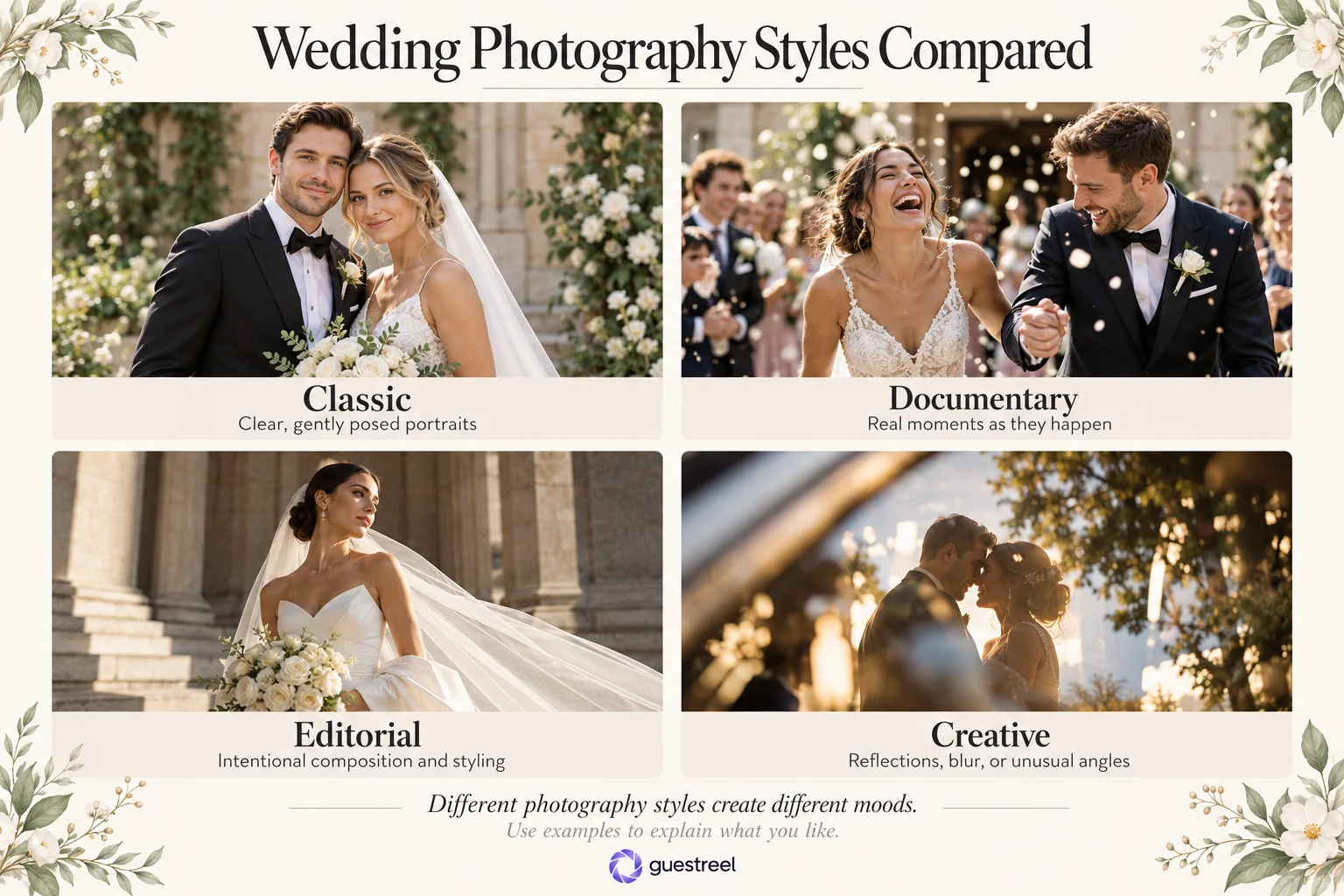
| Style | What it looks like | Particularly useful for |
|---|---|---|
| Classic portraits | Gently directed, clear, camera-facing pictures | Family groups, formal couple portraits |
| Documentary or candid | Real interactions with minimal interruption | Ceremony emotions, mingling, speeches |
| Editorial | Deliberate poses, framing and light | Fashion-focused portraits, dramatic settings |
| Creative or experimental | Reflections, blur, silhouettes, unusual angles | A handful of memorable artistic frames |
You can mix these styles. A gallery of mostly candid moments still benefits from a few uncomplicated smiling portraits. Equally, a formal wedding doesn't need to feel stiff in every photograph.
For an outdoor ceremony, think about what the place already offers: a shady garden path, an open field or dramatic architecture. Our guide to outdoor wedding venue ideas can help you think through the setting and its practical limitations.
Save examples to show your photographer, but explain why you like them. "We love how relaxed they look" is much more helpful than "Please copy this exact image."
Plan Family Photos Without Losing Half the Celebration
Family photographs are one area where a detailed list genuinely helps. Your photographer doesn't know who your stepfather is, which cousins grew up together, or which relatives would prefer not to be photographed together.
Start with groupings that matter to you, then add names:
| Group | Example for your list |
|---|---|
| Immediate family | Couple + both parents/caregivers + siblings |
| Each side separately | Couple + Partner A's family; couple + Partner B's family |
| Older relatives | Couple + named grandparents or other relatives |
| Siblings and partners | Couple + siblings + their partners, if wanted |
| Chosen family | Couple + specific close friends or guardians |
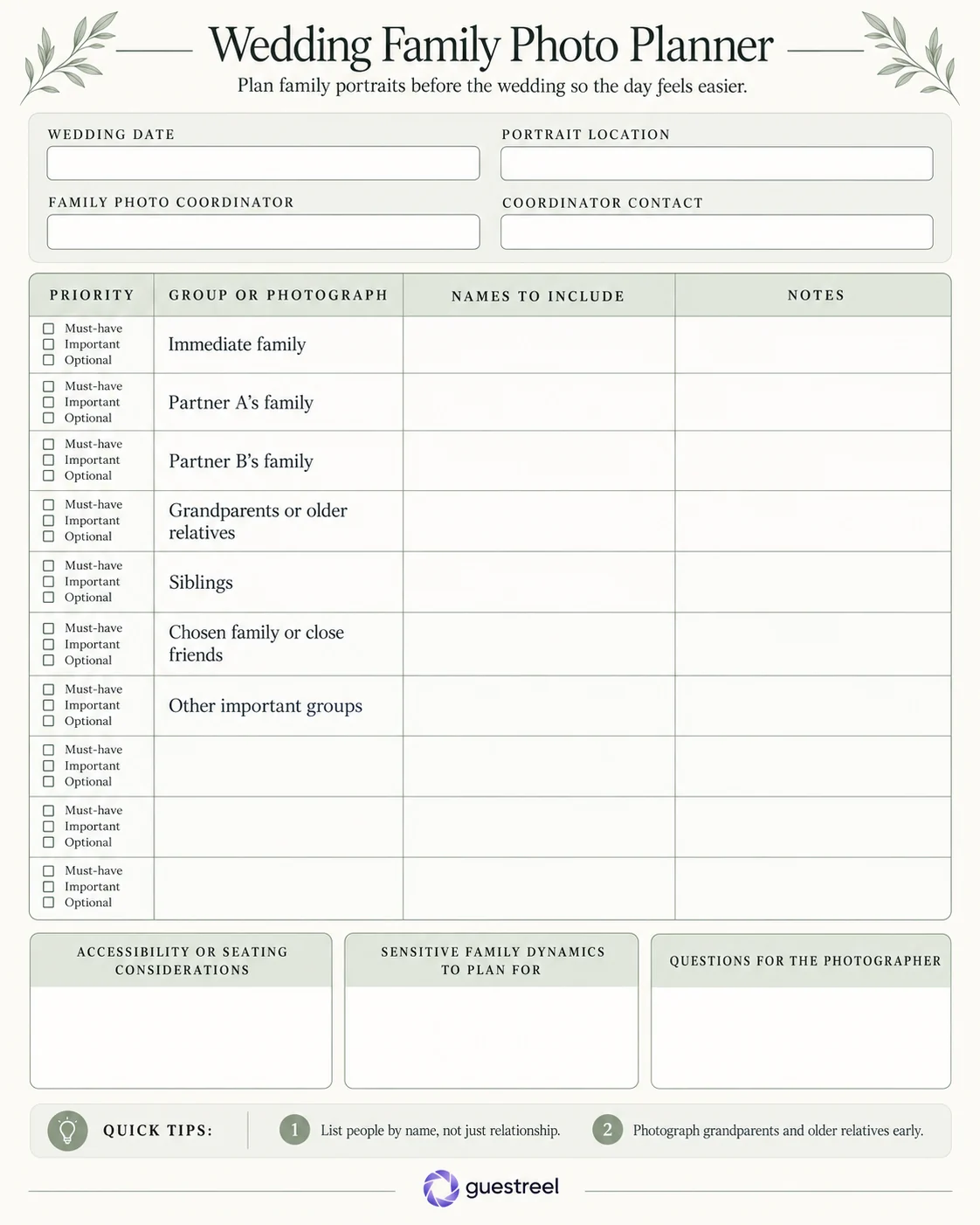
This is a menu, not a rulebook. For blended families, separated parents, bereavement or other difficult dynamics, decide privately which combinations feel right. You can also arrange separate photographs rather than asking everyone to stand together.
Ask someone familiar with your families to gather the next group while the current one is being photographed. Sharing named family groupings and any sensitive dynamics beforehand helps your photographer work efficiently and respectfully.
One practical detail: tell everyone involved where to meet and when. A good list isn't much use if the people on it have already disappeared to the bar.
Don't Forget the Details That Have a Story
Your photographer will likely capture rings, flowers, outfits and decorations. Let them know which objects are more than just decoration: a handwritten note, a locket belonging to someone who's no longer here, a handmade table setting, or a ceremony item connected to your culture.
Have small accessories ready in one place if your photographer asks for them. But don't spend a large part of the morning arranging objects if you'd rather have pictures of the people around you.
A photo of your wedding ceremony arch before guests arrive may be useful. A photo of someone standing beneath it during a meaningful moment may tell you more years later. Ideally, you'll have both.
How to Make a Wedding Photography Shot List
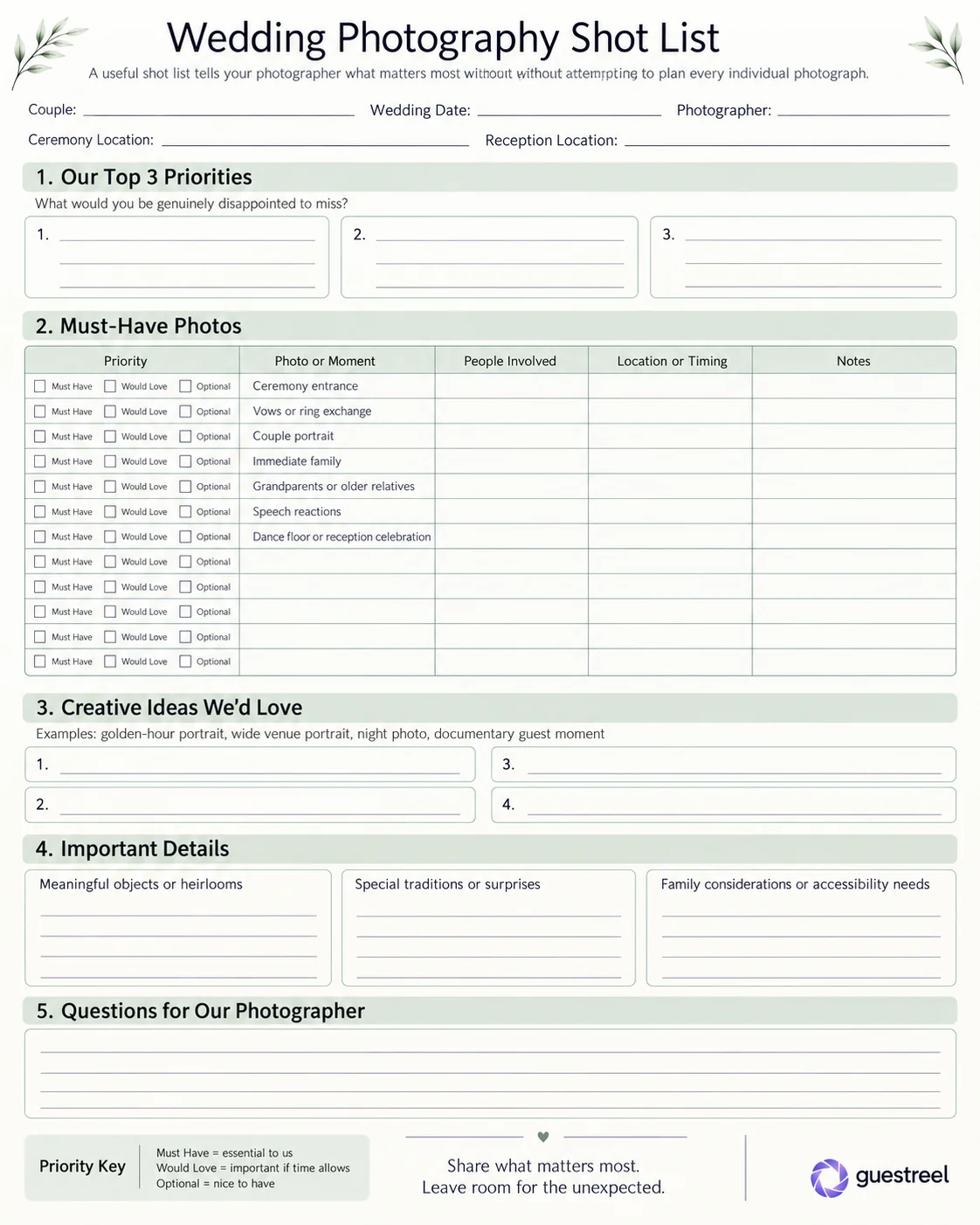
A wedding photography shot list is a brief list of the moments, people and details you want your photographer to prioritise. It works best as a communication tool, not a minute-by-minute script.
1. Pick Your Priorities
Review the 40 ideas and mark each one:
- Must have: a particular family grouping, ceremony ritual or important person;
- Would love: a style or creative shot you'd enjoy if the conditions work;
- Optional: an image that's nice in theory but not worth rearranging the day around.
A shot list with ten personal, clearly described requests can be more useful than a hundred screenshots with no explanation.
2. Write Down People by Name
Put family groupings in a separate list. Include the names of everyone in each photo and flag any accessibility needs or sensitive relationships. Decide who will help call people over.
3. Match Requests to the Timeline
Check with your photographer about travel between locations, daylight, preparation at separate venues and how long formal groups may take. If the reception room matters to you, arrange access before guests enter. If a night-time portrait is a priority, keep the photographer's finishing time in mind.
For a broader schedule, use our wedding planning checklist.
4. Share the Context, Not Just the Picture
Use this compact brief when you meet your photographer:
| What to share | Your notes |
|---|---|
| Top three photo priorities | |
| Essential family groups and names | |
| Meaningful objects or people | |
| Preferred photography style | |
| Special traditions or surprises | |
| Timing, access and venue restrictions | |
| Family photo coordinator |
Ask one final question:
"Is anything on our list unrealistic for the time or location?"
A useful conversation now is better than a disappointing surprise on the day.
5. Let the Unplanned Moments Happen
Once the essential photographs are agreed, give your photographer freedom to work. The best expression during a speech or the sweetest interaction between guests cannot be scheduled in advance.
How to Capture Photos Your Photographer Might Miss
A professional photographer can plan for the ceremony, portraits and reception highlights, but two good moments can happen in different rooms at the same time. Guests see parts of the celebration from their own tables, conversations and friendships.
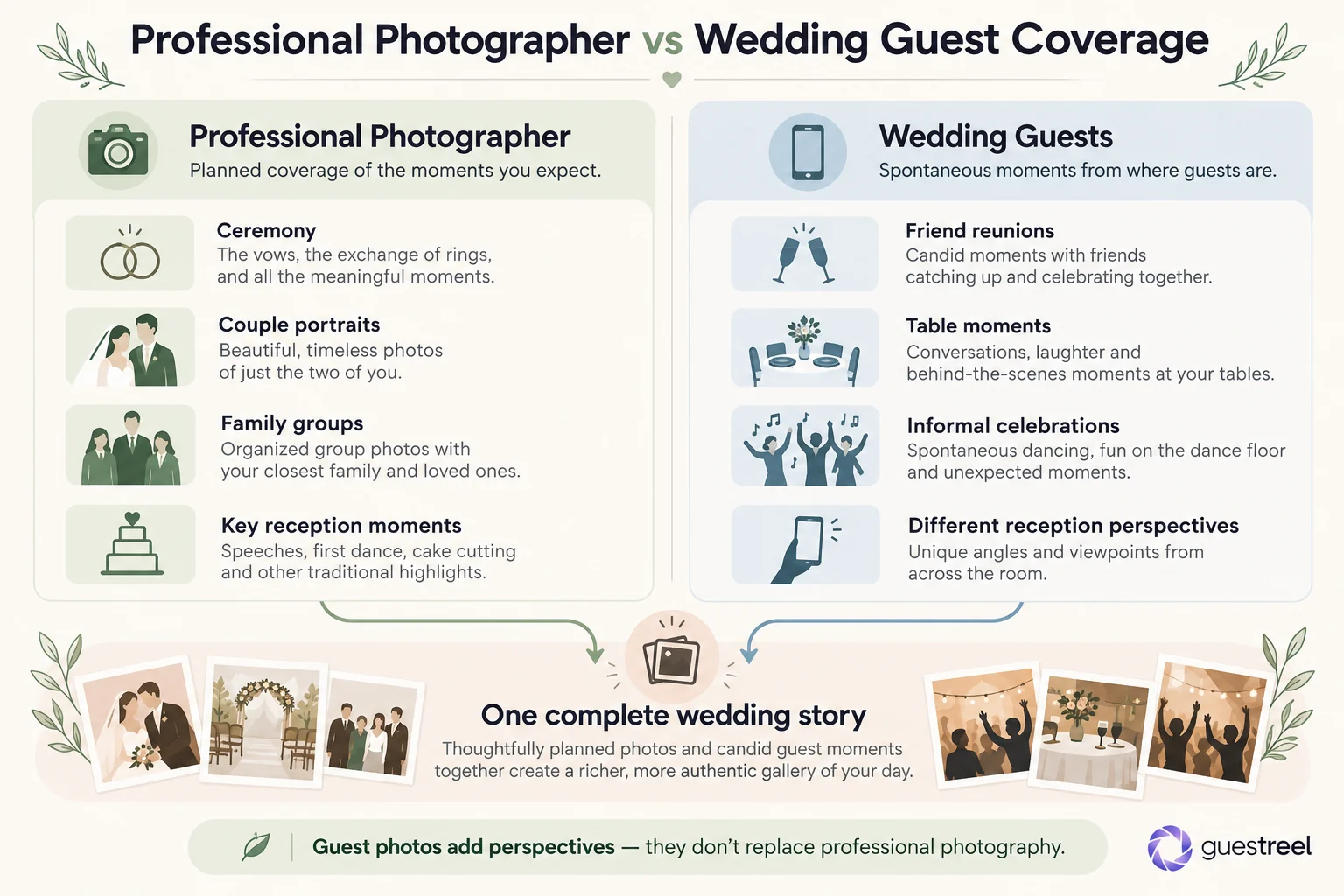
Invite them to photograph what they naturally notice: a reunion at cocktail hour, friends posing together or the late-night dance floor. Don't ask everyone to raise a phone during your vows if you've chosen an unplugged ceremony.
Then decide how you'll collect those images. Shared albums, messages and direct file transfers can work, but they may leave photographs scattered across multiple conversations.
If you'd prefer one collection point, Guestreel's wedding photo-sharing tool provides a QR code and event link. Guests can upload photos and videos through a browser without downloading an app or creating an account, and the files are collected in a private gallery at their original quality. It complements professional coverage; it doesn't replace it.
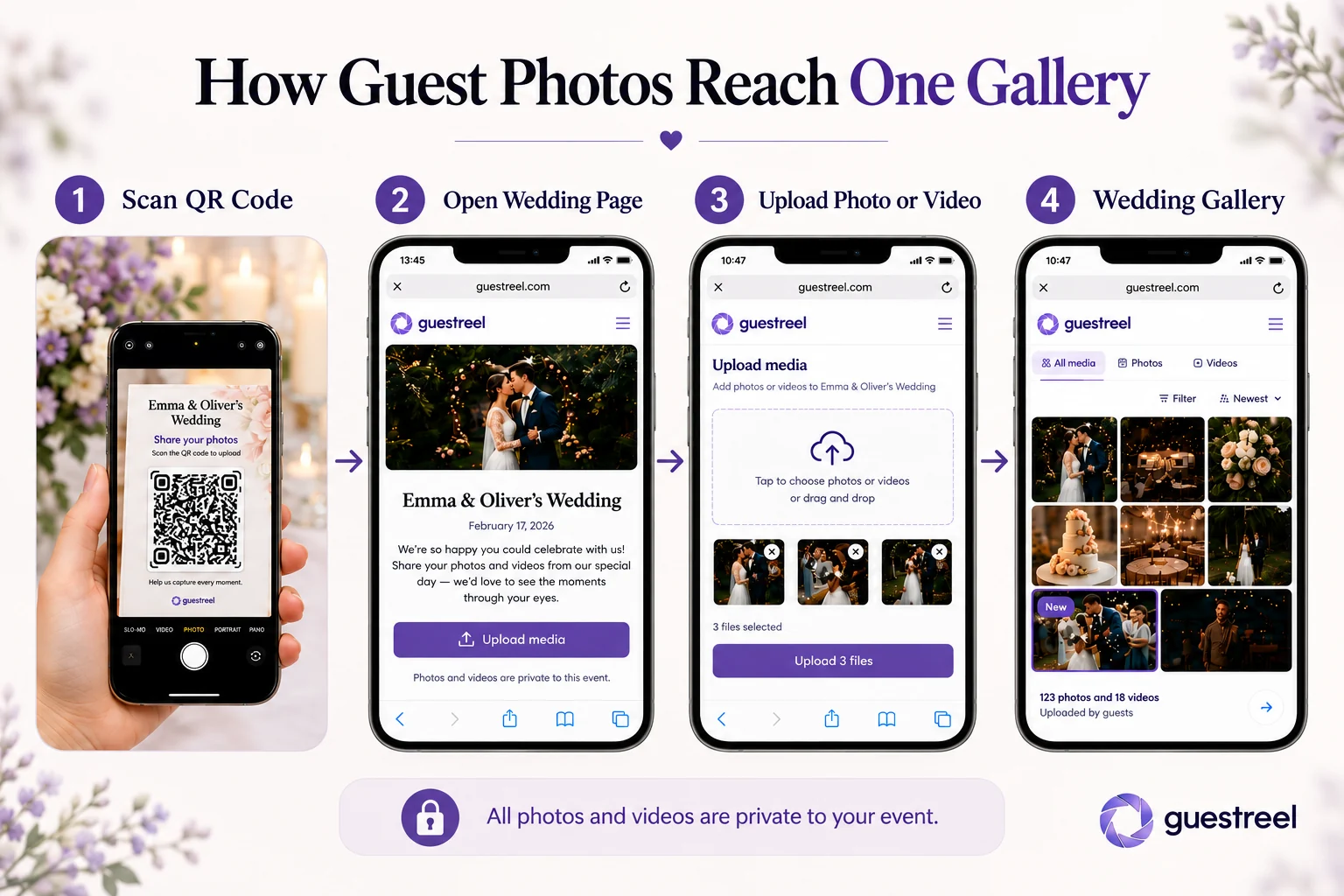
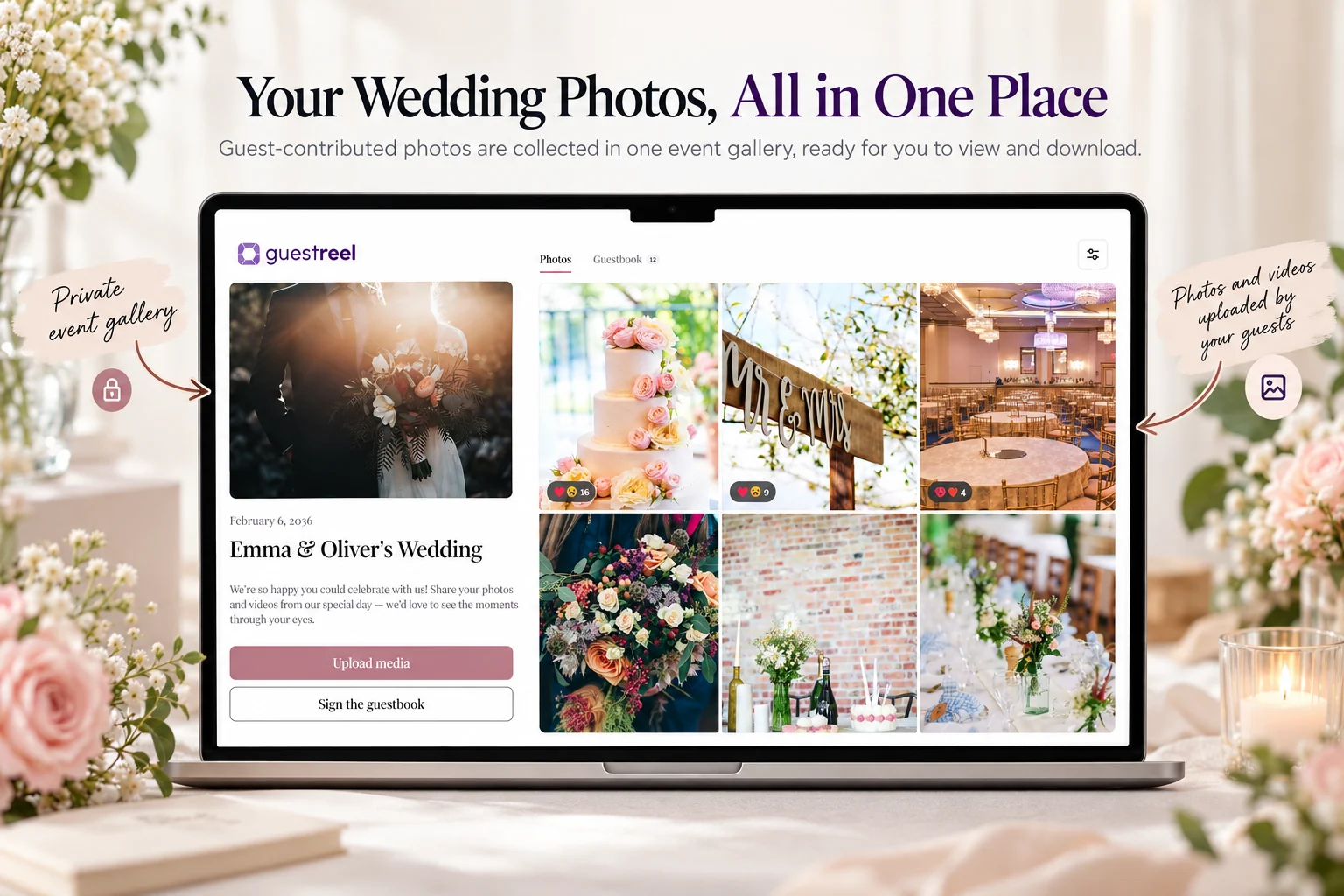
For ways to encourage guests to contribute, see how to collect wedding photos from guests. However you collect them, tell guests who can see the pictures and make participation optional.
Wedding Photography Mistakes Worth Avoiding
- Planning every pose. A long Pinterest board can become a list of distractions. Choose a few favourites and explain what you like about them.
- Leaving family combinations until the day. Names, timing and a person to gather relatives prevent confusion.
- Assuming beautiful light is guaranteed. Rain, clouds, nearby buildings and the season change what's possible. Discuss a backup location.
- Forgetting venue rules. Some ceremony spaces limit flash, movement or where cameras can be placed.
- Skipping straightforward portraits. Artistic photographs are wonderful, but a clear smiling picture of you together can be just as valuable.
- Scheduling away the celebration. Leave time to spend with guests rather than treating every moment as another photo opportunity.
One Last Thought
Choose your wedding photo ideas with the finished album in mind. You'll want to remember how everything looked, but also who stood beside you, who made you laugh, and what the day felt like.
Pick the photographs that matter, tell your photographer what's personal, and leave some room for surprise. You can have a thoughtful shot list without turning your wedding into a photo shoot.
Frequently asked questions
What wedding photos are essential?
Prioritise the ceremony, at least one clear portrait of the couple, family photographs with the people who matter, and key parts of the reception. Add personal rituals and relationships that won't be obvious to the photographer. A wedding without a first dance or traditional processional needs a different list, not a longer one.
How many shots should be on a wedding photography checklist?
There is no ideal number. A useful checklist separates standard wedding coverage from requests unique to your day. Give your photographer a concise list of essential family groupings, personal details and unusual events, then discuss how many can realistically fit the timeline.
Should we do a first look before the ceremony?
Only if you want to. A first look can create private time together and allow some portraits earlier in the day. Waiting until the ceremony may feel more meaningful to you. Ask your photographer how either choice changes the schedule, particularly if daylight or travel is limited.
How can we look natural in wedding photos?
Tell your photographer if posing makes you uncomfortable. Walking, talking, sitting together or holding hands can feel more familiar than copying formal poses. Gentle direction is helpful, but there's no need to manufacture laughter or expressions. Choose a photographer whose portfolio includes people looking comfortable, not just striking compositions.
How much time should we allow for couple and family portraits?
It depends on the number of groups, distance between locations, lighting and your photographer's workflow. Share the exact family list and any creative requests well before the wedding so your photographer can recommend an appropriate schedule. Don't rely on a single universal time estimate.
Can guests take photos during the ceremony?
That depends on your wishes and the venue's rules. Some couples welcome guest photographs; others prefer an unplugged ceremony so people can watch without phones. If guests won't be taking pictures during the ceremony, let them know when and where they'd be welcome to photograph later.
Which wedding photos do people tend to overlook?
Easy-to-miss photographs include individual portraits of each partner, older relatives, smaller friendship groups, people listening to speeches, and objects with personal history. Review your guest list and think about who you would love to have a picture with, rather than checking only the traditional wedding moments.
Written by Linda DoWrites Guestreel’s planning guides.